

Commentary
Judy Dempsey
{
  "authors": [
    "Judy Dempsey"
  ],
  "type": "commentary",
  "blog": "Strategic Europe",
  "centerAffiliationAll": "",
  "centers": [
    "Carnegie Endowment for International Peace",
    "Carnegie Europe"
  ],
  "collections": [],
  "englishNewsletterAll": "",
  "nonEnglishNewsletterAll": "",
  "primaryCenter": "Carnegie Europe",
  "programAffiliation": "",
  "programs": [],
  "projects": [],
  "regions": [
    "Europe"
  ],
  "topics": [
    "EU"
  ]
}
Source: Getty
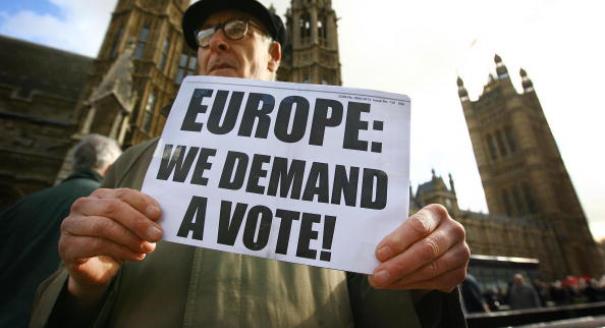
In a letter to Conservative lawmakers, a former Tory member of parliament calls for an early referendum on Britain’s EU membership. Labour’s Ed Miliband should take note.
On September 2, the dwindling band of Britain’s pro-EU Conservative lawmakers opened their e-mails to find a message marked “private and confidential.”
The letter was written by a former Tory parliamentarian and passionate European, who asked not to be named. It was sent in response to Prime Minister David Cameron’s humiliating defeat in parliament last Friday over his plans to join the Americans to bomb targets in Syria.
The author of the letter is concerned that the Conservatives’ Euroskeptical wing could feel emboldened by the prime minister’s defeat to challenge his leadership. Even more than that, he fears that Tory Euroskeptics are becoming stronger every day. By 2017, the date set by Cameron for a referendum on Britain’s EU membership, they would be likely to carry the day.
The anonymous Conservative suggests that a referendum should take place much sooner, perhaps even as early as next year. This is a chance for Labour leader Ed Miliband to explain his position on Europe.
The implications of a British exit for Europe and its strategic ambitions would be horrifying. So too would be the consequences for the future of the UK as a country that encompasses Scotland, Wales, and Northern Ireland, as well as England.
A very important moment will be next May’s European Parliament elections. Analysts suggest that half of the British Conservative members of the European Parliament (MEPs) elected next spring could turn out to be staunchly anti-European, and might disown Cameron and call for Britain to leave the EU as soon as possible.
These new Tory MEPs, allied to their anti-EU backbench colleagues in London, could even stage a coup against Cameron, an idea that has been gaining ground since last Friday’s debacle.
“Last week’s events significantly enhanced the chances of the prime minister facing a challenge to his leadership, at the latest following the European [Parliament] elections next year,” the letter states.
There could also be an alliance shaping up between Conservative anti-EU backbenchers and the Euroskeptical UK Independence Party (UKIP), which already has eleven of the 73 British seats in the European Parliament. A union of these two groups would set Britain retreating into an extraordinary kind of isolationism not seen since Elizabethan times.
Last Friday’s vote was “further proof of the strength of a new English isolationism, hostile to Europe, hostile to America, hostile even to the Scots, which is the real fuel of UKIP and our real opponent in keeping this country inside the European Union and Scotland inside the United Kingdom,” states the letter.
So far, Cameron has been hoping for a turnaround in public opinion by 2017—bolstered by an improved economic performance and the renegotiation of some elements of the EU treaties—that would allow the pro-Europeans to win the referendum.
Yet after Friday’s vote, this scenario seems unrealistic.
For one thing, Cameron’s fellow EU leaders are not going to give him what he wants. Second, Cameron can no longer be so sure that he will still be in power by then, as a general election is due in 2015. Indeed, some observers were surprised that he even survived the vote last Friday.
An early EU referendum would clarify a lot of things. And it might also influence how Scots vote in their own referendum on Scottish independence next September. Scots are generally pro-European. They want to stay in the EU.
The author of the letter is no Labour man. But his remarks lead me to think that it is time for Miliband to take a clear stance on Britain’s EU membership and to support an early referendum. He has been sitting on the fence for too long.
The longer he delays, the more the anti-Europeans will have a free run. Moreover, by calling for a referendum soon, Miliband could put an end to what the letter states is the “studied ambiguity of many leading politicians, commentators, and businesspeople.”
This attitude has been “one important reason why public opinion is currently so hostile to the EU. When they hear from their leaders too little that is positive and so much that is negative about Europe, it is hardly surprising that electors take such a jaundiced view,” adds the letter.
In other words, an early referendum would force many opinion-formers to make a clear and public choice, either for or against withdrawal from the EU. Miliband should jump.

Nonresident Senior Fellow, Carnegie Europe
Judy Dempsey is a nonresident senior fellow at Carnegie Europe
Recent Work
Judy Dempsey
Judy Dempsey

The EU can impose sanctions but struggles to enforce them without the United States. With Washington increasingly disinterested in backing European interests, the bloc must now fend for itself.


Nicu Popescu, Tiago Antunes

Russia is testing the waters of NATO’s mutual defense clause. What do strikes in Romanian territorial waters mean for the alliance’s posture toward Moscow?

Dimitar Bechev

With its public finances in shambles, the far right polling at 35 percent ahead of the 2027 presidential election, and a growing protest movement, is France’s crisis a threat to the EU’s geopolitical awakening?

Rym Momtaz, ed.

Ahead of a tough winter for Ukraine, Donald Trump’s swing back toward Russia bodes ill. But instead of panicking, Kyiv’s European allies are focusing on action.
Rym Momtaz

While the EU and European governments are embracing the much-lauded middle-power moment, this entails three difficult conundrums.

Richard Youngs