

Commentary
Judy Dempsey
{
  "authors": [
    "Judy Dempsey"
  ],
  "type": "commentary",
  "blog": "Strategic Europe",
  "centerAffiliationAll": "",
  "centers": [
    "Carnegie Endowment for International Peace",
    "Carnegie Europe"
  ],
  "collections": [],
  "englishNewsletterAll": "",
  "nonEnglishNewsletterAll": "",
  "primaryCenter": "Carnegie Europe",
  "programAffiliation": "",
  "programs": [],
  "projects": [],
  "regions": [
    "Russia",
    "Western Europe",
    "Germany",
    "Europe"
  ],
  "topics": [
    "EU"
  ]
}
Source: Getty
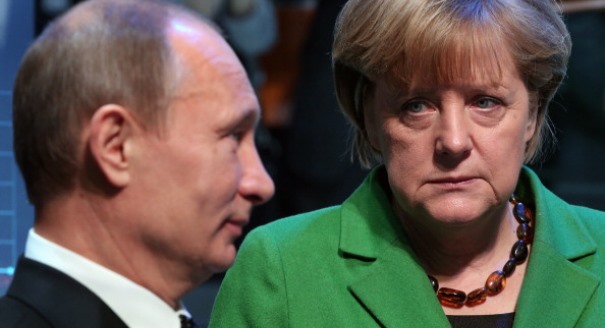
Angela Merkel seems intent on doing the bare minimum in dealing with Vladimir Putin. She will need to do a lot more than that—not least when it comes to the Eastern neighborhood.
Angela Merkel is the first German chancellor to publicly show her dislike for a Russian leader. Yet personal dislike alone doesn’t make for a successful policy.
In former times, Merkel’s predecessors would frequently grit their teeth when meeting the gerontocracy that ruled over the Communist Soviet Union. But for geopolitical reasons, the German political elites were committed to détente with Russia. That inevitably influenced the EU’s policy toward Moscow.
Today, Merkel, recently reelected for a third term, has abandoned that close relationship with the Kremlin, and this has implications for EU policy toward Russia as well. Moscow can no longer rely on Berlin to promote the Kremlin’s agenda within the EU.
“Our policy must not only be addressed to the Kremlin but it must include a wider society,” says German parliamentarian Andreas Schockenhoff, Berlin’s special envoy on Russia and a prominent member of Merkel’s Christian Democratic Union party. “Our partners can’t just be the officials,” he said.
According to Schockenhoff, Germany’s policy should aim to create a “real political and societal competition” in Russia. It should be inclusive and not replicate the Kremlin’s politics of exclusivity. That would mean reaching out to civil society, individuals, and prodemocracy movements.
Schockenhoff has little praise for Germany’s outgoing foreign minister, Guido Westerwelle of the Free Democratic Party, or his predecessor, the Social Democratic Party’s Frank-Walter Steinmeier.
“Westerwelle did not have a policy on Russia,” Schockenhoff said. As for Steinmeier, “his Russian policy was old-fashioned. It was based on modernization and nothing else.”
Schockenhoff is convinced that the Kremlin has a completely different understanding of the term “modernization” from what Steinmeier had proposed to Russia in 2008. Then, Germany’s Social Democrats hoped that, with support from German industry, the Russian economy would be reformed so profoundly that some political liberalization would become inevitable.
“The Russian team in the Kremlin has no idea what modernization means,” Schockenhoff says. “That word is no longer used in Russian parlance. For [Russian President Vladimir] Putin, it means technological change in the existing framework. In our view, modernization means the modernization of society, of the institutions.”
Schockenhoff’s conclusion is that Germany’s policy of modernization has failed.
Now, even if the Kremlin is hoping that the Social Democrats will be Merkel’s new coalition partners and will take the reins of the Foreign Ministry, the Russia dossier will remain in the Chancellery.
Schockenhoff—himself sharply criticized by the Kremlin for his outspoken views on Russian corruption and weak rule of law—says Merkel has a clear concept of how to deal with Russia under Putin in her third term.
“She will pursue a policy that offers a much deeper perspective to Russia, based not on the old parameters but on a more open society,” he said.
Merkel’s first test will be in November, when leaders of the EU and the six Eastern Partnership countries will convene in Vilnius. On the summit’s agenda are new trade and political accords with Armenia, Azerbaijan, Belarus, Georgia, Moldova, and Ukraine. The accords are designed to bring these countries politically and socially closer to Europe.
Under immense pressure from Russia, Armenia announced this month that it would not be signing the accord. Moldova is being threatened with a boycott of its exports to Russia and a reduction in Russian gas imports if it agrees to sign. Georgia is facing pressure to reject the agreement, too.
As for Belarus, President Alexander Lukashenko is close to returning his country to the Russian orbit. Azerbaijan’s leadership, which controls vast energy resources and an authoritarian political system, sees no need to sign up to the EU accord either.
Germany’s influence in the run-up to the Vilnius summit is crucial to counteract the pressure from Moscow. “We don’t want to let Ukraine shift toward the Euro-Asia orbit or toward any kind of Russian hegemony,” says Schockenhoff.
“There is a big strategic competition taking place,” he adds. “We are not convinced that it is in Ukraine’s interests to be exposed to Russian interference. Ukraine understands the conditions they have to fulfill before Vilnius. They are clear: the rule of law, no selective justice. These are European values.”
Whatever the outcome of the Vilnius summit, Merkel seems intent on doing the bare minimum dictated by protocol when dealing with Putin. She is unlikely to bow to pressure from the pro-Russian German industry lobby anytime soon to be more accommodating toward Putin.
But Merkel needs to do more than the bare minimum. In order to woo both the Eastern neighborhood countries and relevant groups in Russia away from Putin’s authoritarian rule, she will need good ideas, persistence, and fortune.
She will also require much greater support from the German embassy in Moscow and the big German political foundations. With their experts on the ground, they can surely play a much bigger role in reaching out to young people and nongovernmental organizations.
And if Putin tries to intimidate these foundations, then Merkel should resort to conditionality. After all, she managed to veto a proposed visa liberalization regime for Russia.
Western cooperation with Russian civil society is exactly the kind of competition that Putin’s team dislikes intensely. That should be an enticing incentive for this particular German chancellor.

Nonresident Senior Fellow, Carnegie Europe
Judy Dempsey is a nonresident senior fellow at Carnegie Europe
Recent Work
Judy Dempsey
Judy Dempsey
Carnegie does not take institutional positions on public policy issues; the views represented herein are those of the author(s) and do not necessarily reflect the views of Carnegie, its staff, or its trustees.

As we close out another season of Strategic Europe, it is worth taking stock of the deep shifts underway.

Rym Momtaz

The EU had to compromise to adopt a twenty-first sanctions package against Russia, exposing growing cracks in the union’s resolve. Is this latest, weaker round worth it to keep pressure on Moscow?
Rym Momtaz, ed.

Trump is distracted and Ukraine wants Europe to step up. The continent’s leaders must find their voice and assert it in talks with Russia.

Alissa de Carbonnel

Mounting economic strain and battlefield losses will not necessarily make the Kremlin less dangerous. They could instead push Moscow toward a more aggressive hybrid campaign designed to test NATO’s Eastern flank, exploit allied hesitation, and fracture European resolve.

Maksym Beznosiuk

Over the past ten years, NATO has held almost as many summits as it did during the entirety of the Cold War. Are they still useful, or is it time to stop holding annual meetings?
Rym Momtaz, ed.