

Commentary
Judy Dempsey
{
  "authors": [
    "Judy Dempsey"
  ],
  "type": "commentary",
  "blog": "Strategic Europe",
  "centerAffiliationAll": "",
  "centers": [
    "Carnegie Endowment for International Peace",
    "Carnegie Europe"
  ],
  "collections": [],
  "englishNewsletterAll": "",
  "nonEnglishNewsletterAll": "",
  "primaryCenter": "Carnegie Europe",
  "programAffiliation": "",
  "programs": [],
  "projects": [
    "Eurasia in Transition"
  ],
  "regions": [
    "Middle East",
    "Syria",
    "Russia"
  ],
  "topics": [
    "Security"
  ]
}
Source: Getty
Every week leading experts answer a new question from Judy Dempsey on the foreign and security policy challenges shaping Europe’s role in the world.
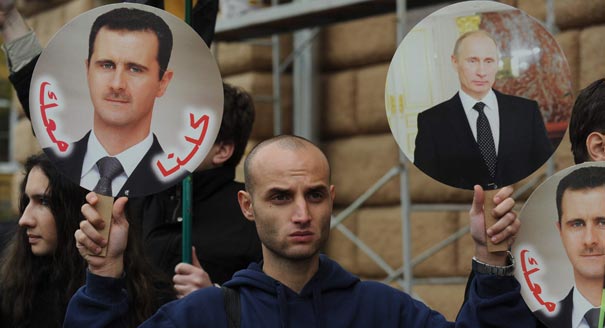
Following a Russian initiative, Moscow and Washington have reached an agreement that calls for Syria’s arsenal of chemical weapons to be removed or destroyed by mid-2014. Our experts assess whether Syrian President Bashar al-Assad will now deliver for his Russian counterpart Vladimir Putin.
Assad is expected to deliver on two different, but related, fronts. On the first, he probably will; on the second, it might be up to Putin.
The first—and most pressing—issue is to follow up on the proposal by Russian Foreign Minister Sergei Lavrov and U.S. Secretary of State John Kerry for putting Syria’s chemical weapons beyond use. That means providing full transparency on the country’s chemical weapons program by this Saturday. Since Assad’s Syria has already agreed to join the Chemical Weapons Convention, which outlaws the production, stockpiling, and use of such arms, he probably will hand over the necessary documents and allow the Organization for the Prohibition of Chemical Weapons to access weapons sites.
But in the meantime, the civil war continues, and Assad must refrain from using chemical weapons again. This leads to the second issue. Putin has made it clear that, by deflecting an imminent U.S. strike, he continues to put his money on Assad. From Moscow’s perspective, Assad must now avoid losing the war. But Syria’s generals will complain about a depleted arsenal, and Assad will want Russian arms to compensate for the loss of his poison gas.
The real question, therefore, may well be the reverse: Will Putin deliver for Assad?
The Russian proposal for dismantling Syria’s stock of chemical weapons was both an offer the West could not refuse and a device that buys the Assad regime more time. Understandably, Western powers have been in two minds about the plan, but they had to treat it seriously.
It would be difficult under any circumstances for Syria to deliver on a commitment to release data on its weapons stocks, authorize full inspections, and complete the highly technical dismantling process in an extremely tight time frame. It is even more complicated for a country at war.
Russia has forced the Syrian regime to accept this unpalatable road map because, like other powers, Moscow was deeply disturbed by the use of chemical weapons. Despite Assad’s denials, it is obvious that the Syrian regime perpetrated the August 21 attack—even if it did so in a way that made the attack entirely deniable. Russia, for its own foreign policy reasons, has an immense stake in Syria delivering, and Moscow will put pressure on Damascus. This is a positive factor.
At the same time, it remains to be seen within Syria whether the whole Assad clan will adhere to the decisions the government has announced so far. In a regime fighting for survival, that is not guaranteed.
In the relationship between the Russian and Syrian leaders, Putin holds sway over Assad—and the puppeteer controls the puppet, not the other way round.
Assad can drag his heels, refuse to cooperate, and zigzag his way through the cliques in Kremlin, but he cannot take decisions. On questions of Russian-Syrian relations, Putin will have the final say. That means that the Syrian civil war will go on, and the rebels will dig in.
A guerrilla war may be effective against a democracy, and widescale death and suffering may eventually push a free-thinking public to say “enough”—as in the Algerian War against France or the Vietnam War against the United States. But Assad rules a mafia-style dictatorship with no free public opinion. He can add more graves to the 100,000 that have already been dug, and nobody close to him will utter a word. Prepare for a long, byzantine “Operation Evading the Truth” from Damascus.
The whole affair is a bleak defeat for U.S. President Barack Obama, whose only consolation is that he has avoided possible humiliation in Congress. Will the White House and the UN now be bold enough to end the Syrian deception? Time will tell.

Nonresident Senior Fellow, Carnegie Europe
Judy Dempsey is a nonresident senior fellow at Carnegie Europe
Recent Work
Judy Dempsey
Judy Dempsey
Carnegie does not take institutional positions on public policy issues; the views represented herein are those of the author(s) and do not necessarily reflect the views of Carnegie, its staff, or its trustees.

A summer of escalation in the Black Sea has hurt Ukraine economically and is exacerbating world food security. A truce is needed—as is a broader reframing of Europe’s Ukraine strategy.

Thomas de Waal

Are Germany’s economic, industrial, and political struggles becoming a liability for the EU’s ability to rise to the geopolitical moment?

Rym Momtaz, ed.

European Commission President Ursula von der Leyen is about to give her annual address on the state of the EU. Here’s what she won’t—but should—say.
Rym Momtaz

The EU’s responses to two recent incidents expose the gulf between European perceptions and capabilities. Unless the union can bridge that gap, it will never become a real geostrategic power.
Rym Momtaz

In supporting Europe’s far-right, MAGA and Russia both want the same thing: a weaker EU. Europe must defend itself without abandoning the openness these forces exploit.

Armida van Rij