
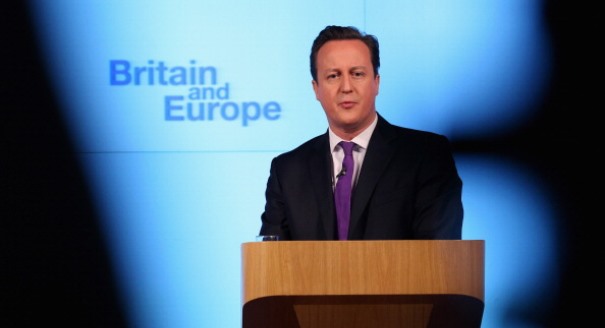
Britain now has to decide which direction it will take.
When the British parliament last week voted against joining the United States in air strikes against Syria, it not only dealt Prime Minister David Cameron a painful defeat. It also, for the first time ever, publicly questioned the future of Britain’s special relationship with the United States.
The realignment that is implicit in this vote leaves the UK with two choices. It can decide also to reject Europe—all that would take is reelection for the Conservatives at the next general election and then a “no” vote at the planned 2017 referendum on EU membership. That would set Britain on the path toward a politically dangerous and economically harmful isolationism.
Or the UK can finally acknowledge that its real future lies with Europe. Taking that step is long overdue and would hugely benefit both the British people and the rest of Europe.
Ever since 1945, successive British governments set enormous store by the durability and importance of London’s relationship with Washington at the expense of Europe.
But this almost mythical alliance has had several profoundly negative consequences for Britain’s foreign policy and Europe’s strategic ambitions.
The first consequence is that Cameron failed to consider how much Britain (and his own Tory party) has changed since the Iraq War.
Ten years ago, then prime minister Tony Blair was still able to bring the British into the U.S. campaign in Iraq despite the lack of a UN mandate. Even the fact that Britain’s military top brass was highly critical of both the legal base and the actual conduct of the war didn’t stop the UK’s participation.
Today, however, most voters in Britain consider the Iraq War to have been a mistake. The Afghanistan campaign, in hindsight, doesn’t seem that worthwhile, either.
These wars have scarred British public opinion to the extent that a solid majority opposes using force against Syria. Even if it could be proved beyond doubt that President Bashar al-Assad was responsible for a poison gas attack that killed many hundreds of civilians, they would remain skeptical of military intervention.
The second cost of the UK-U.S. relationship is that Cameron failed to take into account U.S. President Barack Obama’s strategic shift away from Europe to the Asia-Pacific region. Cameron just didn’t take this pivot seriously enough, despite the fact that Obama warned him when he visited the White House last May about turning his back on Europe.
The third impact is the fallout from the U.S. National Security Agency spying affair. As revelations seep out about how Washington and London snooped on their own citizens and allies, the British public has grown suspicious and indeed disgusted with UK-U.S. relations.
The most nefarious effect of the Anglo-American relationship, however, was that it allowed London not to take Europe seriously as a genuine partner. There was no need for Britain to think about its future with Europe, or about Europe’s own future, as long as the London-Washington axis endured.
That was one reason why the growing euroskepticism in Britain could flourish. The British—or at least the English—believed they could always turn to the United States as their traditional ally.
Now that the weakness of that link has been demonstrated, all of Britain’s strategically minded politicians should see that it is time for Britain to look toward Europe.
The advantages for both sides of the UK engaging more with the rest of the EU would be huge.
The existence of the internal market, of competition, and of an EU capable of defending its trade interests (when the member states do not undermine it) has benefited Britain enormously.
Militarily and politically, too, the UK can no longer afford to go it alone. As it is, the Cameron government has radically cut the country’s armed forces. “The prime minister would like to use the military, he just doesn’t want to have to pay for it,” a military official told the Financial Times.
And with defense budgets being slashed in most EU countries, wouldn’t this be the time for sharing military resources? Britain’s immense military experience and standing would give the EU’s fledgling security and defense ambitions a much-needed boost. The UK, in turn, would enjoy a big say in shaping such a policy.
There are other advantages for a British foreign policy that looks toward Europe.
The EU sorely needs British diplomats to give it a strategic dimension to Europe’s relations with Turkey and Russia. Against its better judgment, given the immense challenges facing Europe in the Middle East and the Caucasus, Brussels has allowed the relationship with Ankara to stagnate. A Britain that was fully engaged in Europe’s foreign, security, and defense policy could change that.
The UK parliament’s Syria vote, which came as a big surprise not only to the United States but also to Britain itself, offers a proud, old nation an unsought opportunity to reappraise its position in the world. The UK’s future lies with Europe—perhaps now it can begin to accept that.


