

Commentary
Nathalie Tocci, Jan Techau
{
  "authors": [
    "Jan Techau"
  ],
  "type": "commentary",
  "blog": "Strategic Europe",
  "centerAffiliationAll": "",
  "centers": [
    "Carnegie Endowment for International Peace",
    "Carnegie Europe"
  ],
  "collections": [],
  "englishNewsletterAll": "",
  "nonEnglishNewsletterAll": "",
  "primaryCenter": "Carnegie Europe",
  "programAffiliation": "",
  "programs": [],
  "projects": [],
  "regions": [
    "Europe",
    "North America"
  ],
  "topics": [
    "EU"
  ]
}
Source: Getty
Western Europeans should watch Central Europe carefully. Its obsessions should not be dismissed lightly, and its ambitions make good historical, political, and economic sense.
Central Europe is scared, desperate, ambitious, complex-ridden, and obsessed with the past. Is it also the future of Europe?
I have been to all the big conferences on Central Europe this year: GLOBSEC in Bratislava, the Snow Meeting near Vilnius, the Wrocław Global Forum, the Rīga Conference, the U.S.-Central European Strategy Forum in Washington. Being a smug Western European, like most think tankers, I was deeply disturbed by my own ignorance about that strangely vibrant area that arches across the continent from the Baltic states, through Poland, down to Bulgaria.
So I decided to pay a little more attention. Having attended all of these eminent gatherings, I am still far from an expert on the region. I never will be. But it is clear that this part of Europe is special.
First of all, Central Europe is still home to both almost unconditional love for the United States and real, hopeful ambition for the EU. Naturally, both afflictions come at the price of great disappointment; but what part of Europe could be better placed to let hope prevail over disillusionment?
Poles and Balts, especially, are hungry for the EU to get its act together, develop a better foreign policy, and stick to its course of free trade and open markets. They understand that the price of embracing European integration is a loss of some sovereignty—but that’s a calculated risk. After the Soviet-era Warsaw Pact, the advantages of EU membership beat the downsides of Brussels’s rather mild centralism hands down.
In marked contrast to some of their Western European partners, Central Europeans understand that playing the EU against transatlanticism makes no sense. It is only by becoming more capable and more independent from the United States that Europeans will remain useful and influential allies for Washington.
More importantly, the countries of Central Europe want to stay relevant for the United States. That is why they react with worry, disappointed love, and thinly veiled panic to widespread American ignorance of the region, and to U.S. President Barack Obama’s pivot to Asia.
Central Europeans’ worldview has as much to do with an American-style love of freedom as with a fear of Russia. No matter how different the political cultures of, say, Hungary, Estonia, and Slovakia may be, these states all share a profound and well-nurtured resentment of Russia, especially its current leadership. Central Europeans fear Russian mingling in their affairs so much that they have developed an obsession that often borders on the unhealthy.
It is hard not to feel sympathetic about that, given Central Europe’s traumatic experiences during Soviet times and the Kremlin’s immature and brazen bullying these days. And yet one can never quite shed the feeling that Central Europeans’ fixation with Moscow is slightly overdramatized and partly irrational.
But there is a flip side to this overplayed Russia obsession: the huge complacency the rest of Europe has when it comes to almost everything that is important for Central Europe. Western Europeans have too little concern for Russian President Vladimir Putin’s aggressive posturing, too little attachment to NATO, too little focus on the EU’s original greatness, no real understanding of the enormous strategic value of the EU’s Eastern neighborhood, and too much cheap and shallow anti-Americanism.
The same is true of U.S. neo-isolationist tendencies and the warped leadership of the Obama administration. This Western complacency makes people in Central Europe very nervous—much more than any Russian rowdiness.
This nervousness becomes apparent in heated discussions about whether the post-Communist transition in Central Europe has failed, stalled, or succeeded. “Can we trust ourselves?” is the unspoken question. That self-interrogation has as much to do with these countries’ victimization during the Cold War as with the corruption, nationalistic populism, and illiberal temptations visible in parts of Central Europe today.
So, in good old European tradition, issues of identity prevail. What is left of the mythical Mitteleuropa? Is there such a thing as a politically and culturally meaningful Central European identity? How could such an identity become relevant and operational?
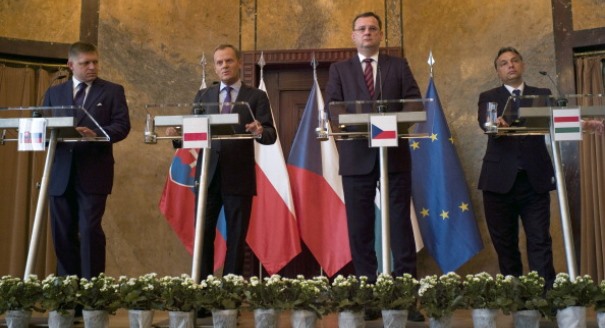
In political terms, these issues have found their expression in the systematic overselling of the relevance of the Visegrád Group of countries, which includes the Czech Republic, Hungary, Poland, and Slovakia. To the outside world, the V4 is presented as a potential regional game changer. Among themselves, however, most Central Europeans will admit that the group matters very little, and that its main value is not geopolitical but the focus it places on small-scale domestic, technical issues.
Western Europeans should watch Central Europe carefully. Its inferiority complexes and obsessions should not be dismissed lightly, as they stem from a serious concern for existential questions that others have long stopped asking. And Central Europe’s ambitions for the EU and transatlanticism make very good historical, political, and economic sense—even when Russia is removed from the equation.
Anyone craving an unsentimental and pragmatic debate about the future of Europe should spend more time in Central Europe. In uncertain times like these, that’s not an insignificant thing to say.

Director, Europe Team, Eurasia Group
Techau is director with Eurasia Group's Europe team, covering Germany and European security from Berlin. Previously, he was director of Carnegie Europe.
Recent Work

Nathalie Tocci, Jan Techau
Jan Techau
Carnegie does not take institutional positions on public policy issues; the views represented herein are those of the author(s) and do not necessarily reflect the views of Carnegie, its staff, or its trustees.
The EU had to compromise to adopt a twenty-first sanctions package against Russia, exposing growing cracks in the union’s resolve. Is this latest, weaker round worth it to keep pressure on Moscow?

Rym Momtaz, ed.

Trump is distracted and Ukraine wants Europe to step up. The continent’s leaders must find their voice and assert it in talks with Russia.

Alissa de Carbonnel

Mounting economic strain and battlefield losses will not necessarily make the Kremlin less dangerous. They could instead push Moscow toward a more aggressive hybrid campaign designed to test NATO’s Eastern flank, exploit allied hesitation, and fracture European resolve.

Maksym Beznosiuk

Over the past ten years, NATO has held almost as many summits as it did during the entirety of the Cold War. Are they still useful, or is it time to stop holding annual meetings?
Rym Momtaz, ed.
Nearly a year and a half after Europeans leaned into sucking up to Trump, the strategy has produced some benefits when it comes to Ukraine.
Rym Momtaz