

Commentary
Excitement is in the air following Aleksandar Vučić’s defeat in Serbia. To build a truly democratic state, the movement that unseated the former president must learn from the mistakes of the past.
Ivan Vejvoda
{
  "authors": [
    "Pinar Elman",
    "Roderick Parkes"
  ],
  "type": "commentary",
  "blog": "Strategic Europe",
  "centerAffiliationAll": "",
  "centers": [
    "Carnegie Endowment for International Peace",
    "Carnegie Europe"
  ],
  "collections": [
    "Turkey’s Transformation"
  ],
  "englishNewsletterAll": "",
  "nonEnglishNewsletterAll": "",
  "primaryCenter": "Carnegie Europe",
  "programAffiliation": "",
  "programs": [],
  "projects": [],
  "regions": [
    "Europe",
    "Türkiye",
    "Middle East",
    "Eastern Europe"
  ],
  "topics": [
    "EU",
    "Global Governance"
  ]
}
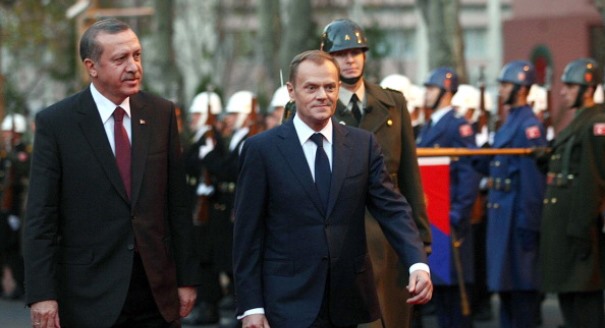
Source: Getty
Recep Tayyip Erdogan is expected to call on Poland and Turkey to forge a common European future. Although risky, a genuine bilateral partnership could benefit both nations.
On November 8, Turkish Prime Minister Recep Tayyip Erdoğan will give a speech in the Polish capital, Warsaw. His expected message: the need for Poland and Turkey to forge a common European future. The visit is symbolic of the way these two catch-up countries have grown in stature and confidence, and their relationship could well make a serious dent in European affairs. And yet, a second look shows that Turkish-Polish ties are fraught with risks as well.
But first, the positive case for an upgraded partnership between the two.
Until recently, Ankara was distinctly skeptical of Polish influence in the European Union. Turkish leaders were primarily interested in building up political links with Berlin, London, and Paris, seeing bonds with Poland and other Central European countries mainly in economic terms. As such, Turkish thinking was still stuck in the last decade, when Poland was a transition country whistling to the tune of Western Europe.
That is now beginning to shift. Poland’s political weight in the EU has grown perceptibly in the past five years, and Ankara has watched with enthusiasm a series of lively speeches by Polish Foreign Minister Radek Sikorski in the capitals of “old Europe.” Turkey has welcomed this transition as evidence not just of the European project’s capacity for hardheadedness, but also of a catch-up country’s ability to assert itself.
For its part, Poland has been a cheerleader of Turkey’s bid to join the EU. In 2012, Sikorski penned a letter with his European counterparts attempting to resuscitate the process. And, although Ankara was disappointed with the progress made during Poland’s EU Council presidency in 2011, Warsaw can hardly be faulted: its pro-enlargement agenda was rather overtaken by events in the Arab world and the eurozone crisis.
Poland sees Turkey as a boost the EU’s market size, its standing in the Middle East and Central Asia, its defense policy, and its energy diversification—perhaps even its demography too. Yet the government in Warsaw is under no illusions about the political and cultural difficulties involved in accommodating a country with a population of 75 million. Still, the potential benefits of Turkey’s accession win out.
Poland has therefore supported the recent restart in Turkey’s EU membership talks despite concerns over democratization—another issue close to Warsaw’s heart. In its justification for a revamp in negotiations, the European Commission condemned Ankara for its repressive actions toward the Gezi Park protesters, but highlighted the need for an engagement with Turkey’s burgeoning civil society. That was a philosophical compromise acceptable to the Poles.
So, will Erdoğan’s visit seal a Warsaw-Ankara axis capable of tackling energy security and frozen conflicts in the wider Black Sea region, or of renewing the EU’s activities in Eastern Europe and North Africa? Will the prime minister use his visit to lay out a blueprint for a hardheaded EU, one energized by catch-up countries that grew up in a globalized age and are not prepared to take lessons from the bankrupt West?
Not necessarily. The trouble with the relationship is that the priorities of Warsaw and Ankara are not entirely congruent. For its part, Warsaw’s interest in Turkish accession contains a good measure of expedience. Poland foresees few downsides for itself from the enlargement. And once this and the accession of Western Balkan countries are out the way, the EU can focus on the area of Poland’s real strategic interest: Eastern Europe.
As for Ankara, the incumbent Justice and Development Party (AKP) government pays at best lip service to Turkey’s official goal of joining the EU. In reality, it has preferred to exploit the EU’s internal inconsistencies for its own purposes: it has used the bloc’s failure to live up to its commitments in order to score points and win concessions. All the while, it has been building up bilateral relations with individual members, increasing its leverage within the EU and, of course, furthering those inconsistencies.
In other words, a new Polish-Turkish relationship could all end rather badly. Poland, keen to have Turkey in the EU as a precondition for realizing its broader interests, is susceptible to political games. Ankara can squeeze concessions from Warsaw to facilitate its entry into the EU without any intention of ever joining. This would damage Polish credibility in the EU and, by association, the EU’s use of enlargement as a foreign policy tool.
That would be a lost opportunity. It would be more fruitful in the longer term for both countries to focus on a genuine partnership on European affairs, looking at the ample areas where Turkish accession might upgrade their joint interests. Given the potential of this new tandem, Erdoğan’s Warsaw speech must command attention.
Pinar Elman
Roderick Parkes
Stiftung Wissenschaft und Politik
Carnegie does not take institutional positions on public policy issues; the views represented herein are those of the author(s) and do not necessarily reflect the views of Carnegie, its staff, or its trustees.
Excitement is in the air following Aleksandar Vučić’s defeat in Serbia. To build a truly democratic state, the movement that unseated the former president must learn from the mistakes of the past.

Ivan Vejvoda

The EU can impose sanctions but struggles to enforce them without the United States. With Washington increasingly disinterested in backing European interests, the bloc must now fend for itself.


Nicu Popescu, Tiago Antunes

Russia is testing the waters of NATO’s mutual defense clause. What do strikes in Romanian territorial waters mean for the alliance’s posture toward Moscow?

Dimitar Bechev

With its public finances in shambles, the far right polling at 35 percent ahead of the 2027 presidential election, and a growing protest movement, is France’s crisis a threat to the EU’s geopolitical awakening?

Rym Momtaz, ed.

Ahead of a tough winter for Ukraine, Donald Trump’s swing back toward Russia bodes ill. But instead of panicking, Kyiv’s European allies are focusing on action.
Rym Momtaz