

Commentary
Judy Dempsey
{
  "authors": [
    "Judy Dempsey"
  ],
  "type": "commentary",
  "blog": "Strategic Europe",
  "centerAffiliationAll": "",
  "centers": [
    "Carnegie Endowment for International Peace",
    "Carnegie Europe"
  ],
  "collections": [],
  "englishNewsletterAll": "",
  "nonEnglishNewsletterAll": "",
  "primaryCenter": "Carnegie Europe",
  "programAffiliation": "",
  "programs": [],
  "projects": [],
  "regions": [
    "Eastern Europe",
    "Western Europe",
    "Europe"
  ],
  "topics": [
    "Democracy",
    "EU"
  ]
}
Source: Getty
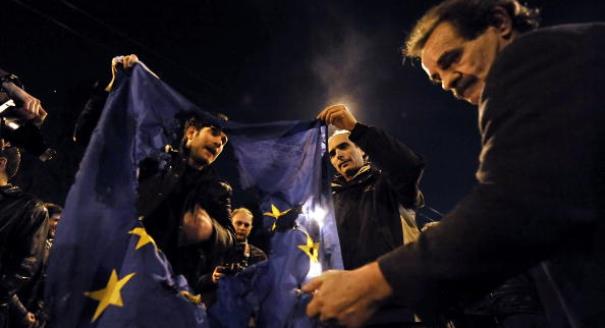
Pro-Europeans shouldn’t be afraid to take on the EU’s rising populist movements. It is time for a public competition of ideas between Euroskeptics and pro-Europeans.
Last week, the Slovak Atlantic Commission, a nongovernmental organization, celebrated its twentieth anniversary in the magnificently restored Château Béla in the wine-making region of southern Slovakia.
As ever with gatherings of the Visegrád Group of four countries—the Czech Republic, Hungary, Poland, and Slovakia—there was endless fretting about the future of the transatlantic relationship.
Closer to home, two other big issues dominated the conversations. One was, predictably, the widespread protests in Ukraine after President Viktor Yanukovych decided not to sign a new association agreement with the EU.
The second was the stunning victory of Marian Kotleba, a far-right politician who last month swept into power in the Slovak region of Banská Bystrica.
It was the first time that the nationalist People’s Party—Our Slovakia won a regional election. Kotleba captured 55.5 percent of the vote after demanding that Slovakia withdraw from NATO and shut out foreign investors.
Kotleba is a well-known racist, a fact that lends his victory a particularly insidious note. He used to lead the extremist Slovak Togetherness-National Party, which organized rallies against the Roma community until the party was banned in 2006.
To this day, successive Slovak governments have done very little to alleviate the misery of the Roma community, according to a recent report by the World Bank. Furthermore, leaders have not spoken out unequivocally against what some participants at the Slovak Atlantic Commission meeting described as the endemic racism that prevails among Slovaks.
Slovakia is not the only country where far-right and populist parties blossom. Hungary has Jobbik, which sits in the Hungarian parliament and occasionally likes to take “head counts” of how many lawmakers are of Jewish or Roma origin. The Czech Republic, Bulgaria, and Romania also have politicians who have made a career out of loathing the Roma.
Thanks to this rising populism, “new Europe” is converging with “old Europe,” where a particular kind of xenophobia coupled with Euroskepticism is gaining ground.
David Cameron, the British prime minister, whose Conservative Party is pandering to the nationalist and Euroskeptic UK Independence Party, called on the EU last week to take a much tougher stance toward immigrants.
In the Netherlands, once the bulwark of “European-ness,” Geert Wilders and his Party for Freedom are riding high in the opinion polls, thanks to his anti-immigration and anti-EU views. He and France’s National Front leader Marine Le Pen have formed a Euroskeptic alliance ahead of next May’s European Parliament elections.
Immigrants have become easy targets of abuse and political fodder for populists in Austria, Belgium, Ireland, and Italy, too. In Finland, in spite of the country’s traditionally pro-European attitude, a populist movement is thriving.
Even in Germany, Chancellor Angela Merkel has to contend with Euroskeptics. Merkel herself is perilously close to playing the populist card by supporting some of Cameron’s views on immigration. If these trends continue, the next European Parliament could be paralyzed by Euroskeptics.
This spread of populism and Euroskepticism is bad and dangerous for Europe. It is bad, because it negates what the EU represents: an open society based on the values of tolerance, opportunity, and equality.
If Cameron were serious about stopping poor, unskilled immigrants from Bulgaria and Romania from coming into Britain, he should propose a solution at EU level. Instead of pandering to the UK Independence Party and turning Britain into a fortress, couldn’t he propose that the EU devote some of its structural funds to developing a long-term education and housing policy for the Roma in their home countries?
The rise of extremism is also dangerous, because the more the mainstream parties co-opt the policies of the Far Right, the less rational the debate becomes.
For demographic reasons alone, the EU desperately needs immigrants. If European leaders continue to pander to the Far Right and make immigrants feel unwelcome, how can companies across Europe that are desperately short of engineers and IT specialists hope to attract skilled immigrants?
Indeed, a German participant at the Slovak Atlantic Commission event argued that German investors would stay away from certain regions in Slovakia if the racism and attacks on the Roma continued. How would Kotleba explain his region’s rising unemployment then?
Instead of wringing their hands over Wilders, Le Pen, and Kotleba, pro-Europeans shouldn’t be afraid to take on these populists. It is time for a public competition of ideas between Euroskeptics and pro-Europeans.
Populists, particularly the conviction politicians among them, often have great oratorical skills. To counter them, leaders who believe in the EU and its values need to regain the confidence of their convictions. If not, Europeans will pay a high price at next May’s elections and beyond.

Nonresident Senior Fellow, Carnegie Europe
Judy Dempsey is a nonresident senior fellow at Carnegie Europe
Recent Work
Judy Dempsey
Judy Dempsey
Carnegie does not take institutional positions on public policy issues; the views represented herein are those of the author(s) and do not necessarily reflect the views of Carnegie, its staff, or its trustees.

Amid uncertainty caused by the Iran war, the global drive for nonproliferation has stalled. With Europe diplomatically marginalized and countries reassessing their nuclear options, efforts to curb the spread of nuclear weapons risk becoming irrelevant.

Jane Darby Menton
Preparing candidate countries for EU membership is no longer enough. As the enlargement process becomes a reality, the union must also prepare its own societies.

Iliriana Gjoni
Five countries staged the biggest political boycott in Eurovision history over Israel’s participation. With the FIFA World Cup and other sporting or cultural touchstones on the horizon, are boycotts effective?

Rym Momtaz, ed.
The full list of humiliations Europe has endured since Donald Trump returned to the White House makes for grim reading. But Washington’s adversarial approach to its allies undermines its own power base.
Rym Momtaz
The closure of the Strait of Hormuz has triggered a global energy crisis, but Europe is stuck in reaction mode. Without more strategic foresight, the EU will remain dependent on fossil fuels and will never be truly secure.


Milo McBride, Pauline Gerard