

Commentary
Judy Dempsey
{
  "authors": [
    "Judy Dempsey"
  ],
  "type": "commentary",
  "blog": "Strategic Europe",
  "centerAffiliationAll": "",
  "centers": [
    "Carnegie Endowment for International Peace",
    "Carnegie Europe"
  ],
  "collections": [],
  "englishNewsletterAll": "",
  "nonEnglishNewsletterAll": "",
  "primaryCenter": "Carnegie Europe",
  "programAffiliation": "",
  "programs": [],
  "projects": [],
  "regions": [
    "South Asia",
    "Afghanistan",
    "Western Europe",
    "United Kingdom",
    "Germany",
    "Europe"
  ],
  "topics": [
    "Security",
    "Military",
    "EU"
  ]
}
Source: Getty
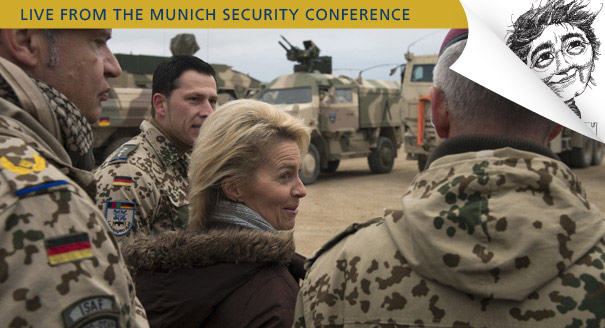
Germany’s defense minister has called for greater European defense capabilities—a laudable ambition, but the reality is persistently low defense spending across Europe.
Ursula von der Leyen does not believe in wasting time. Since becoming Germany’s defense minister on December 17, she has shaken up the top ranks in her ministry. She intends to introduce child-care facilities for families serving in the military. Above all, she has spoken about the future role of Germany’s armed forces. They must, she believes, become more engaged in international missions.
During a speech on January 31 at the Munich Security Conference, von der Leyen made it clear that Germany as well as Europe as a whole had to take much more responsibility for their security and defense.
“European nations ought to be prepared to take over a fair share of the transatlantic burden,” she told her audience. “Germany is ready to contribute to this endeavor. . . . Indifference is never an option—neither from a security perspective nor from a humanitarian perspective,” she added.
Those are fine words. But judging from the panel discussion on the future of European defense that followed von der Leyen’s speech, it seems that the EU has no ambitions and no intentions to take on this responsibility.
One of the panelists, Frank Mattern, who heads the German office of U.S. management consultancy McKinsey & Company, was blunt about the state of Europe’s defense capabilities.
As he sees it, European defense is hampered by lack of cooperation, by duplication, and by other problems. “And it is getting worse,” he opined. “European defense assets are highly fragmented. Only 1.2 percent of defense budgets is spent on research and development. In terms of military capabilities, the gap between Europe and the United States is widening.”
Mattern said that European governments did not have the luxury of being able to continue in this manner. “The U.S. pivot to Asia will require Europe to step up capabilities.”
But will it?
Just before the opening of the Munich Security Conference, Anders Fogh Rasmussen, NATO secretary general, published his 2013 annual report. Much of it is focused on the military alliance’s operations and the drawdown of its combat mission in Afghanistan. He was upbeat about NATO’s efforts to combat piracy along the Horn of Africa and in the Gulf of Aden.
But when it came to defense spending, the picture was bleak. “The gaps in defense expenditures within the alliance are growing,” Rasmussen wrote. “Between 2007 and 2013, the share of U.S. expenditures within the alliance has increased from 68 to 73 percent. In 2013, the European share of the total alliance defense expenditures continued to decrease as a whole,” he added.
Only two European countries—Britain and, astonishingly, Greece, given its own economic woes—met the NATO guideline that members should spend at least 2 percent of their gross domestic product on defense.
Certainly, the global financial crisis, followed by the euro crisis, was the main reason for such a fall in defense spending. Yet surely those crises should have given the European members of NATO even more reason to pool and share resources. With few exceptions, however, the Europeans remain stubbornly against major efforts to share expensive military capabilities.
Rasmussen made it clear that European governments’ low defense spending and their reluctance to work more closely together on big defense projects could damage NATO in the long term. “Further reductions in defense spending risk undermining NATO’s efforts to ensure a modern and capable alliance,” he wrote. And it will also further undermine the transatlantic relationship.
That relationship will be discussed during day two of the Munich Security Conference. But with what impact?

Nonresident Senior Fellow, Carnegie Europe
Judy Dempsey is a nonresident senior fellow at Carnegie Europe
Recent Work
Judy Dempsey
Judy Dempsey
Carnegie does not take institutional positions on public policy issues; the views represented herein are those of the author(s) and do not necessarily reflect the views of Carnegie, its staff, or its trustees.

Are Germany’s economic, industrial, and political struggles becoming a liability for the EU’s ability to rise to the geopolitical moment?

Rym Momtaz, ed.

European Commission President Ursula von der Leyen is about to give her annual address on the state of the EU. Here’s what she won’t—but should—say.
Rym Momtaz

The aftermath of the Ceuta crisis shows Europe has drawn the wrong lessons. Rather than doubling down on failed migration policies, the EU needs to address the underlying roots of such episodes.

Richard Youngs

An overwhelming victory by a far-right-wing party in a small state in eastern Germany will have major repercussions for Chancellor Friedrich Merz’s coalition.
Judy Dempsey

Canadian Prime Minister Mark Carney has twice inspired praise for standing up to U.S. President Donald Trump: at the 2026 World Economic Forum in Davos and on Canada-U.S. trade negotiations. Is Carney showing a third way better than the EU has in dealing with the Trump administration?
Rym Momtaz, ed.