• Research
  • Strategic Europe
  • About
  • Experts
Carnegie Europe logoCarnegie lettermark logo
EUUkraine
  • Donate
{
  "authors": [
    "Judy Dempsey"
  ],
  "type": "commentary",
  "blog": "Strategic Europe",
  "centerAffiliationAll": "",
  "centers": [
    "Carnegie Endowment for International Peace",
    "Carnegie Europe"
  ],
  "collections": [],
  "englishNewsletterAll": "",
  "nonEnglishNewsletterAll": "",
  "primaryCenter": "Carnegie Europe",
  "programAffiliation": "",
  "programs": [],
  "projects": [],
  "regions": [
    "Eastern Europe",
    "North America",
    "United States",
    "Russia",
    "Ukraine",
    "Western Europe",
    "Europe"
  ],
  "topics": [
    "Security",
    "Foreign Policy",
    "EU"
  ]
}
Strategic Europe logo

Source: Getty

Commentary
Strategic Europe

Can Obama Rescue the Transatlantic Relationship?

As G7 leaders meet in Brussels, Europe is weak and divided, and the transatlantic relationship is in dire need of repair. Yet neither side seems capable of mending broken ties.

Link Copied
By Judy Dempsey
Published on Jun 5, 2014
Strategic Europe

Blog

Strategic Europe

Strategic Europe offers insightful analysis, fresh commentary, and concrete policy recommendations from some of Europe’s keenest international affairs observers.

Learn More

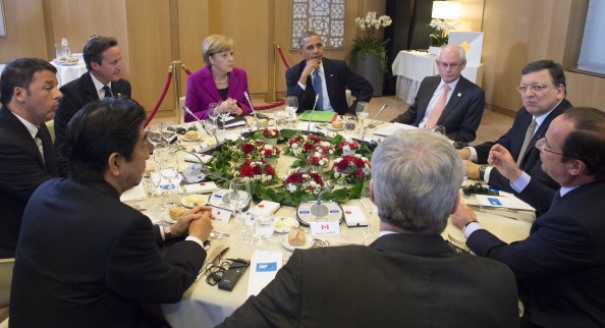
If ever there was an opportunity for the West to pull together, it was on June 4, when leaders of the G7 major industrialized nations met in Brussels.

U.S. President Barack Obama had just flown in from Warsaw. There, he had spent many hours reassuring Poland and other countries in the region that the United States would boost their defenses.

In concrete terms, he proposed a $1 billion fund to train Eastern European countries’ armed forces and improve their military capabilities. That was well short of what Poland wanted, which was a commitment for NATO to set up permanent bases in that part of Europe.

Obama’s pledge to NATO’s Eastern European allies was also aimed at Russia. He wanted to make clear to Russian President Vladimir Putin that his administration was not going to abandon Eastern Europe in the wake of Russia’s annexation of Crimea and the continuing instability in Ukraine. The U.S. president also wanted to demonstrate to Russia that the transatlantic bonds were as strong as ever.

In fact, those bonds have rarely been so weak. Europe, for the most part, is rudderless, while the Obama administration is hobbled by a public tired of war and sees no reason why it should become embroiled in Ukraine’s crisis.

In Europe, Britain’s influence is rapidly waning. UK Prime Minister David Cameron has been huffing and puffing and threatening to leave the EU if Jean-Claude Juncker, a committed federalist, is chosen as the next European Commission president. Cameron knows that Angela Merkel, the German chancellor, holds most of the cards over who gets that top post. Even though Merkel (and the United States) wants Britain to remain in the EU, she is no mood to cede to Cameron’s threats.

When it comes to bolstering the transatlantic relationship, the German chancellor is in a very weak position to make a difference. That is because the U.S. National Security Agency (NSA) spying scandal will not go away. On June 4, Harald Range, Germany’s federal prosecutor, announced he was going to launch formal proceedings into allegations that the NSA had monitored Merkel’s cell phone.

The NSA scandal has already fed a growing anti-Americanism in Germany in a way that affects foreign policy decisions. For example, Germany has opposed any attempt by NATO to deploy troops on a permanent basis in the alliance’s Eastern members. The German public, which is growing increasingly skeptical of NATO and, by extension, of the United States, sees such a move as a militaristic and provocative step on the part of Washington. And even though Obama and Merkel have established a much closer bilateral relationship, especially during the Ukraine crisis, the fallout from the NSA scandal constrains Merkel’s ability to strengthen broader transatlantic ties.

Obama cannot rely much on France either. Washington has considerable respect for French President François Hollande’s decision to send troops to Mali and the Central African Republic. But Obama cannot push Hollande into taking a tougher stance against Russia. Despite U.S. pressure, Hollande has made it clear that he will not abandon the sale of Mistral-class warships to Russia. There are too many jobs at stake.

Yet European leaders can ill afford to allow the transatlantic relationship to weaken even further. Because of their unwillingness to take defense and security seriously, Europeans remain almost completely dependent on the United States to provide them with its security umbrella.

And despite the Ukraine crisis and the modernization of Russia’s armed forces, most Western European governments will not increase their defense spending. Somehow, they assume that Washington will always provide the cover. Perhaps it was Obama’s mistake to offer $1 billion to Poland and other countries in the region without insisting that America’s European allies match that sum or at least contribute to it.

During his speech in Warsaw on June 3, Obama did ask the Europeans to carry some of the burden. But his appeal was halfhearted in tone. The United States knows that in the past, such pleas have fallen on deaf ears in most Western European capitals—as if the Ukraine crisis wasn’t enough reason to boost transatlantic bonds.

Judy Dempsey
Nonresident Senior Fellow, Carnegie Europe
Judy Dempsey
SecurityForeign PolicyEUEastern EuropeNorth AmericaUnited StatesRussiaUkraineWestern EuropeEurope

Carnegie does not take institutional positions on public policy issues; the views represented herein are those of the author(s) and do not necessarily reflect the views of Carnegie, its staff, or its trustees.

More Work from Strategic Europe

  • Commentary
    Strategic Europe
    Taking the Pulse: Can the EU Attract Foreign Investment and Reduce Dependencies?

    EU member states clash over how to boost the union’s competitiveness: Some want to favor European industries in public procurement, while others worry this could deter foreign investment. So, can the EU simultaneously attract global capital and reduce dependencies?

      • Rym Momtaz

      Rym Momtaz, ed.

  • Commentary
    Strategic Europe
    To Survive, the EU Must Split

    Leaning into a multispeed Europe that includes the UK is the way Europeans don’t get relegated to suffering what they must, while the mighty United States and China do what they want.

      • Rym Momtaz

      Rym Momtaz

  • Commentary
    Strategic Europe
    Europolis, Where Europe Ends

    A prophetic Romanian novel about a town at the mouth of the Danube carries a warning: Europe decays when it stops looking outward. In a world of increasing insularity, the EU should heed its warning.

      Thomas de Waal

  • Commentary
    Strategic Europe
    Europe Falls Behind in the South Caucasus Connectivity Race

    The EU lacks leadership and strategic planning in the South Caucasus, while the United States is leading the charge. To secure its geopolitical interests, Brussels must invest in new connectivity for the region.

      Zaur Shiriyev

  • Commentary
    Strategic Europe
    Taking the Pulse: Is It Time for Europe to Reengage With Belarus?

    In return for a trade deal and the release of political prisoners, the United States has lifted sanctions on Belarus, breaking the previous Western policy consensus. Should Europeans follow suit, using their leverage to extract concessions from Lukashenko, or continue to isolate a key Kremlin ally?

      Thomas de Waal, ed.

Get more news and analysis from
Carnegie Europe
Carnegie Europe logo, white
Rue du Congrès, 151000 Brussels, Belgium
  • Research
  • Strategic Europe
  • About
  • Experts
  • Projects
  • Events
  • Contact
  • Careers
  • Privacy
  • For Media
  • Gender Equality Plan
Get more news and analysis from
Carnegie Europe
© 2026 Carnegie Endowment for International Peace. All rights reserved.