

Commentary
Nathalie Tocci, Jan Techau
{
  "authors": [
    "Jan Techau"
  ],
  "type": "commentary",
  "blog": "Strategic Europe",
  "centerAffiliationAll": "",
  "centers": [
    "Carnegie Endowment for International Peace",
    "Carnegie Europe"
  ],
  "collections": [],
  "englishNewsletterAll": "",
  "nonEnglishNewsletterAll": "",
  "primaryCenter": "Carnegie Europe",
  "programAffiliation": "",
  "programs": [],
  "projects": [],
  "regions": [
    "Western Europe",
    "Europe"
  ],
  "topics": [
    "Political Reform",
    "Democracy",
    "EU"
  ]
}
Source: Getty
By promising pan-European party candidates for the next European Commission president, the EU offered something it could not deliver. It would be wiser to stick to the rules.
Perhaps it is too late for sanity. Maybe the dynamic of a false democracy argument cannot be brought back under control. But let me try nevertheless. It is too important to give up now. I am talking, of course, about the European Parliament elections of May 22–25 and the debate over who should be the next president of the European Commission. Over the last week, this debate has gone from irritating to insane.
The scandal is not that EU heads of state and government—the European Council—are trying to find a commission presidential candidate who has the full backing of as many member states as possible. The scandal is that an attempted power grab by the European Parliament could be successfully sold to voters and intellectuals alike as improved democracy in Europe; and that, now the EU’s legal and political realities have called the parliament’s bluff, the very people who were naive enough to buy the story are accusing those who have to fix the mess of being antidemocratic.
Unfortunately, party candidates were a false promise from the beginning. They could only be elected to the European Parliament in their respective home countries. Pan-European parties may exist, but pan-European party lists don’t—and can’t under current law.
So to make the entire idea more appetizing, something else needed to be invented. The leaders of the party groups in the European Parliament saw their chance. How about simply claiming, without any backing from the existing treaties, that the group that wins the parliament elections would automatically nominate the commission president?
The advantage of this strategy was not only that it sounded deceptively like voters really had something to decide in these elections. The plan would also give the parliament enormous, extralegal powers to nominate the candidate for the commission presidency, a right reserved under the Lisbon Treaty to the European Council.
In a frenzy to demonstrate their democratic goodwill to potential voters, none of the political players outside the parliament called its bluff. Everyone felt they needed to play along to avoid being seen as undemocratic. And the heads of state and government, who should have opposed this usurpation of power from the beginning, demonstrated no firmness either. As a result, they share a considerable chunk of the blame for the mess the EU is now in.
EU leaders preferred to overlook how highly unlikely it was that the promised automatism of “winner of elections equals commission president” could survive. It was improbable that either of the two main party groups would win a parliamentary majority massive enough to create an irresistible political momentum. From the outset, it was clear that there was not enough unity among national governments, or even within the party groups, to realistically expect EU leaders to lend their full support to either of the two leading candidates.
What was further ignored was how much damage the unkeepable promise of more democracy could do to an already-scarred EU brand.
The result was a foreseeable disaster. People who believed in that promise now feel betrayed, even though the EU has a perfectly clear constitutional situation. It is the very situation the Lisbon Treaty provides for: no automatism in the selection of the commission president, but rather a carefully negotiated compromise between the member states and the parliament.
Everything is as it should be, although nothing is as it was before. The damage is done. Scores of enraged voters, politicians, intellectuals, journalists, and pundits—most of them with very scarce knowledge of the actual legal and political workings of the EU—have created an angry storm of misguided criticism against those now trying to deal with the situation as it presents itself.
Anyone who dares to say that the promised automatism can’t work, and that it was a hoax from the beginning, is accused of being contemptuous of democracy, even undermining Europe’s foundations.
But the exact opposite is true: the people undermining democracy and bringing Europe into further disrepute are not the ones insisting on a proper, legal process. They are the ones who started a power game that was founded on neither the political nor the legal realities of the EU.
To be sure, Europe needs massive democratic reform to boost its legitimacy. It needs political competition in the form of real pan-European elections, based on crosscountry party lists, and with a meaningful political prize to be won. (In my opinion, the elections should be a vote on the European Council president, not the commission president, but that is another story.) The parliament must become more accountable, and then—only then—it must be given the full right to initiate EU legislation.
Europe badly needs a real politicization. But any attempt to make Europe more political requires a firm institutional foundation that can channel the dynamism of politicized competition into a productive and stable process. What the EU does not need is the unguided unleashing of electoral powers that then run into an institutional void, creating disappointment and rage. And it certainly does not need a European Parliament that empowers itself outside the legal framework of the union.
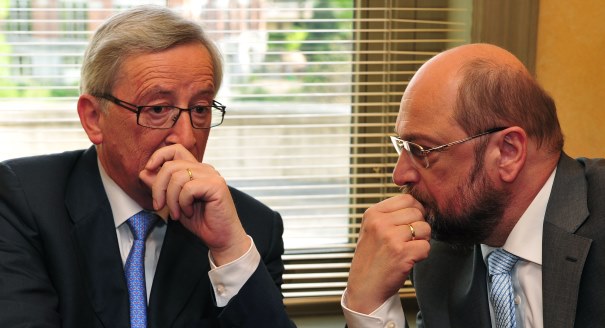
My point is not about Jean-Claude Juncker or Martin Schulz, the commission presidential candidates of the center-right and the Socialists respectively—or any other candidates or parties. It is about showing respect for the constitutional setup of the Lisbon Treaty as it was ratified by all member states and the European Parliament. According to this setup, no automatism exists for the appointment of the commission president. EU heads of state and government propose a candidate by negotiating a compromise. The parliament then elects that candidate.
Let’s respect the rules—and then change them quickly afterward so that real democracy has a chance in Europe.

Director, Europe Team, Eurasia Group
Techau is director with Eurasia Group's Europe team, covering Germany and European security from Berlin. Previously, he was director of Carnegie Europe.
Recent Work

Nathalie Tocci, Jan Techau
Jan Techau
Carnegie does not take institutional positions on public policy issues; the views represented herein are those of the author(s) and do not necessarily reflect the views of Carnegie, its staff, or its trustees.

The European Commissioner for Trade is headed to China. But after President Xi’s bridge-building visit to Washington, can a more isolated EU overcome Beijing’s stranglehold on critical raw materials? Who will blink first?

Rym Momtaz, ed.

The domestic impacts of how long it is taking to end the war in Ukraine have pushed the French electorate to the political extremes and compromised the country’s diplomatic capacity.
Rym Momtaz

Before the next wave of EU enlargement takes place, the union needs to grapple with thorny questions of how power is distributed among its members.


Emil Sondaj Hansen, Ditte Brasso Sørensen

Are Germany’s economic, industrial, and political struggles becoming a liability for the EU’s ability to rise to the geopolitical moment?
Rym Momtaz, ed.

European Commission President Ursula von der Leyen is about to give her annual address on the state of the EU. Here’s what she won’t—but should—say.
Rym Momtaz