• Research
  • Strategic Europe
  • About
  • Experts
Carnegie Europe logoCarnegie lettermark logo
EUUkraine
  • Donate
{
  "authors": [
    "Judy Dempsey"
  ],
  "type": "commentary",
  "blog": "Strategic Europe",
  "centerAffiliationAll": "",
  "centers": [
    "Carnegie Endowment for International Peace",
    "Carnegie Europe"
  ],
  "collections": [
    "Transatlantic Cooperation"
  ],
  "englishNewsletterAll": "",
  "nonEnglishNewsletterAll": "",
  "primaryCenter": "Carnegie Europe",
  "programAffiliation": "",
  "programs": [],
  "projects": [],
  "regions": [
    "North America",
    "Russia",
    "Western Europe",
    "Europe"
  ],
  "topics": [
    "Security",
    "Foreign Policy",
    "EU"
  ]
}
Strategic Europe logo

Source: Getty

Commentary
Strategic Europe

How NATO Speaks to the Public

If NATO wants its member states to spend more on defense and security, it needs to reach out to the public to explain why defense matters.

Link Copied
By Judy Dempsey
Published on Sep 4, 2014
Strategic Europe

Blog

Strategic Europe

Strategic Europe offers insightful analysis, fresh commentary, and concrete policy recommendations from some of Europe’s keenest international affairs observers.

Learn More

It has been billed as historic. That’s the message NATO’s top brass is conveying to the world’s media during the alliance’s two-day summit that opened on September 4 on the grounds of a huge golf course and hotel complex in South Wales.

With the Ukraine crisis dominating the agenda, outgoing Secretary General Anders Fogh Rasmussen will push as far as he can to get a commitment from all 28 NATO member states to raise defense spending to 2 percent of their GDP. That is part of a longer-term strategy aimed at equipping NATO to protect its allies against the threats the alliance faces in its Eastern and Southern neighborhoods.

That’s all very well—and necessary, given Russia’s invasion of eastern Ukraine, Moscow’s annexation of Crimea, and the rise of the Islamic State in the Middle East.

But with Europe’s economies sluggish and several countries, especially the Southern ones, in the throes of cutting public expenditure, there will be resistance to spending more on defense.

That is why NATO needs to explain to the public what it stands for and why defense matters. But the alliance isn’t doing any kind of sustained outreach.

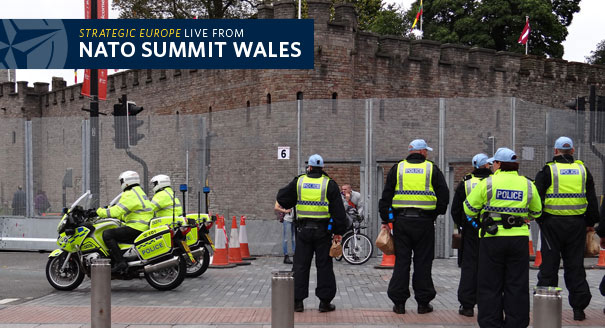
“I haven’t a clue what NATO is or what this summit is about,” said Lilly, a nineteen-year-old student. She has a part-time job as a waitress in a restaurant close to the majestic Cardiff Castle. That means she has a bird’s-eye view not just of all the NATO members’ flags but also of the long steel wire fence around the castle’s perimeter and of the hundreds of police officers on duty. “I don’t know whom the police are protecting. We’re told nothing really.”

Police officers did brief communities living close to the conference center, residents said.

But Sam, a fifty-six-year-old company director specializing in energy exploration, said it was time that NATO itself began to communicate to the public what it stood for.

“Look, I’ve seen NATO in action in Afghanistan, where I was doing geological surveys. So I know something about it,” he explained. “But what really gets me is that NATO officials never bothered to explain to the ordinary public about the summit itself,” he added.

“That’s the problem,” said a hotel manager doing his best to keep relaxed. “At the last minute, we were told to close even an auxiliary car park facility for our guests, for security reasons. I can understand that. What I don’t understand is that NATO had the chance to hold town-hall meetings with the citizens of Cardiff, but we hotel people weren’t briefed.”

Reaching out to the public is going to become even more important for NATO in the coming weeks and months. As the alliance starts to beef up its defenses, NATO needs to engage in dialogue with the public to explain why security matters.

Photo by Jon Candy, used under CC BY-SA / Cropped from original

Judy Dempsey
Nonresident Senior Fellow, Carnegie Europe
Judy Dempsey
SecurityForeign PolicyEUNorth AmericaRussiaWestern EuropeEurope

Carnegie does not take institutional positions on public policy issues; the views represented herein are those of the author(s) and do not necessarily reflect the views of Carnegie, its staff, or its trustees.

More Work from Strategic Europe

  • Commentary
    Strategic Europe
    To Survive, the EU Must Split

    Leaning into a multispeed Europe that includes the UK is the way Europeans don’t get relegated to suffering what they must, while the mighty United States and China do what they want.

      • Rym Momtaz

      Rym Momtaz

  • Commentary
    Strategic Europe
    Europolis, Where Europe Ends

    A prophetic Romanian novel about a town at the mouth of the Danube carries a warning: Europe decays when it stops looking outward. In a world of increasing insularity, the EU should heed its warning.

      Thomas de Waal

  • Commentary
    Strategic Europe
    Europe Falls Behind in the South Caucasus Connectivity Race

    The EU lacks leadership and strategic planning in the South Caucasus, while the United States is leading the charge. To secure its geopolitical interests, Brussels must invest in new connectivity for the region.

      Zaur Shiriyev

  • Commentary
    Strategic Europe
    Taking the Pulse: Is It Time for Europe to Reengage With Belarus?

    In return for a trade deal and the release of political prisoners, the United States has lifted sanctions on Belarus, breaking the previous Western policy consensus. Should Europeans follow suit, using their leverage to extract concessions from Lukashenko, or continue to isolate a key Kremlin ally?

      Thomas de Waal, ed.

  • Commentary
    Strategic Europe
    New Tricks and AI Tools in Hungary’s High-Stakes Election

    Hungarian Prime Minister Viktor Orbán faces his most serious challenge yet in the April 2026 parliamentary elections. All of Europe should monitor the Fidesz campaign: It will use unprecedented methods of electoral manipulation to secure victory and maintain power.

      Zsuzsanna Szelényi

Get more news and analysis from
Carnegie Europe
Carnegie Europe logo, white
Rue du Congrès, 151000 Brussels, Belgium
  • Research
  • Strategic Europe
  • About
  • Experts
  • Projects
  • Events
  • Contact
  • Careers
  • Privacy
  • For Media
  • Gender Equality Plan
Get more news and analysis from
Carnegie Europe
© 2026 Carnegie Endowment for International Peace. All rights reserved.