

Commentary
Judy Dempsey
{
  "authors": [
    "Judy Dempsey"
  ],
  "type": "commentary",
  "blog": "Strategic Europe",
  "centerAffiliationAll": "",
  "centers": [
    "Carnegie Endowment for International Peace",
    "Carnegie Europe"
  ],
  "collections": [
    "Europe’s Eastern Neighborhood"
  ],
  "englishNewsletterAll": "",
  "nonEnglishNewsletterAll": "",
  "primaryCenter": "Carnegie Europe",
  "programAffiliation": "",
  "programs": [],
  "projects": [],
  "regions": [
    "Eastern Europe",
    "Russia",
    "Ukraine"
  ],
  "topics": [
    "Democracy",
    "Civil Society"
  ]
}
Source: Getty
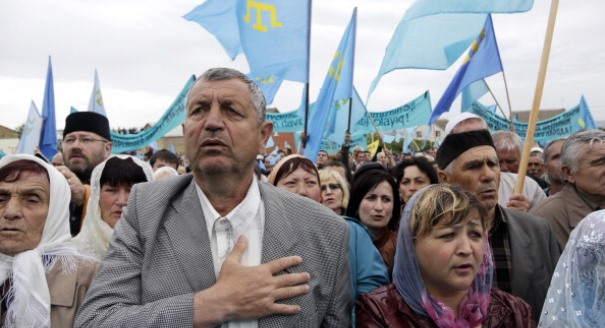
Since the West acquiesced over Russia’s illegal annexation of Crimea, Moscow has a free hand to pressurize and intimidate the peninsula’s Tatars.
Earlier this year, in Poland’s Royal Castle, a diminutive man dressed in a suit that hung loosely over his frail frame was called to take the floor. Mustafa Dzhemilev, the leader of the Crimean Tatars, was being awarded the first-ever international Lech Wałęsa Solidarity Prize at an event that coincided with the twenty-fifth anniversary of Poland’s freedom from Communism.
Radek Sikorski had established the prize. As Poland’s foreign minister, Sikorski has made human rights and the struggle for freedom the hallmarks of his term in office. But more importantly, he used Poland’s peaceful transition to democracy as a means to help other countries in Eastern Europe do the same.
For Dzhemilev, the prospect that Crimea could make that transition has been destroyed, for the moment, by Russia. In March 2014, Russia marched into Crimea and illegally annexed the peninsula, which had previously been part of Ukraine. Since then, the Crimean Tatars, a Turkic ethnic group native to the peninsula, have been subject to intimidation, arrests, and expulsions. Such persecution is a symptom of a new wave of Russian nationalism that, if unchecked, could threaten other minorities.
After the collapse of the Soviet Union in 1991, tens of thousands of Tatars did return to Crimea. According to Ukraine’s 2001 national census, Crimea was home to 243,000 Tatars out of a population of around 2 million.
Dzhemilev knows all about exile. In 1944, his family was deported to Uzbekistan. In 1966, he was arrested and sent to a labor camp after refusing to sign up to the Soviet Army. Over the next two decades, he spent almost fifteen years in camps and exile, in part because of his work in co-founding the Initiative Group for the Defense of Human Rights in the USSR, which petitioned the UN on behalf of victims of Soviet repression.
In 1989, Dzhemilev and his family were allowed to return to Crimea. Two years later, he was elected the first chairman of the Mejlis, the organization representing the Crimean Tatars.
When in March 2014 Russia called a snap referendum on the status of Crimea, Dzhemilev and many other Tatars opposed the vote. They wanted the peninsula to remain part of Ukraine. As a result, the Russian authorities installed in Crimea after the annexation declared Dzhemilev and other leading Crimean Tatars personae non gratae. He has been banned from entering Crimea until 2019. Rafat Chubarov, who succeeded Dzhemilev as head of the Mejlis, is living in exile in Kiev.
Over recent months, swastikas have been daubed on some Tatar houses, reflecting how Russian propaganda demonizes those who oppose the Kremlin’s policies as Nazis or fascists. Other houses have been marked indicating that their inhabitants are Tatars. Anybody caught speaking the group’s Turkic language also risks persecution.
Tatars who refuse to take up Russian citizenship in Crimea can retain their Ukrainian citizenship, but they will be deemed foreigners. In short, the Crimean Tatars have come under sustained pressure to toe the line or be expelled.
Such intimidation has increased since September 14, when Crimea held its first local government elections since the annexation. For the most part, the Tatars boycotted these elections.
On September 16, Russian security service agents and police raided the Mejlis and confiscated documents, computers, and books. Sergey Aksyonov, Crimea’s pro-Russian prime minister, said the authorities had received “signals about banned literature.” The Crimean Tatars were given twelve hours to clear the building or face eviction by force.
Aksyonov told the Russian daily newspaper Kommersant that the Mejlis did not exist. “From a juridical perspective, there is no such organization for me. What Mejlis? The organization was not registered properly. It does not exist.”
The Crimea Fund charity, which works for the Tatar community and owns the Mejlis building and other properties, was banned from leasing or selling its properties. In addition, businesses, schools, and mosques have been raided.
It’s hard to see how the Crimean Tatars can resist such pressure. “Crimea has become forgotten,” said Johanna Green, program manager at Unrepresented Nations and Peoples Organization, an advocacy movement. If the Russian authorities continue to persecute the Crimean Tatars, that could bode ill for other minorities in Russia proper, who must sense how a growing wave of Russian nationalism threatens their identity.

Nonresident Senior Fellow, Carnegie Europe
Judy Dempsey is a nonresident senior fellow at Carnegie Europe
Recent Work
Judy Dempsey
Judy Dempsey
Carnegie does not take institutional positions on public policy issues; the views represented herein are those of the author(s) and do not necessarily reflect the views of Carnegie, its staff, or its trustees.

The EU can impose sanctions but struggles to enforce them without the United States. With Washington increasingly disinterested in backing European interests, the bloc must now fend for itself.


Nicu Popescu, Tiago Antunes

Russia is testing the waters of NATO’s mutual defense clause. What do strikes in Romanian territorial waters mean for the alliance’s posture toward Moscow?

Dimitar Bechev

Ahead of a tough winter for Ukraine, Donald Trump’s swing back toward Russia bodes ill. But instead of panicking, Kyiv’s European allies are focusing on action.

Rym Momtaz

Much has been said of the changes Brussels is trying to make to the EU enlargement process. Here’s why gradual integration might—or might not—be the answer.
Dimitar Bechev

The domestic impacts of how long it is taking to end the war in Ukraine have pushed the French electorate to the political extremes and compromised the country’s diplomatic capacity.
Rym Momtaz