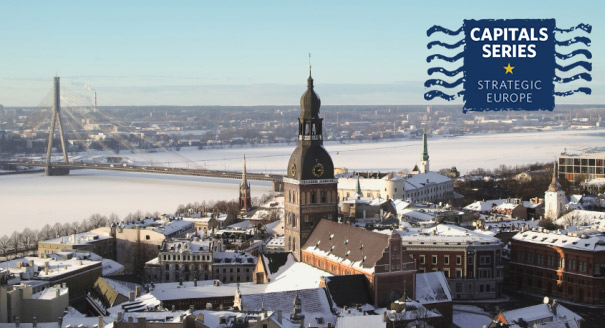
Strategic Europe continues its new series devoted to explaining the foreign and security policy ambitions of the 28 EU member states. We have asked our contributors from each capital to give a candid assessment of their country’s perception of security and strategy, with a ranking on a scale from 0 (the laggards) to 5 (the ambitious). This week, the spotlight is on Latvia.
*
Latvia’s current strategic thinking on foreign policy is quite comfortably situated in line with the EU’s common policies. Riga has moved beyond the grand narratives of the past to a more substantive, down-to-earth approach. On a scale from 0 to 5, Latvia’s strategic thinking would earn a 4—for actively punching its weight and for moving forward in both traditional and new policy areas.
 How did Latvia get to where it is today? Some fifteen years ago, the country’s primary foreign policy goal was to join the EU and NATO. Riga pursued this objective with the utmost commitment and little debate. Other issues were relegated to the background.
Then, once Latvia achieved EU and NATO membership in 2004, things started to change. Accession lifted the limitations on dissenters, who were now free to call for pragmatic, profit-oriented cooperation with non-Western states such as Russia, and for greater independence within the EU.
In 2007–2008, largely due to the financial crisis, a period of strategic uncertainty followed. Latvia still tried to adhere to the common EU line but felt neither significantly limited by it nor obliged to contribute to it.
This soul-searching has now subsided. Latvian foreign policy, it seems, is finally approaching maturity. The country’s chairing of the rotating presidency of the EU Council of Ministers during the first half of 2015 is forcing policymakers to formulate national interests within the EU more clearly and to think in a broader context.
 This new strategic outlook in Latvia’s foreign policy is based on four key principles.
First, Riga pursues a proactive but piecemeal approach. The country’s elevated discourse of the 1990s of returning to Europe has given way to a moderate, pragmatic stance. Latvians now aim to be good Europeans who look after their own interests and push them onto the EU’s agenda but also respect and commit themselves to others’ priorities.
For instance, Latvia supports its Eastern neighbors’ Euro-Atlantic integration—including eventual NATO membership—but only if the conditions for such integration are met. At the same time, Latvia has not forgotten about the Western Balkans or the Middle East and North Africa.
Second, Latvia focuses on short- to medium-term planning, whatever the pluses and minuses of such an approach. Riga is now more inclined than it was to solve problems as they appear, making plans on a yearly rather than a multiannual basis. This means more reactivity, but also greater flexibility.
Third, Latvia follows the rule of “trust but verify.” The country generally views the EU, especially its institutions, as a trustworthy partner. The importance of joint EU policies is undoubted. Indeed, despite its small size, Latvia would like to see itself firmly at the EU’s core—however unrealistic this may seem. At the same time, Riga is increasingly trying to formulate its own vision and new priorities, for instance on Central Asia.
#Latvia seeks to diversify its foreign policy across regions.Tweet This
Fourth, Latvia seeks to diversify its foreign policy across regions and areas. Latvia aims to develop a comprehensive approach covering security, values, and the economy, and to reach out beyond its traditional partners of the EU, the United States, its Eastern neighbors, and Russia. Although Latvia has been highly proactive throughout the Ukraine crisis, it did not stop working on other dossiers like India or Afghanistan.
These principles form the basis of Latvia’s relations with several regions of the world.
The Baltic Sea region, along with the neighboring countries of Germany and Poland, is one of Latvia’s main priorities. Despite some bilateral competition with Estonia and Lithuania, Latvia has a strong Baltic identity and an interest in economic and security cooperation with its two EU neighbors.
Transatlantic relations are indispensable for Latvia and encompass not only various aspects of security but also economic cooperation. The proposed Transatlantic Trade and Investment Partnership (TTIP) is a high priority politically, and Latvia has few concerns about the deal’s substance—possibly due to the country’s low volume of trade with the United States. Riga already maintains a close and trusting dialogue with Washington and would like to see the United States increase its military presence in Europe—on its own territory and in the immediate neighborhood.
#Latvia has an ambitious goal to revive and revamp the EaP.Tweet This
In regard to the EU’s Eastern Partnership, Latvia has moved beyond pro-democracy declarations and now has an ambitious goal to revive and revamp the initiative through small but logical steps. These include tying in all six partners through significantly diversified forms of cooperation; increasing assistance for the implementation of the EU Association Agreements with Georgia, Moldova, and Ukraine; paying more attention to security; and making progress on visa liberalization and other practical issues.
Relations with Russia deteriorated significantly in 2014. Although some economic interests remain, these are now seen as inevitable, not desirable. Latvia has been consistently pushing for a transatlantic consensus on Russia that would couple sanctions with security and financial support to those EU member states worst affected by Russian aggression. Latvia also seeks greater backing for energy interconnectors and new independent media channels for Russian and Russian-speaking minorities in the EU’s Eastern neighborhood. At the same time, Riga is becoming more diligent in doing its homework, diversifying away from Russian markets.
Central Asia is another priority and a policy area where Latvia takes the lead. Its role there is driven mostly by economic interests, but Latvia also pays great attention to security, especially in Afghanistan, where the country’s forces are still present. Latvia was a key partner in establishing the Northern Distribution Network, a supply route from Riga to Afghanistan, and is now working to transform this route into a new Silk Road.
Farther afield, Latvia is trying to upgrade its relations with China, India, South Korea, and other Asian and Latin American states, first and foremost for economic reasons. Riga prefers to develop these relations as part of a common EU approach, thus saving its own resources and gaining new formats for dialogue.
In sum, Latvia’s foreign policy outlook has evolved considerably in the past two decades. Despite being one of the EU’s smaller member states, Latvia aims to make significant contributions to joint EU policies in a number of areas. Moving forward, the challenge for Riga will be to maintain its broadly positive approach as it begins to articulate and promote its own national interests.
Diāna Potjomkina is a research fellow at the Latvian Institute of International Affairs. Her areas of expertise include Latvia’s foreign policy and relations with the EU’s Eastern neighborhood.