

Commentary
Nathalie Tocci, Jan Techau
{
  "authors": [
    "Jan Techau"
  ],
  "type": "commentary",
  "blog": "Strategic Europe",
  "centerAffiliationAll": "",
  "centers": [
    "Carnegie Endowment for International Peace",
    "Carnegie Europe"
  ],
  "collections": [],
  "englishNewsletterAll": "",
  "nonEnglishNewsletterAll": "",
  "primaryCenter": "Carnegie Europe",
  "programAffiliation": "",
  "programs": [],
  "projects": [],
  "regions": [
    "Europe",
    "Western Europe"
  ],
  "topics": [
    "EU"
  ]
}
Source: Getty
Irony is the quintessential Western cultural achievement. If the West does not appreciate the importance of that defining character trait, it won’t stand a chance.
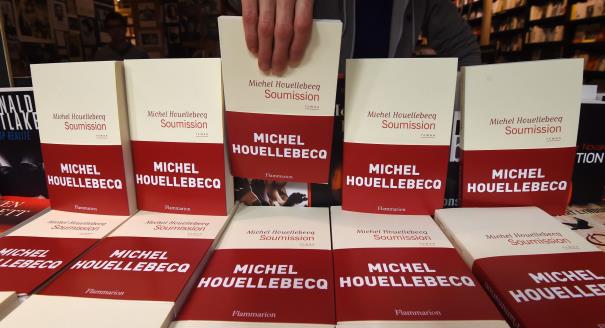
It is not Michel Houellebecq’s fault that his new novel Soumission (“Submission”) was published in France on the same day that fanatic Islamist killers wiped out the editorial board of a satirical newspaper.
But the gruesome fate of Charlie Hebdo—and the heated (and often overheated) debate about Islamic fundamentalism and the terror it has bred in Europe and elsewhere—has become inextricably linked with Houellebecq’s dystopian story of a near-future France in which the election of a Muslim president triggers the transformation of society away from its Western ideals.
In Europe, with its widespread sense of malaise over economic decline, unguided immigration, doubts about national identity, and war in the continent’s periphery, the book has become the soundtrack of our time.
His novel, like some of his earlier works, is essentially a fantasy of self-elimination. It is not about muscle, it is about atony. If Houellebecq, a man with remarkably fine antennae, is only 10 percent right about what he sees as the prevailing currents in Europe, Strategic Europe’s aim will not just be a tall order. It will be impossible.
Soumission depicts a French society on the brink of a nervous breakdown. A charismatic Muslim politician has become the most popular leader in France, and his party has steadily gained in standing, pushing aside the hollowed-out standard center-right and center-left groupings. The French republican elites decide to support this formidable new candidate in the 2022 presidential election to prevent Marine Le Pen, the populist right-wing candidate of the National Front, from assuming the country’s highest office.
The new man gets elected, and what follows is a twisted new French revolution, this time under the banner of Islam. The mainstreaming of Muslim, even Islamist, ideals into French society leads to a dramatic shift toward social conservatism; the nation’s higher education institutions are sold off to Arab sheikhs; and converting to Islam becomes the prerequisite for staying employed in state jobs.
#Houellebecq's #Soumission is essentially a fantasy of self-elimination.Tweet This
This plot is so clever and so seductive not only because it plays with the fears of large parts of society (a feat for which the book has been duly criticized by the vanguards of political correctness) but also because it gets right so many of the subtler undercurrents in the West’s debate about itself.
But this time, Houellebecq brings his trademark social criticism of tired, decadent Western culture to its logical political conclusion. The West simply ends, its politics dead, its values discarded, its principles turned against itself. But it does not end with the noisy clash of civilizations. It ends with the protagonist—a classic representative of the tired, mediocre Western elite—being silently happy, after only scant resistance, that he finally can stop worrying about the impositions of modern life.
The book has been called anti-Muslim, even xenophobic. Nothing could be farther from the truth. Some have called it right wing, not for its alleged criticism of Islam, but for supposedly promoting an archconservative, antimodern worldview that seeks a reactionary traditionalism as the answer to the threats of modernism gone wild.
Houellebecq is much too clever for such simple answers. Like the dead journalists of Charlie Hebdo, he chooses satire to further the cause of enlightenment. Only that his satire is less glaring and attention-seeking. It is the enlightenment of pessimism, not of optimism.
Houellebecq is dismayed not only by society’s illiberal forces, be they Islamist, left wing, or nationalist. He is also dismayed by the lack of resilience, energy, and determination of those whose task is to defend the open liberal society. In his book, zeal can be found only among those who support the antiliberal cause. Faith and principles are strong only among those who want to eliminate the Western way. All those called upon to defend modern life are betraying it. They are interested only in bedding the next pretty thing that is silly enough to fall for them.
None of this charming. It is brutal. No wonder so many people hate Houellebecq, his pose, his prose, his mannerisms. But his narrative is about something else, too: it is full of irony. Which is exactly what has escaped most critics both on the Left and on the Right. The Left hates his incorrectness and his attacks on the self-righteous cultural elites that dominate the discourse.
The Right, at least those intelligent enough to understand it, hate him because he demasks both their emptiness (on the center right) or their evil and seductive populisms (on the far right). High representatives of Muslim communities in France have accused Houellebecq of fearmongering and of furthering xenophobia and hatred among religious communities.
A West that no longer appreciates the value of #irony won't stand a chance.Tweet This
In this lies the biggest value of Houellebecq’s book. It exposes those incapable of appreciating, or even recognizing, the quintessential Western cultural achievement: irony. He has written a biting satire that has found a few false friends and lots of false enemies. It opens the window onto a culture that is so scared of its own fear that it loses its biggest civilizational strength: the ability to gain a critical distance from itself and expose, with biting humor and grim laughter, its own follies.
If the shitstorm that followed the publication of Soumission is indicative of our collective state of mind, Houellebecq’s pessimism is well-placed. A West that no longer appreciates the virtuosic nature of its own defining character trait is indeed a West that won’t stand a chance. The West’s submission will not be primarily to other, more determined cultures. It will be first and foremost a submission to its own small-minded self.

Director, Europe Team, Eurasia Group
Techau is director with Eurasia Group's Europe team, covering Germany and European security from Berlin. Previously, he was director of Carnegie Europe.
Recent Work

Nathalie Tocci, Jan Techau
Jan Techau
Carnegie does not take institutional positions on public policy issues; the views represented herein are those of the author(s) and do not necessarily reflect the views of Carnegie, its staff, or its trustees.

Before the next wave of EU enlargement takes place, the union needs to grapple with thorny questions of how power is distributed among its members.


Emil Sondaj Hansen, Ditte Brasso Sørensen

Are Germany’s economic, industrial, and political struggles becoming a liability for the EU’s ability to rise to the geopolitical moment?

Rym Momtaz, ed.

European Commission President Ursula von der Leyen is about to give her annual address on the state of the EU. Here’s what she won’t—but should—say.
Rym Momtaz

The aftermath of the Ceuta crisis shows Europe has drawn the wrong lessons. Rather than doubling down on failed migration policies, the EU needs to address the underlying roots of such episodes.

Richard Youngs

An overwhelming victory by a far-right-wing party in a small state in eastern Germany will have major repercussions for Chancellor Friedrich Merz’s coalition.

Judy Dempsey