

Commentary
Judy Dempsey
{
  "authors": [
    "Judy Dempsey"
  ],
  "type": "commentary",
  "blog": "Strategic Europe",
  "centerAffiliationAll": "",
  "centers": [
    "Carnegie Endowment for International Peace",
    "Carnegie Europe"
  ],
  "collections": [
    "Europe’s Eastern Neighborhood"
  ],
  "englishNewsletterAll": "",
  "nonEnglishNewsletterAll": "",
  "primaryCenter": "Carnegie Europe",
  "programAffiliation": "",
  "programs": [],
  "projects": [],
  "regions": [
    "Russia",
    "Europe",
    "Eastern Europe",
    "Caucasus",
    "Georgia",
    "Ukraine"
  ],
  "topics": [
    "Foreign Policy",
    "Democracy",
    "EU",
    "Security"
  ]
}
Source: Getty
European governments are powerless to prevent the erosion of the security architecture set out in the 1975 Helsinki Final Act.
South Ossetia has gone the same way as Abkhazia.
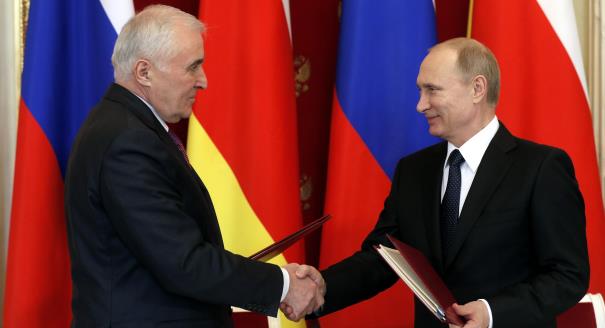
On March 18, Vladimir Putin, the Russian president, and Leonid Tibilov, the separatist leader of South Ossetia, a disputed region in the South Caucasus, met in Moscow. There, they signed a Russian–South Ossetian treaty of alliance and integration.
The accord is similar to the one Russia signed with Abkhazia, another disputed territory, in November 2014. That deal meant that in practice, Moscow would be responsible for the customs, defense, and security of the self-declared republic.
Though neither of these two self-declared republics has been completely annexed by Moscow, it is clear that Georgia, at least for the foreseeable future, hasn’t the slightest possibility of regaining these territories.
It is the same for the Ukrainian government. A year after Russia annexed Crimea, any chance that Kiev will be able to exercise jurisdiction over the Crimean Peninsula is highly remote.
In short, the 1975 Helsinki Final Act, which set out the fundamental principles of sovereignty and the inviolability of borders, is all but in tatters. As the act’s fortieth anniversary approaches, it is hard to see how it can be rescued.
The Helsinki Final Act established the rules of engagement between the West and the then Soviet Union. The document is divided into three sections—security, economic cooperation, and human rights—and gave birth to the Conference, later Organization, for Security and Cooperation in Europe (OSCE).
The act set out ten principles aimed at guiding relations between the participating states. Here they are:
If the points above are applied to Abkhazia, South Ossetia, and Crimea, then Russia’s involvement in all three shows how the West has been unable to uphold this landmark Cold War accord.
But was the West really ever prepared to defend the Helsinki Final Act?
Some could argue that precisely because the accord was signed during the Cold War, and precisely because it was a document aimed at fostering détente, it set out the West’s and the Kremlin’s respective spheres of influence.
So when, for example, Poland’s Solidarity trade union movement challenged the ruling Communist Party in 1980, Western European governments, by and large, were rattled more about the broader implications of the unrest.
Instead of supporting the bravery of Solidarity’s supporters, they fretted about the potential instability that the movement would have on the Cold War settlement—meaning the 1945 Yalta Conference, which established Europe’s borders after World War II. The West was willing to defend its spheres of influence through NATO, but it was not in any way prepared to expand its influence.
Remarkably, the Helsinki Final Act remained intact after the fall of the Berlin Wall in November 1989 and the subsequence collapse of the Soviet Union two years later. Much credit is due to the U.S., German, and Russian leaders at the time. George H. W. Bush, Helmut Kohl, and Mikhail Gorbachev knew what was at stake had they botched up the reunification of Germany.
Indeed, the violent breakup of Yugoslavia during the 1990s showed how German reunification, as well as Central and Eastern European countries’ rediscovery of sovereignty and independence, could have gone badly wrong. In the Baltic states, it was touch and go.
A quarter of a century later, this part of Europe is now rooted in NATO and the European Union.
From Russia’s perspective, the end of the Cold War meant that the Helsinki Final Act could not perpetuate (or guarantee) Cold War–era spheres of influence. If anything, the fall of Communism expanded the West’s presence, peacefully.
It is this growing Western influence, especially in Ukraine and in other countries in Eastern Europe, that poses such a challenge to Putin.
His annexation of Crimea was about reasserting Russia’s position in its backyard. His military pressure on Ukraine was and is about containing Europe’s influence, even though that influence is based on soft, not hard, power. In short, Europe and Russia are in competition with each other.
This competition, fueled by a breakdown of trust, has fundamentally undermined the Helsinki Final Act. And it is fundamentally changing the security architecture of the post–Cold war era.
This competition and lack of trust is highly dangerous. The clash is over a region of Europe whose citizens see the attractiveness of democracy and of the EU’s values. But they are also under immense pressure by Moscow that makes it difficult for them to choose their own direction.
Resorting to spheres of influence is a recipe for instability, as confirmed by the crisis in Ukraine. But the 1975 Helsinki Final Act showed how spheres of influence are not permanent.

Nonresident Senior Fellow, Carnegie Europe
Judy Dempsey is a nonresident senior fellow at Carnegie Europe
Recent Work
Judy Dempsey
Judy Dempsey
Carnegie does not take institutional positions on public policy issues; the views represented herein are those of the author(s) and do not necessarily reflect the views of Carnegie, its staff, or its trustees.

Russia is testing the waters of NATO’s mutual defense clause. What do strikes in Romanian territorial waters mean for the alliance’s posture toward Moscow?

Dimitar Bechev

With its public finances in shambles, the far right polling at 35 percent ahead of the 2027 presidential election, and a growing protest movement, is France’s crisis a threat to the EU’s geopolitical awakening?

Rym Momtaz, ed.

Ahead of a tough winter for Ukraine, Donald Trump’s swing back toward Russia bodes ill. But instead of panicking, Kyiv’s European allies are focusing on action.
Rym Momtaz

While the EU and European governments are embracing the much-lauded middle-power moment, this entails three difficult conundrums.

Richard Youngs

Much has been said of the changes Brussels is trying to make to the EU enlargement process. Here’s why gradual integration might—or might not—be the answer.
Dimitar Bechev