

Commentary
Judy Dempsey
{
  "authors": [
    "Judy Dempsey"
  ],
  "type": "commentary",
  "blog": "Strategic Europe",
  "centerAffiliationAll": "",
  "centers": [
    "Carnegie Endowment for International Peace",
    "Carnegie Europe"
  ],
  "collections": [],
  "englishNewsletterAll": "",
  "nonEnglishNewsletterAll": "",
  "primaryCenter": "Carnegie Europe",
  "programAffiliation": "",
  "programs": [],
  "projects": [],
  "regions": [
    "Europe",
    "Western Europe",
    "Germany"
  ],
  "topics": [
    "EU",
    "Climate Change"
  ]
}
Source: Getty
Athens is using the two issues of refugees and the Nazi occupation of Greece as pawns in its talks with other eurozone members. That is undermining EU solidarity.
Since the beginning of the Greek economic crisis over five years ago, Germany has been demonized by governments in Athens.
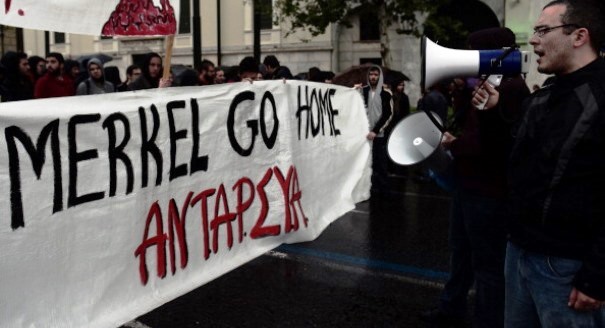
German Chancellor Angela Merkel and Finance Minister Wolfgang Schäuble have been depicted wearing Nazi uniforms and waving swastika flags. The Greek tabloid press has regularly accused Germany of taking over Europe, just as it tried to do during World War II.
The vitriol against Berlin has now taken an even nastier turn under Greek Prime Minister Alexis Tsipras’s left- and right-wing coalition—so much so that efforts to build a European Union based on solidarity and to stop the past from being used for political gain are disintegrating.
Panos Kammenos, the defense minister and leader of the right-wing Independent Greeks party, said as much. “If Europe leaves us in the crisis, we will flood it with migrants and it will be even worse for Berlin if in the wave of millions of economic migrants there will be some jihadists of the Islamic State too.”
Nikos Kotzias, the Greek foreign minister, issued a similar threat. “There will be tens of millions of immigrants and thousands of jihadists [in other EU member states],” he told his EU counterparts.
When it comes to the treatment of refugees, human rights organizations have repeatedly criticized Greece for its appalling record. Conditions for refugees have been so bad that when migrants managed to leave Greece and make their way to Germany, the government in Berlin declined to return them to Greece as they would not have been safe there.
Previous Greek governments did little to improve reception centers for the refugees. The civil war in Syria and the influx of tens of thousands of refugees fleeing the conflict coincided with Greece’s economic crisis. The waves of desperate people seeking safety played into the hands of far-right parties in Greece, represented by politicians such as Kammenos. The country became unsafe for refugees.
The EU has been extremely slow in dealing with Greece’s policies toward its refugees—but also in addressing the bigger issue of how to devise a fair EU system to share the burden of tackling the problem.
At the moment, under the terms of the EU’s Dublin Regulation, the EU country in which a refugee first enters the union must take responsibility for that person’s asylum claim. If refugees move to another EU country illegally, that country has the right to send them back to where they first arrived.
Italy, saddled with a huge influx of refugees, has often dealt with the problem by refusing to register the immigrants and, instead, blithely allowing them to leave Italy for another EU state. As these people often have no official documentation, few governments have any idea from which EU country they came.
But these problems are no excuse for Tsipras to make refugees pawns in his negotiations with other eurozone countries on Greece’s bailout. And for all his left-wing credentials, the debt crisis is no excuse for Tsipras to ignore the shocking conditions faced by migrants. Greece’s cynical use of refugees is shameful. And the threat to Berlin to allow jihadists into Germany is dangerous rhetoric.
As if that were not enough to further poison relations between Athens and Berlin—which, after all, is Greece’s paymaster—on March 10, Tsipras and Nikos Paraskevopoulos, the Greek justice minister, raised the highly sensitive issue of compensation for the Nazi occupation of Greece between 1941 and 1944.
During a debate in the Greek parliament, Tsipras linked Greece’s commitments on economic reforms to ensuring that “all unfulfilled obligations toward Greece and the Greek people are fulfilled.” He added that Greece would revive and strengthen a special committee to pursue a reparations claim against Germany.
Tsipras accused Germany of using “legal tricks” to avoid paying compensation for the Nazi occupation of the country. Meanwhile, Paraskevopoulos threatened to seize German state-owned property to compensate the victims of a Nazi massacre in 1944 in the village of Distomo in which 218 Greek civilians were killed.
The German government was quick to respond. “It is our firm belief that the questions of reparations and compensation have been legally and politically resolved,” Merkel’s spokesman, Steffen Seibert, said on March 11. In 1960, Germany paid out 115 million deutsche marks ($74 million) to Greek victims of Nazi crimes.
Maybe Berlin believes, or at least hopes, the issue is closed. But Germany should have no illusions: Greek governments have used the reparations issue as a pawn in negotiations with the EU before. In 2000, the then Socialist government threatened to seize the German cultural Goethe Institute, a German school, and a German archeology institute if Berlin did not lift its objections to Greece joining the eurozone. Germany relented. The rest is history.

Nonresident Senior Fellow, Carnegie Europe
Judy Dempsey is a nonresident senior fellow at Carnegie Europe
Recent Work
Judy Dempsey
Judy Dempsey
Carnegie does not take institutional positions on public policy issues; the views represented herein are those of the author(s) and do not necessarily reflect the views of Carnegie, its staff, or its trustees.

The aftermath of the Ceuta crisis shows Europe has drawn the wrong lessons. Rather than doubling down on failed migration policies, the EU needs to address the underlying roots of such episodes.

Richard Youngs

An overwhelming victory by a far-right-wing party in a small state in eastern Germany will have major repercussions for Chancellor Friedrich Merz’s coalition.
Judy Dempsey

Canadian Prime Minister Mark Carney has twice inspired praise for standing up to U.S. President Donald Trump: at the 2026 World Economic Forum in Davos and on Canada-U.S. trade negotiations. Is Carney showing a third way better than the EU has in dealing with the Trump administration?

Rym Momtaz, ed.

The EU’s responses to two recent incidents expose the gulf between European perceptions and capabilities. Unless the union can bridge that gap, it will never become a real geostrategic power.
Rym Momtaz

In supporting Europe’s far-right, MAGA and Russia both want the same thing: a weaker EU. Europe must defend itself without abandoning the openness these forces exploit.

Armida van Rij