

Commentary
Nathalie Tocci, Jan Techau
{
  "authors": [
    "Jan Techau"
  ],
  "type": "commentary",
  "blog": "Strategic Europe",
  "centerAffiliationAll": "",
  "centers": [
    "Carnegie Endowment for International Peace",
    "Carnegie Europe",
    "Carnegie Russia Eurasia Center"
  ],
  "collections": [
    "EU Integration and Enlargement"
  ],
  "englishNewsletterAll": "",
  "nonEnglishNewsletterAll": "",
  "primaryCenter": "Carnegie Europe",
  "programAffiliation": "",
  "programs": [],
  "projects": [],
  "regions": [
    "Europe",
    "Western Europe"
  ],
  "topics": [
    "EU",
    "Security",
    "Military"
  ]
}
Source: Getty
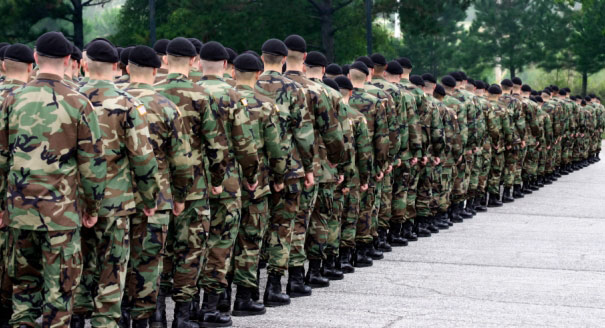
Despite recent calls for an EU army, Europeans should be under no illusions that they are and will remain dependent on the United States for their defense.
The oldest item on the European list of utopian integration topics is a federal superstate. The second oldest is the creation of an EU army. Despite the obvious hopelessness of getting such a thing started and of making it work, this latter idea has been remarkably resilient.
If the Ukraine crisis is the reason why Jean-Claude Juncker, the president of the European Commission, reanimated the idea on March 8 in an interview with a German newspaper, then talk about an EU army might be useful. The proposal points at the strategic weakness of the old world in an increasingly dangerous environment. Juncker’s suggestion could even be seen as a sign that Europeans are starting to understand the nature and size of the threat that has emerged in their Eastern neighborhood.
It is also not entirely clear that European countries have enough trust to make themselves wholly dependent on each other militarily without the United States as the outside mediator and guarantor. And too many member states—most importantly, the irreplaceable United Kingdom—fear an EU army would duplicate structures and uncouple the EU from the United States altogether.
Like the idea of an EU army itself, these counterarguments are not particularly new. But the shock over the Ukraine crisis has reminded Europeans of two things: how limited their own operational military capabilities are; and, as a consequence, how dependent they are on the United States to keep them safe.
As always in Europe, this recognition triggers two different reactions. The first is to accept European dependence and to argue for increased U.S. help. The second is to stress how important it is to finally become less dependent.
Essentially, these different approaches highlight the age-old divide between Atlanticists and Gaullists. European nations have given a clearly Atlanticist response to the Ukraine crisis by putting in place an ambitious program within NATO to reassure the alliance’s Eastern members.
But Gaullist dreams of being independent from the United States have never died, and they might even be behind Juncker’s offensive. After all, he appointed a neo-Gaullist Frenchman, former European commissioner Michel Barnier, as his new point man in the commission on security and defense.
Today, the old divide between Atlanticists and Gaullists is basically irrelevant.Tweet This
It is important to stress that today, this old divide is basically irrelevant. Even the United States, long critical of the EU’s Common Security and Defense Policy, has now embraced a very pragmatic approach that whatever leads to more European capabilities is welcome.
Others, like myself, argue that more EU independence will not only enable Europeans to take on some of the tasks in the union’s neighborhood that the United States is less willing to carry out these days. Greater EU autonomy will also make the Europeans more interesting military partners for the United States, thereby strengthening Atlanticism, not weakening it. That such a move would also give Europeans a little more influence over U.S. decisionmaking would be a positive side effect.
But the really important question, from a strategic perspective, is this: How militarily independent could the EU be if it really aspired to the kind of autonomy that having its own army would bring?
The answer is: not very independent.
The reason for this lies in an old strategic truth that many Europeans either don’t like or aren’t even aware of: ultimately, European security is based on U.S. extended deterrence through NATO. In other words, Europeans rely on the U.S. nuclear arsenal for their freedom and peace and for the fact that they can’t be blackmailed politically. The strategic difference between NATO allies Poland, Germany, and the Netherlands, on the one hand, and nonmember Ukraine, on the other, is the U.S. nuclear umbrella.
As the Europeans will be unable to match or replace this ultimate security guarantee with their own nuclear arms (French and British nukes aren’t overly relevant in this equation), Europe will remain dependent on the U.S. deterrent capability for a long time to come.
This dependence has a decisive impact on the proposed conventional EU army. Any military force that the Europeans might be able to put together would have to be very closely integrated with U.S. and NATO defense and contingency planning. It would be unthinkable—and downright dangerous—for an independent EU armed force to pursue its own plans without close coordination with decisionmakers in the White House, the Pentagon, and NATO headquarters. The provider of strategic deterrence will not split off the conventional side of the coin and let it run free.
Integrating an EU force in this way would not be impossible, of course. But it would make such a force a lot less independent than Gaullist dreamers would like it to be. In reality, the EU army would need approval from Washington for any major operation it were to embark on. There is only one superpower in European security, and it is not the EU. The tail will not wag the dog here, no matter how much this hurts Gaullist pride.
Europeans should be under no illusions: they are dependent on Washington.Tweet This
Europeans should be under no illusions: they are and will remain dependent on Washington. The Atlanticists have won, basically.
Now that’s settled, let’s focus on the real strategic issue in European security today: how to make NATO’s Article 5 security guarantee—that an attack on one ally is an attack on all—the credible deterrent it needs to be. For this, the Europeans must improve their military capabilities as soon as possible, and the Americans must significantly reinforce their troop presence on European territory. Theoretical thought experiments about phantom armies can wait.

Director, Europe Team, Eurasia Group
Techau is director with Eurasia Group's Europe team, covering Germany and European security from Berlin. Previously, he was director of Carnegie Europe.
Recent Work

Nathalie Tocci, Jan Techau
Jan Techau
Carnegie does not take institutional positions on public policy issues; the views represented herein are those of the author(s) and do not necessarily reflect the views of Carnegie, its staff, or its trustees.

Ahead of a tough winter for Ukraine, Donald Trump’s swing back toward Russia bodes ill. But instead of panicking, Kyiv’s European allies are focusing on action.

Rym Momtaz

While the EU and European governments are embracing the much-lauded middle-power moment, this entails three difficult conundrums.

Richard Youngs

Much has been said of the changes Brussels is trying to make to the EU enlargement process. Here’s why gradual integration might—or might not—be the answer.

Dimitar Bechev

The European Commissioner for Trade is headed to China. But after President Xi’s bridge-building visit to Washington, can a more isolated EU overcome Beijing’s stranglehold on critical raw materials? Who will blink first?
Rym Momtaz, ed.

The domestic impacts of how long it is taking to end the war in Ukraine have pushed the French electorate to the political extremes and compromised the country’s diplomatic capacity.
Rym Momtaz