

Commentary
Nathalie Tocci, Jan Techau
{
  "authors": [
    "Jan Techau"
  ],
  "type": "commentary",
  "blog": "Strategic Europe",
  "centerAffiliationAll": "",
  "centers": [
    "Carnegie Endowment for International Peace",
    "Carnegie Europe"
  ],
  "collections": [],
  "englishNewsletterAll": "",
  "nonEnglishNewsletterAll": "",
  "primaryCenter": "Carnegie Europe",
  "programAffiliation": "",
  "programs": [],
  "projects": [],
  "regions": [
    "Middle East",
    "Russia",
    "Syria"
  ],
  "topics": [
    "Security",
    "Military"
  ]
}
Source: Getty
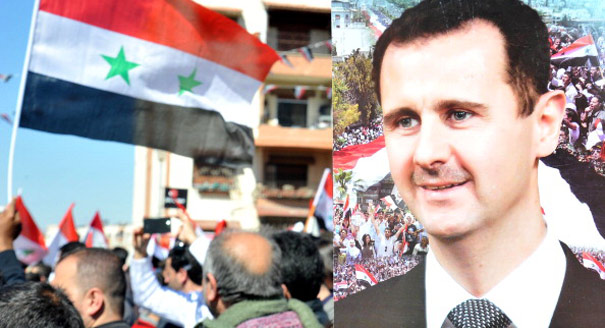
Russian air strikes in defense of the regime of Syrian President Bashar al-Assad might be the least bad option in a conflict that offers no promising solutions.
When no good options remain, tough decisions have to be made. Hard ethical judgment calls, too. Is Syrian President Bashar al-Assad a murderous dictator who has waged unbelievably brutal war on his own people to stay in power? Yes. Would anyone be better off if the so-called Islamic State were residing in Damascus instead of him? Certainly not. So is it possible that maybe, just maybe, Russia is doing the right thing by contemplating air strikes against the Islamic State to support Assad? Well, perhaps.
Russia has been actively supporting Assad since the beginning of the Syrian civil war, in terms of both logistical and political support, most strikingly at the UN Security Council. The Assad family is an age-old ally of the former Soviet Union and now of Russia. Syria—or what remains of it under Assad’s control—is Russia’s only remaining strategic foothold in the Middle East, an asset Moscow wants to defend.
The question is whether a Russian operation against the Islamic State is a good thing or not. Could it be that Russia is doing the right thing, even if for the wrong reasons?
The initial reactions from Western and Middle Eastern representatives to possible Russian air strikes are all negative. The Saudi foreign minister has warned of an escalation. But for Saudis, any support for Assad, one of Iran’s closest allies, is a bad thing, no matter where it comes from.
U.S. Secretary of State John Kerry has also cautioned against a Russian combat mission, fearing an escalation. But the American (and Western) position remains built around the demand that Assad must leave office. Only that this is not going to happen. Russia will not abandon its old ally, Syrian opposition forces are too weak to defeat him, and his voluntary departure from power is extremely unlikely.
And so it looks like the only force capable of ousting him is the Islamic State. The militants have moved dangerously close to Damascus in recent weeks, and no one knows how far they can still go. This begs the question: Which is worse, Assad or the Islamic State? Even the Syrian president’s staunchest enemies might have to concede it’s not him this time. This is where Russian interests in Syria overlap with those of the West.
Is it possible that #Russia is doing the right thing in #Syria? Maybe.Tweet This
Over the last few days, many other Western pundits and commentators have used the escalation argument against a Russian intervention. It is claimed that many more civilians would die if Russia started bombing the Islamic State’s camps and hideouts on Assad’s behalf. But that argument could be dismissed as highly cynical. Haven’t the recent escalations come mainly from the Islamic State? Wouldn’t blaming Russia for escalating the situation turn the militants into victims they are not?
Of course, it would be better if Russia defended not Assad but the democratic opposition in Syria. It would also be better if Russia, by intervening, were not in fact supporting Iran. But these arguments suggest that an ideal outcome is somehow still available. The truth is that the opposition has not played a decisive role in Syria for months and is far from getting anywhere near power. Not to mention that many opposition forces have no liberal, democratic, pro-Western intentions.
In reality, therefore, the options in Syria are all bad. In cases like that, preventing the worst is better than hoping for the best. Perhaps the negative side effects of a Russian intervention in Syria—namely, the stabilization of Assad in power and the increased role of Russia in the region—are acceptable when assessed against the potential takeover of the country’s capital and other large swaths of territory by the Islamic State.
If #Russia's clout is growing in the Middle East, the West can only blame itself.Tweet This
If the West eyes Russia’s possible intervention with suspicion, that’s completely understandable. One of the traditional goals of Western and U.S. policy in the Middle East has been to limit the Soviet Union’s and now Russia’s influence in the region—for good reasons. But if Russia’s clout is growing in the Middle East, the West can only blame itself. The West’s unwillingness to play a responsible role in the region only invites others to play their own game. Leading from behind means that the driver’s seat is up for grabs.
There is a possibility, of course, that the West would silently welcome a Russian intervention. The West could stay clean while the Islamic State gets a thrashing. Indirect support for Assad would come from a country that has no qualms about it, thereby enabling the West to stick to its old he‑must‑go policy.
No matter how cynical the game being played by any of the parties involved, the situation in Syria is so bad, and the fight against the Islamic State has become such a priority, that in the absence of a Western willingness to intervene, a Russian intervention might be the last best option. It is one of the most heartrending realities of today’s Middle East that the right intervention for the wrong reason seems to have become the only ray of hope in that slaughterhouse called Syria.

Director, Europe Team, Eurasia Group
Techau is director with Eurasia Group's Europe team, covering Germany and European security from Berlin. Previously, he was director of Carnegie Europe.
Recent Work

Nathalie Tocci, Jan Techau
Jan Techau
Carnegie does not take institutional positions on public policy issues; the views represented herein are those of the author(s) and do not necessarily reflect the views of Carnegie, its staff, or its trustees.

As we close out another season of Strategic Europe, it is worth taking stock of the deep shifts underway.

Rym Momtaz
The EU had to compromise to adopt a twenty-first sanctions package against Russia, exposing growing cracks in the union’s resolve. Is this latest, weaker round worth it to keep pressure on Moscow?
Rym Momtaz, ed.

Trump is distracted and Ukraine wants Europe to step up. The continent’s leaders must find their voice and assert it in talks with Russia.

Alissa de Carbonnel

Mounting economic strain and battlefield losses will not necessarily make the Kremlin less dangerous. They could instead push Moscow toward a more aggressive hybrid campaign designed to test NATO’s Eastern flank, exploit allied hesitation, and fracture European resolve.

Maksym Beznosiuk

Over the past ten years, NATO has held almost as many summits as it did during the entirety of the Cold War. Are they still useful, or is it time to stop holding annual meetings?
Rym Momtaz, ed.