

Commentary
Judy Dempsey
{
  "authors": [
    "Judy Dempsey"
  ],
  "type": "commentary",
  "blog": "Strategic Europe",
  "centerAffiliationAll": "",
  "centers": [
    "Carnegie Endowment for International Peace",
    "Carnegie Europe"
  ],
  "collections": [],
  "englishNewsletterAll": "",
  "nonEnglishNewsletterAll": "",
  "primaryCenter": "Carnegie Europe",
  "programAffiliation": "",
  "programs": [],
  "projects": [],
  "regions": [
    "Europe",
    "Western Europe",
    "Germany"
  ],
  "topics": [
    "EU",
    "Migration"
  ]
}
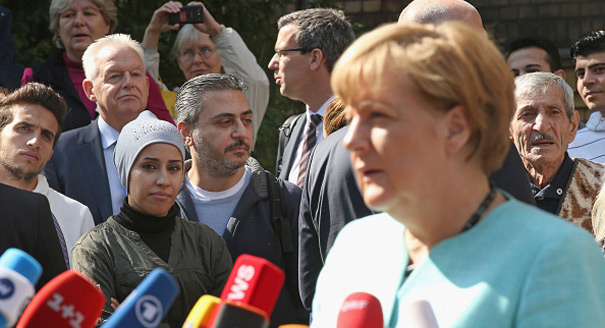
Source: Getty
Germany’s decision to close its borders to stem the flow of refugees is but a stopgap. It also reveals much about Chancellor Angela Merkel’s leadership style.
It was only a matter of time. After nearly 14,000 refugees arrived in the Bavarian city of Munich during the weekend of September 12–13, the local authorities said they had run out of accommodation. They were also running out of patience with Berlin.
Thomas de Maizière, the German interior minister, announced on September 13 that Germany’s border with Austria would be temporarily closed—only days after Berlin threw open its frontiers to refugees. “This measure is also a signal to Europe” that more needs to be done, and quickly, de Maizière said. “Introducing temporary border controls will not solve the whole problem,” he said.
And Chancellor Angela Merkel has become the heroine for human rights groups and liberals across Europe for her policy toward the refugees. She has also, however, become the bête noire for the governments of Eastern and Central Europe. They don’t want to be told by EU leaders, especially Merkel, that they have to share the burden of accepting refugees.
Merkel’s conservative political allies in Bavaria had also criticized her leadership style. There, the Christian Social Union, the Bavarian sister party of Merkel’s Christian Democrats, had questioned the chancellor’s unilateral decision to open Germany’s borders. The party knew that most other EU countries were unwilling to accept refugees. Ahead of a meeting of EU interior ministers on September 14, Christian Social Union leader Horst Seehofer said Merkel’s refugee policy had been ill thought out.
Ministers are unlikely to agree to share the burden of refugees. It is puzzling that Donald Tusk, the Polish president of the European Council, which brings together the EU’s 28 heads of state and government, hasn’t yet called a summit of EU leaders, given how this crisis has exposed the abysmal weakness of Europe’s foreign and security policy and the miserable state of its crisis management machinery.
That aside, Merkel’s policy toward the refugees is similar to a radical decision she made in March 2011. Both episodes reveal much about her leadership style.
In the wake of the nuclear accident at Japan’s Fukushima plant, Merkel did a U-turn that took her own party by complete surprise. She announced that Germany was abolishing nuclear energy.
#Merkel has become the heroine for liberals for her policy toward #refugees.Tweet This
Similar to her response to the refugee crisis, Merkel’s decision on nuclear power was based on neither tactics nor strategy. The Fukushima catastrophe occurred during the middle of a regional election campaign in Baden-Württemburg, the engine of the German economy. For decades, the southwestern state had been governed by the Christian Democrats, but the party was facing defeat by the opposition Greens.
Commentators at the time said Merkel’s decision to abolish nuclear energy—something the Greens had always demanded—was a cynical and tactical attempt to win the election. If that was the case, it backfired. The Greens romped home, and for the first time in any German state, they took over the reins of government.
Nor was the chancellor’s decision a strategic one. Germany’s renewable energy sector was not advanced enough to compensate for phasing out nuclear energy within just a decade.
Above all, Merkel did not inform her EU partners about her decision, even though Germany’s energy policies and supplies affected its neighbors. So why did Merkel embark on a policy that her own party opposed, that stunned Germany’s big energy-intensive chemical and engineering companies, and that left her EU partners in the dark?
As a scientist, Merkel was shaken by what had happened in Fukushima. Her decision was a rare, spontaneous, and highly risky one, so out of character with Merkel’s reputation for excessive caution.
The same could be said about her decision to open Germany’s borders to refugees. It was not based on tactics. Witness the unease inside her conservative bloc. It was not based on strategy. Germany was not prepared for such an influx and was not ready to integrate so many tens of thousands of newcomers. She did not inform her EU partners. It was as unilateral a decision as her move to phase out nuclear power. Why?
“Compassion,” said Elmar Brok, a prominent Christian Democrat and chairman of the European Parliament’s foreign affairs committee. “There was also the legal imperative to provide refuge. We are now picking up the pieces for America’s invasion of Iraq,” he added.
#Germany must take the lead in establishing a sustainable EU #refugee policy.Tweet This
Merkel’s response has thrust Germany into an ambiguous leadership role. Having taken the lead in welcoming refugees, Germany now has no option but to take the lead inside the EU in establishing a sustainable policy toward the refugees.
It is not just about setting up reception centers in Greece or the Western Balkans to regulate the flow of asylum seekers and economic migrants. Or about dealing with the smugglers who bring the refugees across the Mediterranean. Or about reappraising the EU’s entire panoply of development aid to its Southern neighborhood. It is about ending the wars in Syria, Iraq, and Libya—something that Merkel and other EU leaders have yet to address.

Nonresident Senior Fellow, Carnegie Europe
Judy Dempsey is a nonresident senior fellow at Carnegie Europe
Recent Work
Judy Dempsey
Judy Dempsey
Carnegie does not take institutional positions on public policy issues; the views represented herein are those of the author(s) and do not necessarily reflect the views of Carnegie, its staff, or its trustees.

In supporting Europe’s far-right, MAGA and Russia both want the same thing: a weaker EU. Europe must defend itself without abandoning the openness these forces exploit.

Armida van Rij

As we close out another season of Strategic Europe, it is worth taking stock of the deep shifts underway.

Rym Momtaz
The EU had to compromise to adopt a twenty-first sanctions package against Russia, exposing growing cracks in the union’s resolve. Is this latest, weaker round worth it to keep pressure on Moscow?
Rym Momtaz, ed.

Trump is distracted and Ukraine wants Europe to step up. The continent’s leaders must find their voice and assert it in talks with Russia.

Alissa de Carbonnel

Mounting economic strain and battlefield losses will not necessarily make the Kremlin less dangerous. They could instead push Moscow toward a more aggressive hybrid campaign designed to test NATO’s Eastern flank, exploit allied hesitation, and fracture European resolve.

Maksym Beznosiuk