

Commentary
Judy Dempsey
{
  "authors": [
    "Judy Dempsey"
  ],
  "type": "commentary",
  "blog": "Strategic Europe",
  "centerAffiliationAll": "",
  "centers": [
    "Carnegie Endowment for International Peace",
    "Carnegie Europe"
  ],
  "collections": [
    "EU Integration and Enlargement"
  ],
  "englishNewsletterAll": "",
  "nonEnglishNewsletterAll": "",
  "primaryCenter": "Carnegie Europe",
  "programAffiliation": "",
  "programs": [],
  "projects": [],
  "regions": [
    "Europe",
    "Eastern Europe"
  ],
  "topics": [
    "EU",
    "Migration"
  ]
}
Source: Getty
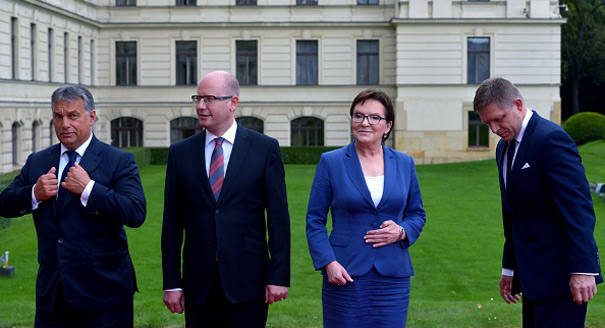
Experts from the Czech Republic, Hungary, Poland, and Slovakia explain the positions taken by their governments toward Europe’s refugee crisis.
The Czech, Hungarian, and Slovak governments have opposed the European Commission’s plans to redistribute refugees throughout the EU, causing a major rift inside the union. Poland, previously also against the proposals, has reluctantly changed its mind and will now accept its share of refugees.
Carnegie Europe asked experts from each of these four Central European countries, known as the Visegrád Group, to explain their government’s stance toward the refugee crisis.
Martin Ehl
The official position of the Czech government is that a quota system to redistribute refugees within the EU will not work because the Czech Republic is not a country in which refugees would like to stay so they will leave for Germany. As consequence, Germany would then seal its border with the Czech Republic anyway.

The problem for Czech politicians is their inability to explain these arguments to their partners in Europe. To a big extent, this is caused by politicians’ lack of knowledge about how EU politics work and their poor language skills. (This has become an issue. During a meeting of EU interior ministers on September 22, Milan Chovanec, the Czech interior minister, was sitting alone when the others chatted because he is not able to speak any language but Czech.) Furthermore, the Czech government hasn’t put on the table any alternative plan for dealing with the refugees.
On this topic, there is unique unity among the relevant political parties in Prague. Nobody wants to allow foreigners in, and the issue is starting to become a kind of political game: whichever party does the most to refuse the refugees will win the country’s next parliamentary election, due in 2017.
There is also a general feeling in Czech society that citizens should fear anything connected to Islam. That sentiment is driven by populist politicians, led by President Miloš Zeman.
Martin Ehl is a journalist for Hospodářské noviny, a Czech daily.
László Kontler
The refugee crisis has presented Hungary with a level of complexity and unfamiliarity that would have been hard for many governments to handle smoothly.

There can be no denying the fact that the Hungarian government was under an obligation to deal with the influx of migrants in conformity with the relevant EU regulations. However, Budapest made very little (if any) effort to facilitate this process. It has done a great deal to turn the images of crowds of indigent and aggressive foreigners swarming the country’s public spaces—pictures already conjured up in the government’s propaganda before the real outbreak of the crisis—into a self-fulfilling prophecy.
The crisis has also brought to surface another Hungary: that of civic organizations with activists and volunteers. Contrary to representations by government spokespersons and government-friendly media, these are not starry-eyed liberal idealists who are simply trying to soothe their consciences while blind to the possible risks and threats posed by the migration phenomenon. They are individuals motivated by compassion and solidarity who regularly participate in other forms of humanitarian help and who have prevented the refugee crisis from becoming a humanitarian catastrophe.
At the same time, the Hungarian government’s strategy has so far worked. The majority of its targets—sympathizers lost to the Far Right—seem to have been reconquered, and after a decline in the fall and winter of 2014–2015, the popularity of Prime Minister Viktor Orbán and his conservative Fidesz party has climbed back to where it had been before.
László Kontler is a professor of history and pro-rector at the Central European University in Budapest.
Jarosław Kuisz and Karolina Wigura
The position of the Polish government toward the refugees has been very unclear and hesitant in the past few weeks, because it has been determined mostly by the ad hoc political dispute unfolding in the run-up to the country’s October 25 parliamentary elections.

The Polish government first declared a policy of resistance to the proposals of some Western European countries to redistribute refugees within the EU. With this message, Kopacz went to Prague on September 4 for a meeting with her Central European counterparts convened by Viktor Orbán, the Hungarian prime minister.
Soon, however, the solidarity of the Visegrád Group began to fall apart, whereas the determination of most Western European countries on the refugee issue proved rather unshakable. As a result, the Polish government agreed to accept not only the 5,082 refugees assigned to Poland at a meeting of EU interior ministers on September 22 but also up to 2,500 more. One of the Polish ministers admitted honestly afterward, “Poland would anyway have been outvoted.”
Last but not least, the recent zigzags of the Polish government are a consequence of the problems of the generation of politicians who have been in power since 1989. Not only the refugee crisis but also revelations of secret U.S. Central Intelligence Agency prisons in Poland show that cynical pragmatism too often replaces solidarity and human rights, values that led Poland to its democratic breakthrough in 1989. Let’s hope the coming elections will change this a bit.
Jarosław Kuisz is the editor in chief of the Polish online weekly newspaper Kultura Liberalna. Karolina Wigura is the head of the political section of Kultura Liberalna.
Andrea Bilá
The reasons for the Slovak government’s stance toward the refugee crisis are mostly political. In the context of Slovakia’s upcoming parliamentary election, due by March 2016, and of significantly radicalized Slovak public opinion, the ruling center-left Smer-SD party seems to consider any condemnation of xenophobia or Islamophobia politically risky, as it could be perceived as a de facto concession to the EU’s common migration policy.

There are voices that oppose the government’s line. After 71 refugees were found dead in a truck close to the Slovak-Austrian border in August, several public personalities including Slovak President Andrej Kiska launched an initiative called Plea for Humanity, urging the government to draft an action plan for the crisis.
But it now seems clear that the Slovak government is using its populist and simplistic rhetoric, which consists of labeling the refugees at times as potential terrorists, at times as economic migrants, to manipulate public opinion.
Instead of presenting the quota system as a temporary solution, which would certainly lead to growing support for nationalists and radicals, Bratislava uses the momentum created by this issue to flex its muscles in Brussels and thus build its political capital.
In the meantime, issues like corruption scandals, economic discontent, and public frustration with the political establishment, which made front-page news only weeks ago, are slowly sinking into oblivion.
Andrea Bilá is a project manager for the fight against discrimination, racism, and xenophobia at the Open Society Foundation in Bratislava.

Nonresident Senior Fellow, Carnegie Europe
Judy Dempsey is a nonresident senior fellow at Carnegie Europe
Recent Work
Judy Dempsey
Judy Dempsey
Carnegie does not take institutional positions on public policy issues; the views represented herein are those of the author(s) and do not necessarily reflect the views of Carnegie, its staff, or its trustees.

The European Commissioner for Trade is headed to China. But after President Xi’s bridge-building visit to Washington, can a more isolated EU overcome Beijing’s stranglehold on critical raw materials? Who will blink first?

Rym Momtaz, ed.

The domestic impacts of how long it is taking to end the war in Ukraine have pushed the French electorate to the political extremes and compromised the country’s diplomatic capacity.
Rym Momtaz

Before the next wave of EU enlargement takes place, the union needs to grapple with thorny questions of how power is distributed among its members.


Emil Sondaj Hansen, Ditte Brasso Sørensen

A summer of escalation in the Black Sea has hurt Ukraine economically and is exacerbating world food security. A truce is needed—as is a broader reframing of Europe’s Ukraine strategy.

Thomas de Waal

Are Germany’s economic, industrial, and political struggles becoming a liability for the EU’s ability to rise to the geopolitical moment?
Rym Momtaz, ed.