

Commentary
Judy Dempsey
{
  "authors": [
    "Judy Dempsey"
  ],
  "type": "commentary",
  "blog": "Strategic Europe",
  "centerAffiliationAll": "",
  "centers": [
    "Carnegie Endowment for International Peace",
    "Carnegie Europe"
  ],
  "collections": [
    "Europe’s Eastern Neighborhood"
  ],
  "englishNewsletterAll": "",
  "nonEnglishNewsletterAll": "",
  "primaryCenter": "Carnegie Europe",
  "programAffiliation": "",
  "programs": [],
  "projects": [],
  "regions": [
    "Europe",
    "Eastern Europe",
    "Moldova"
  ],
  "topics": [
    "Democracy",
    "EU",
    "Civil Society"
  ]
}
Source: Getty
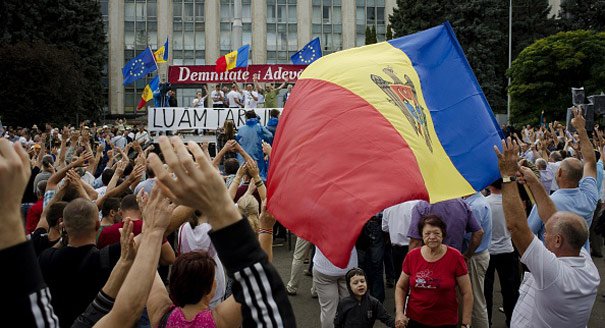
A new antigovernment protest movement against rampant corruption in Moldova might finally lead to real change in a politically rotten country.
Have the citizens of Moldova had enough of leaders who have consistently turned a blind eye to corruption?
Judging from the tens of thousands who over the past few days have taken to the streets of the capital, Chişinău, this may well be the case. And not before time for this small, poor country that is sandwiched between EU member state Romania and Ukraine and where, since the 1990s, Russia has been meddling in the breakaway region of Transnistria.
Moldova’s politics has for several years been seeped in corruption, and the country’s elites have resisted attempts to introduce any degree of transparency, accountability, or good governance.
The prime minister, millionaire businessman Valeriu Streleţ, who was appointed to head the government in July 2015, has shown no intention of tackling corruption, one of the main roots of Moldova’s ills. That would mean naming names, particularly of those who have refused to clean up Moldova’s banking system, or what is left of it.
Indeed, it is a banking scandal—or rather, a massive theft—that has finally broken the patience of the citizens. In November 2014, thieves stole $1 billion from three of the country’s banks through fraudulent loans and transfers.
Not that the government reacted swiftly to the theft. It was not until April 2015 that the full extent of the damage became clear, thanks to the speaker of the parliament, who leaked a report about the heist, which has been investigated by the security firm Kroll.
According to the report, the theft amounted to 8 percent of Moldova’s gross domestic product. The National Bank of Moldova stepped in and took over the insolvent banks. It injected $600 million, which it didn’t have. So it expanded the money supply. As a result, inflation soared, and to plug the deficit, electricity prices were increased by 30 percent.
In normal circumstances, the government should have launched an investigation in a bid to clean up the banking system and the financial sector. It did nothing of the sort. Throughout the summer, the political system and the economy were virtually paralyzed. Streleţ’s new government brought no reprieve.
It is not only #Moldova's citizens who are fed up with corruption.Tweet This
It is not only citizens who are fed up with the cover-ups and corruption. Moldova’s international lenders and donors, including the World Bank and the European Union, are taking stock of how to deal with the elites.
After many months—indeed, after several years—of trying to cajole the political elites into introducing major structural reforms, the World Bank recently withheld a $45 million loan. In July, the EU froze its financial and aid programs, which would have amounted to over €40 million ($45 million) for 2015. That’s a lot of money for a country with a gross domestic product of $7.9 billion in 2014. But then, ordinary Moldovans haven’t seen many tangible benefits of such aid.
Those who have had enough of the endemic corruption have left the country to find work in the EU. This has been made easier since the EU lifted its visa restrictions after Moldova signed what should have been a pathbreaking political and economic Association Agreement with the EU in June 2014.
Those who remain and who are not contaminated by the political system have now rallied around the pro-European Dignity and Truth. This civic platform, established in April, is seeking the resignation of President Nicolae Timofti and of those who head the country’s financial institutions. The movement is also calling for early parliamentary elections.
Parliamentary elections will not make a difference unless the nexus between the oligarchs and the elites is broken. In that sense, Moldova is a microcosm of Ukraine, where since the early 1990s, the poisonous relationship between the oligarchs and national and local elites has made it impossible to introduce reforms and modernize the state institutions.
There is a growing consensus that #Moldova's elites have no interest in reform.Tweet This
Precisely because Moldova is small—its population is 3.6 million—size should have been an advantage when it comes to modernizing the country and completing the transformation of this post-Communist state into one with a functioning market economy. But there is a growing consensus among the EU, the World Bank, and the European Bank for Reconstruction and Development that the elites have no interest in pushing ahead with reform.
The leaders of Dignity and Truth say the movement will remain a civic one and will not transform itself into a political party.
“Our platform will remain civic,” said Igor Boţan, a political analyst and senior figure in the group. “It will remain an informal organization, nongovernmental, that will try to always be on guard so that those who come to power in place of those who leave, and whom we will initially consider to be an improvement, don’t get off track and return to oligarchy and corruption,” he added.
It’s almost reminiscent of Ukraine’s pro-EU Maidan movement, which ousted the former president Viktor Yanukovych from power in February 2014. Ukraine’s civil society groups have had to keep pushing the government in Kiev to deliver on reform. In Moldova, Dignity and Truth also seems determined to pressure the elites to reform. Their struggle has only just begun.

Nonresident Senior Fellow, Carnegie Europe
Dempsey is a nonresident senior fellow at Carnegie Europe
Recent Work
Judy Dempsey
Judy Dempsey
Carnegie does not take institutional positions on public policy issues; the views represented herein are those of the author(s) and do not necessarily reflect the views of Carnegie, its staff, or its trustees.
The far right failed to win big in France’s municipal elections. But that’s not good news for the country’s left wing, which remained disunited while the broader right consolidated its momentum ahead of the 2027 presidential race.

Catherine Fieschi
Donald Trump has demanded that European allies send ships to the Strait of Hormuz while his war of choice in Iran rages on. He has constantly berated NATO while the alliance’s secretary-general has emphatically supported him.

Rym Momtaz, ed.
The EU is structurally incapable of reacting to today’s foreign policy crises. The union must fold the EEAS into the European Commission and create a security council better prepared to take action on the global stage.

Stefan Lehne
The war in Ukraine is costing Russia its leverage overseas. Across the South Caucasus and Middle East, this presents an opportunity for Europe to pick up the pieces and claim its own sphere of influence.

William Dixon, Maksym Beznosiuk
The war in Iran proves the United States is now a destabilizing actor for Europe and the Arab Gulf. From protect their economies and energy supplies to safeguarding their territorial integrity, both regions have much to gain from forming a new kind of partnership together.
Rym Momtaz