

Commentary
Gwendolyn Sasse
{
  "authors": [
    "Gwendolyn Sasse"
  ],
  "type": "commentary",
  "blog": "Strategic Europe",
  "centerAffiliationAll": "",
  "centers": [
    "Carnegie Endowment for International Peace",
    "Carnegie Europe"
  ],
  "collections": [
    "Europe’s Eastern Neighborhood"
  ],
  "englishNewsletterAll": "",
  "nonEnglishNewsletterAll": "",
  "primaryCenter": "Carnegie Europe",
  "programAffiliation": "",
  "programs": [],
  "projects": [],
  "regions": [
    "Europe",
    "Eastern Europe",
    "Ukraine"
  ],
  "topics": [
    "Democracy"
  ]
}
Source: Getty
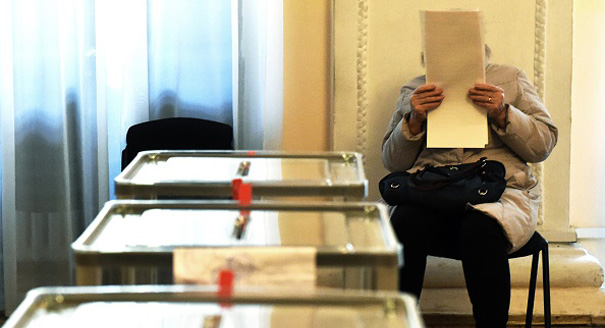
Even before the results of Ukraine’s recent local elections have been published, flawed conclusions are emerging from the postelection analysis.
There are no official results yet after the October 25 local and regional elections in Ukraine—due to the complexity of the vote, results are not expected until the end of this week. But several flaws have already crept into the election commentary.
The most prominent of these misinterpretations are the disappointment about the low turnout—currently estimated to be between 46 and 47 percent—and the strong showing of the Opposition Bloc in Ukraine’s southeastern regions. In fact, the turnout was typical of local elections across Europe (and well above U.S. midterm elections since 1970). Moreover, focusing only on the Opposition Bloc misses the new political diversity in the southeast.
On balance, then, the participation in Ukraine’s local elections was pretty impressive. According to the more detailed estimates so far, turnout varied between 51 percent in the west and 41–43 percent in the southeast, according to data by the NGO Opora.
Election participation in countries that are not deemed fully fledged democracies tends to be measured against ideal-type benchmarks rather than actual turnout in consolidated democracies. In fact, Ukraine fits neatly within Europe-wide trends when we compare like for like and ignore local elections that are held on the same day as national or European contests, combinations that boost turnout figures.
For example, the local elections in the German region of North Rhine-Westphalia in September 2015 recorded a turnout of 41 percent in the first round and 35 percent in the second round. Turnout in Germany’s latest regional elections varied between 48 and 73 percent across the regions. Here it is important to note that in contrast to Ukraine, Germany is a federal state with substantial regional powers, which again makes for higher average turnout levels. But at the lower end, the figures are surprisingly similar to Ukraine’s. Participation in the local elections in England in 2014 stood at 36 percent. Also in 2014, turnout in local elections in Poland was 47 percent; in Slovakia, 48 percent; and in Hungary, 44 percent.
The second misconception taking hold in Ukraine’s postelection commentary is linked to the revival of former president Viktor Yanukovych’s Party of Regions in the form of the Opposition Bloc. Former Yanukovych affiliates are definitely very visible in the southeast, but the key here is that the interests they represent never went away and are now regrouping in various ways through a number of loose party structures, of which the Opposition Bloc is the biggest and probably most internally diverse.
It is noteworthy that—just like in the parliamentary election—a wide range of parties and interests is now represented at different levels of government that traditionally did not have much of a presence in the eastern and southern regions. Among these forces are the parties of the current ruling coalition, including the president’s Petro Poroshenko Bloc, former prime minister Yulia Tymoshenko’s Fatherland party, and Self-Reliance, the party of Lviv Mayor Andriy Sadovyi.
These parties will have a presence in local and regional councils at a time when decentralization reforms are likely to afford them more power. This diversity of voices at the subnational level reflects an important shift in Ukraine’s political landscape.
Finally, while it is regrettable that there is plenty of evidence of vote buying and electoral fraud, in particular in the eastern regions, some of these issues at least became more apparent this time round, and there were cases in which the Central and Local Election Commissions acted swiftly to deal with irregularities. It would have been entirely unrealistic to expect completely clean local and regional elections in Ukraine. Here, Western reactions to the elections once again apply an ideal-type yardstick.
The analysis in the coming days of Ukraine’s latest election results should not be tainted by Western wishful thinking or the familiar lenses that the majority of observers have become accustomed to when discussing Ukrainian politics. Significant developments are under way in Ukraine: society has become more politically mobilized, the political landscape is being redefined across the country, and there are attempts at greater electoral transparency. It is important to recognize these positive changes amid the predominantly negative news cycle about Ukraine.

Nonresident Senior Fellow, Carnegie Europe
Gwendolyn Sasse is a nonresident senior fellow at Carnegie Europe. Her research focuses on Eastern Europe, with a particular focus on Ukrainian politics and society, EU enlargement, and comparative democratization.
Recent Work
Gwendolyn Sasse
Gwendolyn Sasse
Carnegie does not take institutional positions on public policy issues; the views represented herein are those of the author(s) and do not necessarily reflect the views of Carnegie, its staff, or its trustees.

Trump is distracted and Ukraine wants Europe to step up. The continent’s leaders must find their voice and assert it in talks with Russia.

Alissa de Carbonnel

Mounting economic strain and battlefield losses will not necessarily make the Kremlin less dangerous. They could instead push Moscow toward a more aggressive hybrid campaign designed to test NATO’s Eastern flank, exploit allied hesitation, and fracture European resolve.

Maksym Beznosiuk

Over the past ten years, NATO has held almost as many summits as it did during the entirety of the Cold War. Are they still useful, or is it time to stop holding annual meetings?

Rym Momtaz, ed.
Nearly a year and a half after Europeans leaned into sucking up to Trump, the strategy has produced some benefits when it comes to Ukraine.
Rym Momtaz
Far-right leader Marine Le Pen can—and will—run in France’s next presidential election. What does the outcome of her appeal against a 2025 embezzlement conviction mean for the country’s political future?
Catherine Fieschi