

Commentary
Judy Dempsey
{
  "authors": [
    "Judy Dempsey"
  ],
  "type": "commentary",
  "blog": "Strategic Europe",
  "centerAffiliationAll": "",
  "centers": [
    "Carnegie Endowment for International Peace",
    "Carnegie Europe"
  ],
  "collections": [
    "EU Integration and Enlargement"
  ],
  "englishNewsletterAll": "",
  "nonEnglishNewsletterAll": "",
  "primaryCenter": "Carnegie Europe",
  "programAffiliation": "",
  "programs": [],
  "projects": [],
  "regions": [
    "Europe",
    "Western Europe",
    "Germany"
  ],
  "topics": [
    "EU",
    "Security"
  ]
}
Source: Getty
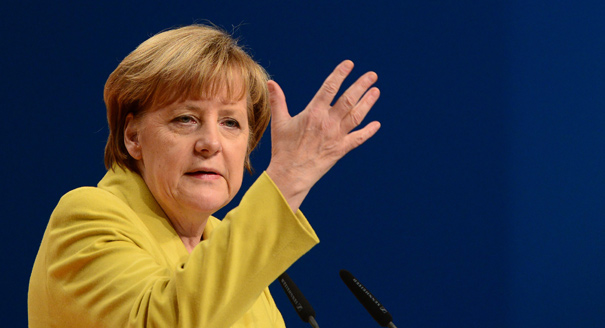
The German chancellor has the chance to change Europe and the transatlantic relationship. She should seize it.
Angela Merkel spent the beginning of her eleventh year as German chancellor in the Bavarian capital, Munich. By all accounts, it was not a very pleasant occasion. Europe’s most powerful leader had to endure snide remarks and criticism from the Christian Social Union, a regional party that just happens to rely on Merkel’s popularity to remain in power as part of Germany’s governing coalition.
The party’s leader, Horst Seehofer, has done everything possible to undermine Merkel as she faces the biggest challenge in her political career: a refugee crisis that has pitted Merkel against her own conservative bloc and against several EU countries.
More than ever before, Merkel needs Europe and vice versa. Merkel needs a stronger and more integrated Europe to deal with the conflicts and wars raging in its Eastern and Southern neighborhoods.
The wretched response by most EU countries to the refugee crisis not only shows a lack of humanity in face of the suffering of so many people. It also reveals an EU that does not function as a bloc willing to take and share responsibility.
Several EU leaders argue that the refugee crisis and its causes have nothing to do with Europe. Yet the EU’s mishandling of, if not indifference to, the huge refugee crisis in Lebanon and Jordan—not to mention its complete lack of strategy in dealing with the aftermath of the Arab Spring—implicates Europe, whether some leaders want to admit it not. A handful of EU countries, led by Germany, are now picking up the pieces of that shortsightedness.
Merkel could use the refugee crisis to push for more Europe. Her inclination to lean on the intergovernmental approach, with an emphasis on the EU’s member states rather than its institutions, has been one of her main weaknesses.
In retrospect, Merkel could not have relied on the European Commission, the EU’s executive, to steer the union through the euro crisis. She could not have relied on the commission to take the lead in imposing sanctions on Russia after its annexation of Crimea and its invasion of eastern Ukraine.
And she has seen how, despite his best intentions, European Commission President Jean-Claude Juncker has no powers to implement any decisions setting out how refugees should be shared out among the member states. The refugee crisis has shown that the EU does not work when it should; that nation-states take precedence on what is a Europe-wide issue.
Recent terrorist attacks in Europe are another indictment of how member states refuse to recognize the need for a united and strong response. In this context, Merkel could change the German narrative. If Merkel has so far been strong enough to rally EU countries to impose sanctions on Russia, she should be strong and confident enough to turn the EU from a soft-power bloc into one that is willing to use hard power to defend its values and its citizens.
As it is, there is not even a handful of EU countries willing to use hard power. It has fallen to France to use this approach. The attack on a luxury hotel in Bamako, the capital of Mali, on November 20—a week after the Paris attacks—showed how France has to pay the price for using hard power. In 2013–2014, France launched a military operation in Mali to oust Islamic militants in the north of the country.
But when did soft power alone achieve its goals or protect citizens? Would Iran’s leadership have sat down to negotiate a deal over the future of its nuclear program without the threat of hard power or the knowledge that the international sanctions against it would continue?
Germany cannot duck these issues, and not just because of the terrorist attacks. It is also because Berlin and the rest of Europe are witnessing the fraying of the transatlantic alliance. NATO has been passive over the refugee crisis when it could have helped the Western Balkan countries in providing security and assistance to the refugees.
NATO has been passive too over the terrorist attacks. It has shown no willingness to become involved in confronting the so-called Islamic State. This is understandable. NATO’s record in dealing with the day after an intervention has been far from stellar—all the more reason for the alliance to ask what its raison d’être is in the twenty-first century and how it should deal with real threats facing Europe.
European leaders, particularly Merkel, should realize that Europe needs a strong security and defense policy. Relying on one or a few member states to use hard power is not enough. Europe needs a security policy anchored to a panoply of hard- and soft-power tools.
This is not only about intelligence sharing and coordination, the lack of which has been known for some time by heads of the intelligence services in London, Paris, and other capitals. It is also about Europe thinking strategically. And for that to happen, it is time for EU governments to consider a security doctrine. It will require a major shift by Merkel to make that happen. It could define her second decade in power.

Nonresident Senior Fellow, Carnegie Europe
Dempsey is a nonresident senior fellow at Carnegie Europe
Recent Work
Judy Dempsey
Judy Dempsey
Carnegie does not take institutional positions on public policy issues; the views represented herein are those of the author(s) and do not necessarily reflect the views of Carnegie, its staff, or its trustees.
Montenegro and Albania are frontrunners for EU enlargement in the Western Balkans, but they can’t just sit back and wait. To meet their 2030 accession ambitions, they must make a strong positive case.


Dimitar Bechev, Iliriana Gjoni
Donald Trump has repeatedly bashed NATO and European allies, threatening to annex Canada and Greenland and deploring their lack of enthusiasm for his war of choice in Iran. Is this latest round of abuse the final straw?

Rym Momtaz, ed.
Donald Trump’s repudiation of NATO goes against the Make America Great Again vision of a U.S.-centered foreign policy. If the goal is to preserve the alliance by boosting Europe’s commitments, leaning into France’s vision is the most America First way forward.
Rym Momtaz
Hungarians head to the polls on April 12 for an election of national and European consequence. Three different outcomes are on the cards, each with their own implications for the EU.
Zsuzsanna Szelényi
The far right failed to win big in France’s municipal elections. But that’s not good news for the country’s left wing, which remained disunited while the broader right consolidated its momentum ahead of the 2027 presidential race.
Catherine Fieschi