

Commentary
European Commission President Ursula von der Leyen is about to give her annual address on the state of the EU. Here’s what she won’t—but should—say.
Rym Momtaz
{
  "authors": [
    "Daniel Keohane"
  ],
  "type": "commentary",
  "blog": "Strategic Europe",
  "centerAffiliationAll": "",
  "centers": [
    "Carnegie Endowment for International Peace",
    "Carnegie Europe"
  ],
  "collections": [],
  "englishNewsletterAll": "",
  "nonEnglishNewsletterAll": "",
  "primaryCenter": "Carnegie Europe",
  "programAffiliation": "",
  "programs": [],
  "projects": [],
  "regions": [
    "Europe",
    "Western Europe",
    "France"
  ],
  "topics": [
    "Security",
    "Military",
    "EU"
  ]
}
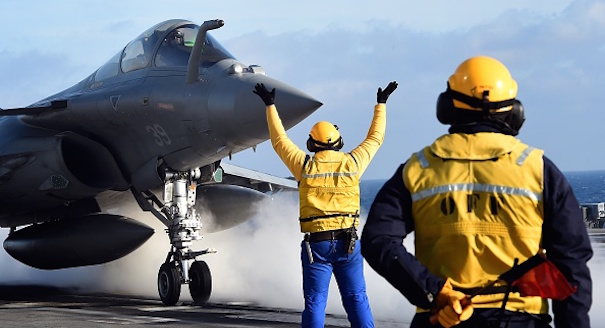
Source: Getty
Despite recent terrorist attacks by the so-called Islamic State, EU governments are unlikely to commit to deeper European military cooperation.
Following the November 13 terrorist attacks in Paris, France invoked the EU’s mutual-assistance clause, calling on European governments to help it counter the terrorist threat from the self-proclaimed Islamic State, including with military means. In recent years, France has been the most active European country fighting Islamist terrorists abroad (think Mali, Iraq, and Syria).
Paris is now intensifying its bombings of the Islamic State in Syria and Iraq and wants other EU governments to share more of its overall military burden, either by attacking the Islamists or by relieving French forces elsewhere, for example via EU or UN operations in Mali or Lebanon. But France may end up feeling—to paraphrase novelist Milan Kundera—the unbearable lightness of European defense. There are at least four reasons for this.
First, different European capitals have different political priorities, given the other major challenges the EU is currently enduring—namely, managing refugee flows and stabilizing the eurozone. Before the Paris attacks, many Europeans were weary and wary of foreign military interventions. This is understandable in light of the mixed experiences in Afghanistan, Iraq, and Libya since 2001.
Plus, fewer resources are available for external missions: according to figures from the European Defense Agency, EU defense budgets decreased by around 15 percent between 2006 and 2013, and the average number of soldiers EU governments sent abroad fell from about 83,000 in 2006 to just over 58,000 in 2013.
Second, Europeans suffer from a serious lack of strategic consensus. Some EU governments are more focused on territorial defense, others on expeditionary operations. In relative terms, only France and the UK can immediately do both simultaneously, and even they are struggling due to reduced resources. Russia’s 2014 invasion of eastern Ukraine bolstered this emerging divide by reinvigorating NATO’s core task of defending its members’ territory.
In contrast, external missions are the oxygen of EU defense policy, because in practice that policy forms part of EU foreign policy and plays no role in defending European territory from attacks by other states. Combined with preexisting public weariness of foreign wars and diminished defense budgets, the Ukraine crisis has been a shot in the arm for NATO but a shot in the leg for EU defense policy.
Third, there is an emerging geographic divide between those governments focused on the challenge of Russia and those concentrated on the threats emanating from the Middle East and North Africa. Compare, for example, last year’s 57-page Polish national security strategy, which contains half a sentence mentioning the Middle East, with the new Italian defense white book, which identifies the Mediterranean region as a priority.
It would be wrong, however, to assume that all those governments looking Eastward care only about territorial defense—consider Sweden’s robust reconnaissance role in NATO’s 2011 Libya intervention. Nor would it be right to think that those looking Southward care mainly about projecting force abroad. Spain and Greece, for instance, have contributed little to international operations in recent years.
Fourth, there are big divisions between the big three—France, Germany, and the UK—which collectively account for almost two-thirds of EU defense spending. In sum, Germany is reluctant to use robust military force abroad, Britain is reluctant to act militarily through the EU, and France is stuck in the middle.
However, while Germany currently seems unlikely to join the anti–Islamic State bombing campaign, it may increase its presence elsewhere to relieve French forces. The UK may join in bombing the Islamic State in Syria (it already does so in Iraq). But London is very unlikely to participate heavily in EU military operations: UK Prime Minister David Cameron does not want to give any impression of joining a Euro-army ahead of the referendum on Britain’s EU membership expected to take place during 2016.
For these four reasons, despite unanimous political support from the other 27 governments following the French invocation of the EU’s mutual-assistance clause, no one should expect a common EU military response to fighting the Islamic State. Nor does it seem likely that substantially more military resources will be sent to useful EU or UN operations elsewhere.
Atlanticists, however, should not gloat over the EU’s military weakness, because the European part of NATO depends on the same (un)willingness and (in)ability of the organization’s members to act: 22 EU countries are also members of the Atlantic alliance. A weak EU defense policy means a weaker NATO. This is the unbearable lightness of European defense.
It was not meant to be like this. When EU defense policy was formally launched in June 1999, the idea was that Europeans would up their military game by reforming their armed forces to be able to act without American help if necessary. Back then, the 15 EU member states could deploy and sustain only around 7–8 percent of their armed forces externally. Sadly, the same ratio holds true for today’s 28 EU countries.
Combined with a revisionist Russia, Middle Eastern disorder, and U.S. ambiguity, if the Paris attacks do not encourage EU governments to shed their unbearable lightness and commit to deeper European military cooperation, what will?
Daniel Keohane is a senior researcher at the Center for Security Studies—ETH Zürich.
Daniel Keohane

European Commission President Ursula von der Leyen is about to give her annual address on the state of the EU. Here’s what she won’t—but should—say.

Rym Momtaz

The aftermath of the Ceuta crisis shows Europe has drawn the wrong lessons. Rather than doubling down on failed migration policies, the EU needs to address the underlying roots of such episodes.

Richard Youngs

An overwhelming victory by a far-right-wing party in a small state in eastern Germany will have major repercussions for Chancellor Friedrich Merz’s coalition.

Judy Dempsey

Canadian Prime Minister Mark Carney has twice inspired praise for standing up to U.S. President Donald Trump: at the 2026 World Economic Forum in Davos and on Canada-U.S. trade negotiations. Is Carney showing a third way better than the EU has in dealing with the Trump administration?
Rym Momtaz, ed.

The EU’s responses to two recent incidents expose the gulf between European perceptions and capabilities. Unless the union can bridge that gap, it will never become a real geostrategic power.
Rym Momtaz