

Commentary
Before the next wave of EU enlargement takes place, the union needs to grapple with thorny questions of how power is distributed among its members.
Emil Sondaj Hansen, Ditte Brasso Sørensen
{
  "authors": [
    "Igor Boțan"
  ],
  "type": "commentary",
  "blog": "Strategic Europe",
  "centerAffiliationAll": "",
  "centers": [
    "Carnegie Endowment for International Peace",
    "Carnegie Europe"
  ],
  "collections": [
    "Europe’s Eastern Neighborhood"
  ],
  "englishNewsletterAll": "",
  "nonEnglishNewsletterAll": "",
  "primaryCenter": "Carnegie Europe",
  "programAffiliation": "",
  "programs": [],
  "projects": [],
  "regions": [
    "Europe",
    "Eastern Europe",
    "Moldova"
  ],
  "topics": [
    "Foreign Policy",
    "EU"
  ]
}
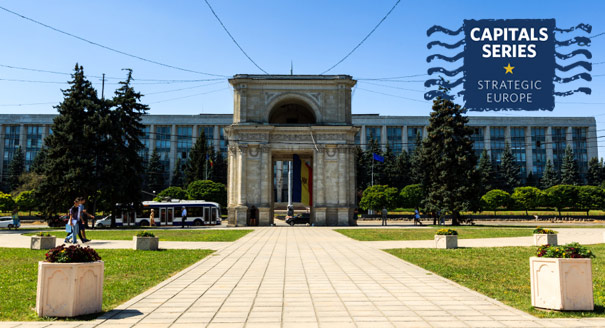
Source: Getty
In the last five years, Moldova has gone from success story to captured state. Any EU support for the country should be linked to the fight against corruption.
Strategic Europe continues the second phase of its Capitals Series exploring how EU foreign policy is viewed by six countries in Europe’s Eastern neighborhood. We have asked our contributors from each capital to give a candid assessment of the EU’s policies toward their country, with a ranking on a scale from “miserable” to “excellent.” This week, the spotlight is on Moldova.
*
In Moldova, corruption is endemic and systemic. It is entrenched in the government institutions and at every level of society. Corruption includes the state’s capture of key institutions to benefit private interests.

The case represented an extraordinary example of corruption, whose scale is unequaled in recent history. The amount that disappeared from the Moldovan banking system was equivalent to about 20 percent of the country’s GDP. The heist occurred after ten years of economic, financial, and political assistance from Moldova’s development partners. This aid was aimed in particular at the implementation of the 2005–2010 EU-Moldova Action Plan and at the preparation of Moldova’s signing of an Association Agreement with the EU in 2014.
When anticorruption experts consider that corruption in Moldova is endemic and systemic, it is worth understanding what makes Moldova different from other countries in the region, and how these particularities should be taken into account to efficiently fight corruption. A look at Moldova’s cultural, sociopolitical, and regional context helps explain the scale of the problem.
Moldova is part of the Orthodox Christian world, where large segments of the population are traditionally more tolerant toward so-called small corruption than in Roman Catholic or Protestant societies. The political culture of Moldova is deeply patriarchal, and an indulgent attitude toward the authorities persists.
According to surveys, about 90 percent of Moldovans have high confidence in the Orthodox Church, which maintains a very close relationship with the authorities. Moldova’s neighbor Romania is also part of the Orthodox world, but recently it managed to register significant successes in fighting corruption.

These civilizational and cultural aspects explain the perpetuation of relatively tolerant attitudes toward corruption: people condemn those who are corrupt but easily accept corruption deals to solve personal problems.
The sociopolitical changes of the post-Soviet period play a role too. This era has been marked by deep cleavages in Moldovan society based on ethnolinguistic, ideological, and geopolitical criteria. These factors were perceived as more important than fighting corruption and establishing the rule of law in a state with functioning institutions.
The post-Soviet era can be divided into four periods. First, from 1990 to 1993, the political scene was dominated by pro-Romanian and pro-Russian nationalists, who were romantic but unable to efficiently administer public affairs.
Second, the years 1993–2001 saw the rise of the pragmatic former Communist nomenklatura, composed mainly of ex-directors of collective farms. These administrators started a privatization process, transforming public property into private property. This was the period when corruption gained deep roots, but the existent ethnolinguistic cleavages prevented the public from observing and fighting corruption. Thus, the social divisions in Moldovan society deepened.
Third, the 2000s were dominated by the Communist party, which managed to convert people’s nostalgia for Soviet-style low but stable living standards into political gains. A new split in society emerged based on ideological criteria: Communist and anti-Communist. During the Communist party’s first mandate from 2001 to 2005, Moldova improved its socioeconomic situation due to regional economic growth and an agreement to be an active partner of the EU’s European Neighborhood Policy. After a relative success during its first term, the party started to slide toward authoritarian governance and oligarchization of power, mixing state affairs with the family business of the ruling party leader.
Finally, the period since 2009 has witnessed the emergence of businessmen who made their fabulous fortunes during so-called predatory privatizations and used their money to set up political parties or join preestablished parties to transform politics into business. The parties that set up the Alliance for European Integration, the ruling coalition from 2009 to 2013, managed to transform the governance of Moldova into a pure oligarchy. They politicized the state’s law enforcement and regulatory bodies and used these agencies for personal and clan enrichment.
During this time, the government paid lip service to the fight against corruption to secure the support of the country’s development partners and to reassure public opinion that European integration was Moldova’s strategic goal. The impact of this approach was a deep banking, financial, economic, political, and moral crisis in society, exemplified by the $1 billion bank robbery.
The regional geopolitical context plays a huge role in attempts both to fight corruption and to attenuate the pressure on a corrupt government by treating it indulgently.
The launch of the EU’s Eastern Partnership in 2009 and of Russia’s Eurasian Economic Union in 2011 placed Moldova between two poles of attraction. The effect has been that the split segments of Moldovan society now consist of two almost antagonistic blocs: pro-European and pro-Eurasian.
In these circumstances, the corrupt supposedly pro-European coalition claims that it is the guarantor of Moldova’s European integration and that those who criticize the coalition are in fact in favor of replacing European with Eurasian integration.
The problem is that the ruling parties are very rich because of their corrupt practices and their quasitotal control over the country’s administration and mass media. At the same time, the pro-European parties that are not represented in the parliament are very poor and lack the instruments to participate in equal, free, and fair electoral competitions.
Meanwhile, the pro-Eurasian political parties enjoy the financial and media support of Russia and could win the next parliamentary elections by exploiting current corruption scandals. The ruling coalition parties use this geopolitical argument to blackmail the pro-European electorate to diminish the pressure from voters and from the country’s development partners.
This is the story of Moldova’s evolution from the success story of 2010 to the captured state of 2015. What can the EU do? Any kind of EU support for Moldova should be strongly conditioned on the fight against corruption. In practice, the country’s law enforcement and regulatory institutions should be depoliticized. Perhaps then, corruption in Moldova can finally be tackled seriously.
Igor Boțan is the executive director of the Association for Participatory Democracy in Moldova.
Igor Boțan
Carnegie does not take institutional positions on public policy issues; the views represented herein are those of the author(s) and do not necessarily reflect the views of Carnegie, its staff, or its trustees.

Before the next wave of EU enlargement takes place, the union needs to grapple with thorny questions of how power is distributed among its members.


Emil Sondaj Hansen, Ditte Brasso Sørensen

A summer of escalation in the Black Sea has hurt Ukraine economically and is exacerbating world food security. A truce is needed—as is a broader reframing of Europe’s Ukraine strategy.

Thomas de Waal

Are Germany’s economic, industrial, and political struggles becoming a liability for the EU’s ability to rise to the geopolitical moment?

Rym Momtaz, ed.

European Commission President Ursula von der Leyen is about to give her annual address on the state of the EU. Here’s what she won’t—but should—say.
Rym Momtaz

The aftermath of the Ceuta crisis shows Europe has drawn the wrong lessons. Rather than doubling down on failed migration policies, the EU needs to address the underlying roots of such episodes.

Richard Youngs