
Carnegie Europe was on the ground at the 2016 Munich Security Conference, offering readers exclusive access to the debates as they unfolded and providing insights on today’s most urgent international issues. Check out our live coverage here.
*
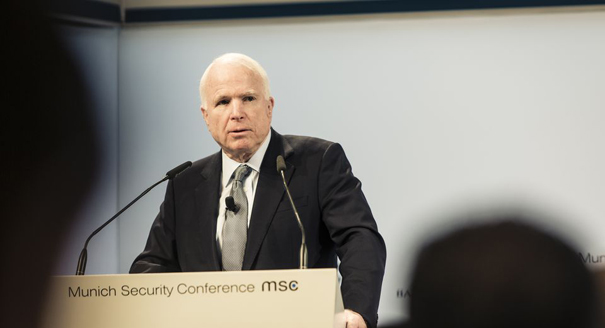
It was left to John McCain, U.S. Republican senator and chairman of the Committee on Armed Services, to spell out to the 2016 Munich Security Conference what was wrong with the West’s policies toward Syria. The West, McCain told participants during the closing session of the event on February 14, had no strategy for ending the war in Syria. It had no resolve.
This lack of strategy and resolve is having devastating consequences for Western policy and Western credibility. It is weakening the transatlantic alliance, and it is weakening the West’s courage and decency to deal with the refugee crisis.
Above all, the West is handing Russian President Vladimir Putin a prize he has relentlessly pursued: the undermining of the transatlantic alliance in such a way that he, not the West, can set the agenda for when and under what conditions Russia can be brought in from the cold.
This policy was tested in 2008 in Georgia, in 2014 in Ukraine, and now in Syria, where Russia is bombing the Syrian opposition and unequivocally supporting President Bashar al-Assad’s brutal regime. All the above should have been enough for the West to understand that Putin was using hard power to restore Russian might.
Yet U.S. and European diplomats, particularly the French and the Germans, now say they need Russia more than ever to help end the war in Syria. Forget that Russia’s attacks on civilians have led to more refugees trying to flee the country, with many wanting to reach Europe, and that Russia continues to bomb Aleppo despite the ceasefire plan to which world powers agreed on February 12. Precisely because Europe in particular has no coherent policy toward the refugees or terrorism, European weakness in handling these two crises works to Russia’s advantage.
Away from the main conference speeches, the other talk in Munich was about a return to diplomacy with Russia. Such a return would be premature and misguided because it would be based on Western weakness not strength.
German Chancellor Angela Merkel would not have been able to get Putin to agree to a ceasefire in eastern Ukraine without her determination to impose sanctions on Russia for its March 2014 annexation of Crimea and its invasion of parts of Ukraine’s east. The EU’s decision to roll over the sanctions when they came up for renewal in December 2015 represented rare unity, thanks to Merkel. But that unity is fraying, and fast.
France now sees Russia as an ally in fighting the so-called Islamic State, even though Russia is not bombing targets of the militant group in Syria. Merkel needs a ceasefire in Syria to reduce the flows of refugees to Turkey and Europe.
The logic of some European diplomats and German Social Democrats is that it might be time to consider lifting the sanctions—as if the measures could be linked to Russia’s bombing of Syria. This urge to return to diplomacy with Russia is supported by Federica Mogherini, the EU’s foreign policy chief, who is trying to restore a relationship with Russia.
With this weakening of European resolve, it is hard to know for how long Merkel can hold out on her policy toward Russia. As it is, she is being assailed from all sides—from criticism by her EU partners of her refugee policy to backstabbing by her members of her own coalition.
Merkel’s partners in government are prepared to compromise over Russia, as confirmed by recent visits to Putin in Moscow by Sigmar Gabriel, German vice chancellor and leader of the Social Democrats, and by Horst Seehofer, leader of the Christian Social Union, the Bavarian sister party of Merkel’s Christian Democratic Union. These diplomatic overtures by German politicians to Putin are not reciprocal, however, because the West is opening up a diplomatic front from a position of weakness. The West is not prepared to use leverage.
The Americans who were in Munich have admiration for Merkel but also despair at the way she is being undermined by her coalition and EU partners—all to Putin’s benefit. “She remains a source of conscience and resolve in our transatlantic alliance when we desperately need it,” McCain said. Yet for all that, she won’t be able to halt this move to engage Russia.
Indeed, Russia’s tactics amounted to “diplomacy in the service of military aggression,” McCain argued. “And it is working because we are letting it. The only deterrence that we seem to be establishing is over ourselves.” By establishing that kind of deterrence, the West is eschewing its interests and values.
Photo by MSC/Kuhlmann, used under CC BY 3.0 DE (cropped from original)


