
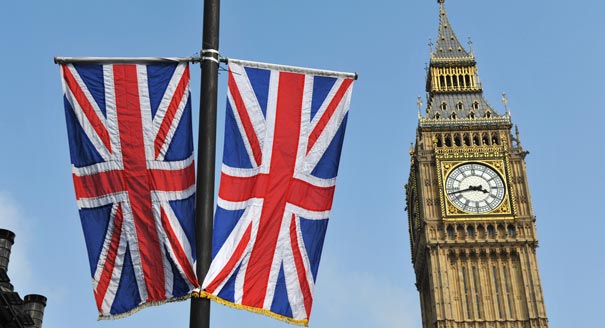
The possibility that Britain will leave the EU and the rise of populist movements across Europe are two topics that dominate many public and closed debates in the bloc’s capitals. The two issues are so closely linked that they could decide Europe’s ability to act strategically and establish strong and credible foreign and security policies.
A British vote at the June 23 referendum to leave the EU would be exploited by Euroskeptic parties in France, Germany, and the Netherlands, to name just three of the founding members of the bloc. In the wake of Brexit, Marine Le Pen, the leader of France’s far-right National Front, would be in a strong position to issue her list of demands from the EU if she chose to run a presidential election campaign on the basis of pulling France out of the bloc.
Other populist leaders who are anti-immigrant, anti-Muslim, and anti-EU could do the same. Being “anti” is what these leaders all have in common. What they want the EU to become is another matter. Few, if any, articulate how they see Europe’s future.
Martin Selmayr, who heads the cabinet of European Commission President Jean-Claude Juncker, recently tweeted what Brexit would mean:
#G7 2017 with Trump, Le Pen, Boris Johnson, Beppe Grillo? A horror scenario that shows well why it is worth fighting populism. #withJuncker
— Martin Selmayr (@MartinSelmayr) May 26, 2016
Selmayr writes that his tweets do not reflect the views of his boss—as if anyone would believe that. The fact that he wrote about what Europe could become if Britain left was a sobering reminder about the fragility of the EU, not to speak of its waning influence.
In the run-up to the British referendum, EU leaders have made a tacit pact not to tackle issues they believe would damage the Remain campaign. The EU’s long-awaited Global Strategy drawn up by EU foreign policy chief Federica Mogherini will be postponed in case of Brexit. Plans to revamp the EU’s defense policy that might even include the idea of establishing a European army have been shelved. Further enlargement of the EU is hardly mentioned. As for a more politically integrated EU, this has become a taboo subject—and not just because of the British referendum.
A closer, more integrated EU is anathema to populists and to British Prime Minister David Cameron. Yet to deal with the ever-present eurozone crisis, to tackle youth unemployment, and to give the EU the intelligence, security, and defense capabilities to protect its citizens, Europe needs more integration. No EU member state can afford to go it alone, despite what populists believe. Europe’s refugee and migration crisis has surely shown that.
Whatever the outcome of the British vote, these issues have to be put back on the table, particularly the need for Europe to have strong foreign and security policies. The continent’s future and stability depend on that.
Britain’s role in building such a policy has been ambiguous. It was Britain and France that together back in December 1998 forged the Saint-Malo accord. Against the background of the war in the former Yugoslavia, former British prime minister Tony Blair and former French president Jacques Chirac wanted Europe to have its own security and defense policies.
The EU, they said, “must have the capacity for autonomous action, backed up by credible military forces, the means to decide to use them, and a readiness to do so, in order to respond to international crises.” These were ambitious plans (later radically scaled back) for the EU to be able to have 60,000 troops at its disposal within months.
Then, in 2004, Britain and France had the great idea to create so-called battle groups. These groups were to be the answer to Europe’s notoriously slow response to crises and conflicts. The aim was to have these forces on standby for six months. They were supposed to be deployable within a few days and sustainable for thirty days. Nothing came of that either.
Not for want of trying, in 2010, Cameron and former French president Nicolas Sarkozy launched a new military cooperation accord. The plan was to contribute to more capable and effective forces and improve the collective capabilities of NATO and European defense. However, that cooperation was a snub to the EU, which over the years had failed to develop a credible security policy.
If Britain and France really wanted to give the EU strong security and defense policies, the pair could have worked hard inside the bloc to achieve this. Britain, however, has always opposed the idea of a strong EU defense policy, even going so far as to block plans for the EU to have its own military planning headquarters. As for France, it has been frequently disappointed with the level of support from its EU counterparts for its military operations in Africa.
The 2015–2016 terrorist attacks in Paris and Brussels are slowly changing the discourse among security and defense officials in the EU. Cameron now repeatedly states that Britain would be more secure if the country remained in the EU.
But the UK has yet to embrace strong EU security and defense policies. In other words, whatever the outcome of the British vote, the EU’s future depends on having vibrant and convincing foreign and security policies. Waiting for Britain to change course over this issue is no longer an option.


.png)


