

Commentary
Before the next wave of EU enlargement takes place, the union needs to grapple with thorny questions of how power is distributed among its members.
Emil Sondaj Hansen, Ditte Brasso Sørensen
{
  "authors": [
    "Irakli Menagarishvili"
  ],
  "type": "commentary",
  "blog": "Strategic Europe",
  "centerAffiliationAll": "",
  "centers": [
    "Carnegie Endowment for International Peace",
    "Carnegie Europe"
  ],
  "collections": [
    "Europe’s Eastern Neighborhood"
  ],
  "englishNewsletterAll": "",
  "nonEnglishNewsletterAll": "",
  "primaryCenter": "Carnegie Europe",
  "programAffiliation": "",
  "programs": [],
  "projects": [],
  "regions": [
    "Russia",
    "Eastern Europe",
    "Caucasus",
    "Georgia"
  ],
  "topics": [
    "Security"
  ]
}
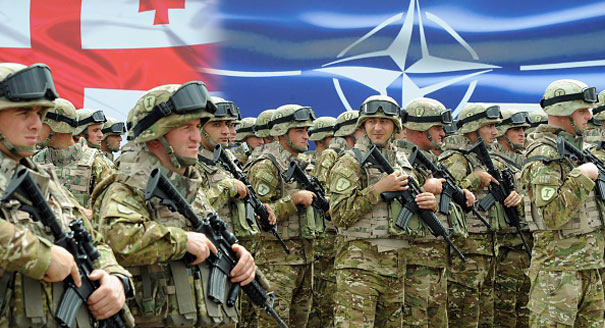
Source: Getty
Despite Georgians’ best efforts, some NATO allies do not seem ready to let the alliance bear its share of the responsibility for nurturing Georgia’s future.
As a Georgian, I welcome the strong words of the previous NATO secretary general published on Strategic Europe on May 6. Most Georgians agree completely with Anders Fogh Rasmussen’s statement that “those in the West should hold no illusions about Russia’s intentions and willingness to apply raw force.”
Unfortunately, however, Rasmussen’s piece did not continue to a logical conclusion. He could have noted that NATO’s recent decision to sign an Accession Protocol with Montenegro confirms that NATO membership is the best protection for vulnerable democracies against regional instability. Or he could have recalled similar offers in 2008 for Georgia and Ukraine—two countries that are truly under threat. Or he could have observed that those offers remain unfulfilled.
Indeed, if NATO had moved forward on Ukraine’s desire to join the alliance in 2008, would Russia would have dared to annex Crimea in 2014? The same could be asked about the 2008 Russian invasion of Georgia.
Equally important is the challenge that President Vladimir Putin’s Russia presents to Europe’s democratic future. Georgia and Ukraine have made a clear choice. The populations of these countries are deeply attached to Western values. Georgians and Ukrainians represent the promise that in Europe, democracy will not end at some imaginary line drawn between Russia and the West.
Europe’s credibility and values hinge on its commitment to fulfill the promise of NATO membership. Georgia is the only true success story of democratic transition in the strategic South Caucasus region. Georgia is a threat to no one. In fact, over the past four years Georgia has built a reputation of cooperation with all of its neighbors, including Russia. Georgians have been repeatedly praised by NATO, the EU, the Council of Europe, and others for their steady progress toward solidifying the first functioning democracy in the country’s history.
In recognition of this fact, in June 2014 the EU signed an Association Agreement with Georgia, described by Brussels as “a concrete way to activate the potential of EU-Georgian relations.” But despite Georgians’ best efforts, some NATO allies do not seem ready to allow the alliance to bear its part of the responsibility for nurturing Georgia’s future. Eight years after receiving the promise of membership at NATO’s 2008 Bucharest summit, Georgia has not even been offered a Membership Action Plan, the first very small step toward membership.
This raises several questions: Is NATO still committed to the realization of the democratic project that was defined as the foundation of the Western vision for Europe after 1990? Does democratic civil society remain the core of Western strategy, or is rebuilding diplomatic cooperation relations with Russia now the West’s first goal?
Similarly, are the nations of the South Caucasus still considered organic parts of the European project? Or are they a faraway corner whose democratic dreams have become a hindrance to Europe’s wider geostrategic interests with Russia?
The answers to these questions will be essential for defining Georgia’s national future. As a part of the Western community, Georgia will prosper. As a distant partner, the country will always live under the threat of Russian aggression. Without a clear and strong Western commitment to Georgia’s democratic future, Russia will continue to tear at the country’s social fabric, as it does today.
I count myself among the politicians who aligned Georgia with its Western partners after the fall of the Soviet Union in spite of the enormous difficulties of the time. Georgia still had to deal with political and economic chaos, but those of us in power managed to convince our fellow citizens to believe in Georgia’s European and Euro-Atlantic future and to support this choice as a strategic national goal. Now, for NATO to refuse once again to offer Georgia a chance to achieve even a Membership Action Plan would confirm to Russia that the West always gives in to Russian pressure tactics.
Georgia seeks pragmatic and friendly relations with Russia, but Russia now claims to represent a different vision of humankind and wishes to set up a new Eurasian community that does not represent European values. Georgians cannot allow themselves to be consigned to an ill-defined buffer between Russia and Europe.
By threatening the sovereignty and territorial integrity of democratic nations, revisionist Russia both calls into question these countries’ destinies and poses a threat to the democratic pan-European project. Here, the only correct and effective response is rigorous and clear support for the choices of these nations. The time has come for NATO to make a decision.
Irakli Menagarishvili is a former foreign minister of Georgia.
Irakli Menagarishvili
Carnegie does not take institutional positions on public policy issues; the views represented herein are those of the author(s) and do not necessarily reflect the views of Carnegie, its staff, or its trustees.

Before the next wave of EU enlargement takes place, the union needs to grapple with thorny questions of how power is distributed among its members.


Emil Sondaj Hansen, Ditte Brasso Sørensen

A summer of escalation in the Black Sea has hurt Ukraine economically and is exacerbating world food security. A truce is needed—as is a broader reframing of Europe’s Ukraine strategy.

Thomas de Waal

Are Germany’s economic, industrial, and political struggles becoming a liability for the EU’s ability to rise to the geopolitical moment?

Rym Momtaz, ed.

European Commission President Ursula von der Leyen is about to give her annual address on the state of the EU. Here’s what she won’t—but should—say.
Rym Momtaz

The EU’s responses to two recent incidents expose the gulf between European perceptions and capabilities. Unless the union can bridge that gap, it will never become a real geostrategic power.
Rym Momtaz