
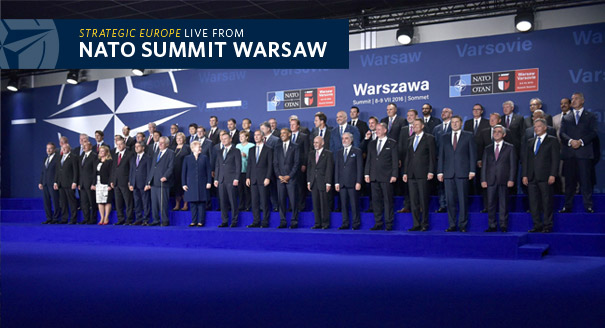
Carnegie Europe was on the ground at the NATO summit in Warsaw, offering readers exclusive access to the high-level discussions as they unfolded. See our live coverage here.
*
NATO has set out in 139 points a complex list of ambitions that raises many questions about the alliance’s ability to be ubiquitous and effective in an increasingly complex security environment. The communiqué issued on the second and final day of NATO’s July 8–9 summit in Warsaw took many months to agree on and was only finally penned during the closing stages of the gathering of alliance leaders.
The very length of the text, reckoned to be one of the longest communiqués in the history of NATO, showed just how seriously the alliance has to adapt itself to the changing geostrategic environment that affects its members, its Eastern and Southern neighborhoods, and also Afghanistan and Iraq. In all these areas, NATO has pledged to become engaged in some way.
Point 5 of the communiqué sets the tone for the document. “There is an arc of insecurity and instability along NATO’s periphery and beyond,” it states. “The Alliance faces a range of security challenges and threats that originate both from the east and from the south; from state and non-state actors; from military forces and from terrorist, cyber, or hybrid attacks.”
These threats affect the safety and security of citizens. That has spurred the alliance to try to adapt to circumstances that have radically changed even since NATO’s last summit in Wales in September 2014.
NATO has set several main tasks. It will step up its defense of Poland and the Baltic states to the north and of Romania and Bulgaria to the south in response to Russia’s 2014 annexation of Crimea and invasion of parts of eastern Ukraine.
The communiqué stresses that the “Alliance does not seek confrontation and poses no threat to Russia. But we cannot and will not compromise on the principles on which our Alliance and security in Europe and North America rest. NATO will continue to be transparent, predictable and resolute.” But it is clear that any sustained defense of these NATO members will depend on the level of capabilities and political commitment. That’s already a challenge in itself.
Farther afield, NATO will remain in Afghanistan, where it will increase its training of the Afghan security forces. It will also play a role in advising the Iraqi government on training and security issues. As for Libya, NATO has not ruled out some kind of military or training role. But the alliance is extremely reluctant to become embroiled in the conflict there.
There are many other regions where NATO will become or will continue to be involved. The alliance will support the EU in dealing with the migration crisis in the Aegean Sea and deepen its relations with partner countries, particularly Jordan and the states of North Africa, through training programs. In fact, there is hardly a country in NATO’s Eastern or Southern neighborhood with which it does not now have some kind of relationship.
With such a plethora of challenges and tasks, NATO has no illusions that it cannot go it alone. The accord between NATO and the EU forged in Warsaw has the potential to complement the hard-power and soft-power characteristics of the two organizations. NATO’s wish to work more closely with the African Union shows the need to cooperate with and strengthen regional players.
But above all, what the NATO communiqué reveals is the ever-increasing complexity of security. Bringing about security or stability, ending conflicts, and preventing states from becoming failed entities are no longer possible with the tools of hard or soft power (as if they ever were). Globalization has changed the entire dynamics of security. The onslaught of cyberwar and hybrid warfare, disinformation, terrorism, asymmetric threats, and migration has been thrust on NATO and, indeed, on the EU.
NATO’s communiqué certainly doesn’t shy away from the list of threats and challenges it has to address. But NATO’s top brass must know that the alliance is going to require a completely different mind-set. It is also going to require a completely different political culture—one based no longer on reaction but on agility and strategic flexibility—to deal with these challenges. And NATO is going to need a set of new intelligence tools if it really does want to make a difference.


