

Commentary
Judy Dempsey
{
  "authors": [
    "Judy Dempsey"
  ],
  "type": "commentary",
  "blog": "Strategic Europe",
  "centerAffiliationAll": "",
  "centers": [
    "Carnegie Endowment for International Peace",
    "Carnegie Europe"
  ],
  "collections": [],
  "englishNewsletterAll": "",
  "nonEnglishNewsletterAll": "",
  "primaryCenter": "Carnegie Europe",
  "programAffiliation": "",
  "programs": [],
  "projects": [],
  "regions": [
    "Europe",
    "Eastern Europe",
    "Western Europe",
    "Russia"
  ],
  "topics": [
    "EU",
    "Security"
  ]
}
Source: Getty
Brexit, the refugee crisis, and the instability along Europe’s borders should be enough to remind Europeans about the shocking past upon which the EU was built.
Halfway through Martin Pollack’s haunting book, Kontaminierte Landschaften (in English, “Contaminated Landscapes,”) the author recounts spending a quiet day in his garden.
Digging away to clear the place of weeds, Pollack, an Austrian, unearthed a fork. He brushed it off. It had the emblem of the Nazi SS, the armed military wing of the Nazi party. It triggered lots of questions about this small landscape. Who owned it? How did it get there?
This small example of uncovering the past is nothing compared to Pollack’s determined attempts to discover and explain what lies not so deep—but certainly forgotten, unclaimed, or purposely covered up—throughout the lands of Europe.
The lands of Europe are contaminated.
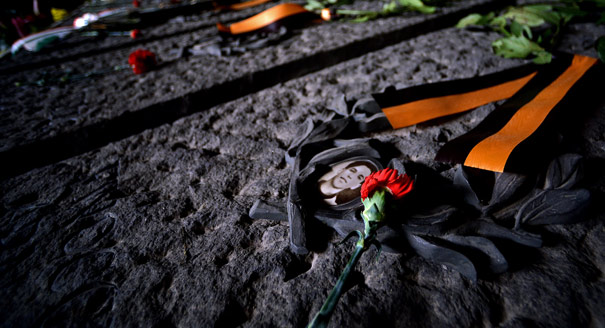
From the former Yugoslavia to Ukraine, which Pollack treks across relentlessly, post-World War II Europe has been constructed on unmarked mass graves. There are no headstones for the many tens of thousands who were flung into these pits. Nothing. Instead, Pollack found anonymity and often amnesia on the part of the locals and regional authorities.
Pollack, who has spent decades as a journalist and author, recounts how some villagers shied away from his questions about what happened while others gave matter-of-fact accounts of what they saw: people being shot by either Nazis, or Russians, or Croatia’s Ustasha—to name but a few of the perpetrators.
Witnesses spoke of the Jews in northern Bessarabia being rounded up and murdered by Romanian troops. Pollack describes his visits to villages with unmarked graves. He cites those who have tried, similar to him, to put this past into the present by arguing that these murders, small or mass, need to be dug up; they need to be remembered.
Pollack, who I first met nearly 30 years ago ago in one of his favorite, less-well-known coffee houses in Vienna and who was already engrossed in Central Europe, describes a place in a forest near Lviv, in western Ukraine, where the Germans killed 90,000 Jews. There was no plaque to commemorate those who were murdered.
Pollack writes mostly about what happened during World War II and its aftermath. He is best at how he asks villagers and survivors what they saw and how they feel today. Memory serves some well in their wish to deal with the past; others don't want to know or be disturbed in any way. As Pollack shows, memory can be selective, or distorted, or crystal clear.
Pollack doesn't set out to judge. Indeed, toward the end of this short book he asks if we should bother opening up the past. Is it really worth it? Is it better to let the past ebb away? It’s clear where Pollack stands. Otherwise, he wouldn’t have spent so much of his adult life writing about the forgotten, killed, or dying communities of Central Europe.
This book, which will hopefully find its way into English translation, is also about contemporary Europe.
Pollack contrasts his approach to Europe and the past through the prism of war, of suffering, of a time when Europe was being devoured by Nazism and Communism. The extraordinary support of the British, and the Americans, and anti-Nazi movements salvaged Europe from dictatorship.
Today’s Europe is wedded to short-termism, increasingly to sound bites about history.
What is forgotten is that the EU was built on the ruins of World War II, on the destruction of European Jewry, and on the unmarked mass graves of innocent people who either opposed the Nazis or Stalin’s ruthless regime. These graves are dotted all over the continent. Pollack’s book is important, especially as European populist leaders select their own version of the past.
Kontaminierte Landschaften was published in German by Residenz Verlag in February 2014.

Nonresident Senior Fellow, Carnegie Europe
Judy Dempsey is a nonresident senior fellow at Carnegie Europe
Recent Work
Judy Dempsey
Judy Dempsey
Carnegie does not take institutional positions on public policy issues; the views represented herein are those of the author(s) and do not necessarily reflect the views of Carnegie, its staff, or its trustees.

The European Commissioner for Trade is headed to China. But after President Xi’s bridge-building visit to Washington, can a more isolated EU overcome Beijing’s stranglehold on critical raw materials? Who will blink first?

Rym Momtaz, ed.

The domestic impacts of how long it is taking to end the war in Ukraine have pushed the French electorate to the political extremes and compromised the country’s diplomatic capacity.
Rym Momtaz

Before the next wave of EU enlargement takes place, the union needs to grapple with thorny questions of how power is distributed among its members.


Emil Sondaj Hansen, Ditte Brasso Sørensen

A summer of escalation in the Black Sea has hurt Ukraine economically and is exacerbating world food security. A truce is needed—as is a broader reframing of Europe’s Ukraine strategy.

Thomas de Waal

Are Germany’s economic, industrial, and political struggles becoming a liability for the EU’s ability to rise to the geopolitical moment?
Rym Momtaz, ed.