

Commentary
Judy Dempsey
{
  "authors": [
    "Judy Dempsey"
  ],
  "type": "commentary",
  "blog": "Strategic Europe",
  "centerAffiliationAll": "",
  "centers": [
    "Carnegie Endowment for International Peace",
    "Carnegie Europe"
  ],
  "collections": [
    "EU Integration and Enlargement"
  ],
  "englishNewsletterAll": "",
  "nonEnglishNewsletterAll": "",
  "primaryCenter": "Carnegie Europe",
  "programAffiliation": "",
  "programs": [],
  "projects": [],
  "regions": [
    "Europe",
    "Eastern Europe",
    "Western Europe"
  ],
  "topics": [
    "EU",
    "Security",
    "Military"
  ]
}
Source: Getty
The idea that the EU should have its own army lacks all credibility—and besides, it is no panacea to Europe’s glaring security and intelligence deficits.
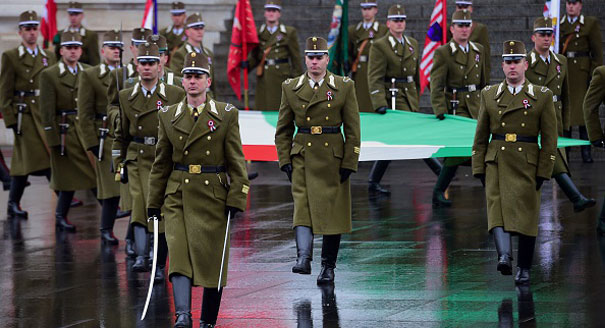
The Visegrád countries believe it’s time for the European Union to have its own army. The Visegrád Four, which consist of the Czech Republic, Hungary, Poland, and Slovakia, had already been toying for some time with the idea of having their own battle group. These battle groups, first conceived in 2003 by Britain and France to provide the EU with flexible forces that could deploy rapidly, do little else except train.
So the idea that the Visegrád countries are now pushing for the EU to have its own army when they can’t even mobilize a battle group lacks all credibility. Indeed, the calls are half-baked if not insincere. The EU is not going to have its own army, not least in the near future, for the following reasons.
First, the Visegrád Four leaders are linking the existence of a European army to internal security. Bohuslav Sobotka, the Czech prime minister, said that “only EU-wide armed forces will allow us to defend our interests on our own.” He was keen to insist that such an army would not compete with NATO. However, he added, an EU military force should become “a more actionable and reliable partner”—as if NATO wasn’t anything but reliable. None of the Visegrád leaders has asked about the use of hard power or whether an EU army should be used for missions outside the bloc.
Second, there has been no discussion about how such an army would be established. As it is, it has been extremely difficult for the EU member states to pool military resources and reduce duplication of military capabilities. The European Defense Agency, which was set up precisely to share resources, has had an uphill struggle to achieve its goal. Just imagine the politics of setting up an EU army.
Consider too how an army would be financed. Finance ministers would be loath to pour money into such a force. Even when it comes to funding NATO, finance ministries try and hold on to every cent when allocating funds to their NATO allies.
And then how would the army be commanded? Britain opposed the idea of creating a EU military headquarters. But to believe that Britain’s decision to leave the EU now opens the door to both a headquarters and an army is naive.
With or without Britain, EU member states are going to fight tooth and nail to control their own armies. National parliaments will also continue to play a major role when it comes to deciding where soldiers should be sent. Member states would be very reluctant to cede any substantial powers related to defense to the European Commission—the EU executive—or to the European Council, which represents the member states.
Finally, the calls for a European army have become confused with the refugee crisis, terrorism, and the security of the EU’s external borders. It’s as if an EU army would be used to protect Europe’s frontiers. If the Visegrád countries really want to make a serious contribution to Europe’s security, they should focus on intelligence sharing and cybersecurity and leave the EU army for another time.

Nonresident Senior Fellow, Carnegie Europe
Judy Dempsey is a nonresident senior fellow at Carnegie Europe
Recent Work
Judy Dempsey
Judy Dempsey
Carnegie does not take institutional positions on public policy issues; the views represented herein are those of the author(s) and do not necessarily reflect the views of Carnegie, its staff, or its trustees.

Trump is distracted and Ukraine wants Europe to step up. The continent’s leaders must find their voice and assert it in talks with Russia.

Alissa de Carbonnel

Mounting economic strain and battlefield losses will not necessarily make the Kremlin less dangerous. They could instead push Moscow toward a more aggressive hybrid campaign designed to test NATO’s Eastern flank, exploit allied hesitation, and fracture European resolve.

Maksym Beznosiuk
Over the past ten years, NATO has held almost as many summits as it did during the entirety of the Cold War. Are they still useful, or is it time to stop holding annual meetings?

Rym Momtaz, ed.
Nearly a year and a half after Europeans leaned into sucking up to Trump, the strategy has produced some benefits when it comes to Ukraine.
Rym Momtaz
Far-right leader Marine Le Pen can—and will—run in France’s next presidential election. What does the outcome of her appeal against a 2025 embezzlement conviction mean for the country’s political future?

Catherine Fieschi