

Commentary
Judy Dempsey
{
  "authors": [
    "Judy Dempsey"
  ],
  "type": "commentary",
  "blog": "Strategic Europe",
  "centerAffiliationAll": "",
  "centers": [
    "Carnegie Endowment for International Peace",
    "Carnegie Europe"
  ],
  "collections": [],
  "englishNewsletterAll": "",
  "nonEnglishNewsletterAll": "",
  "primaryCenter": "Carnegie Europe",
  "programAffiliation": "",
  "programs": [],
  "projects": [],
  "regions": [
    "Russia",
    "Europe",
    "Western Europe",
    "Germany"
  ],
  "topics": [
    "EU",
    "Security",
    "Economy",
    "Climate Change"
  ]
}
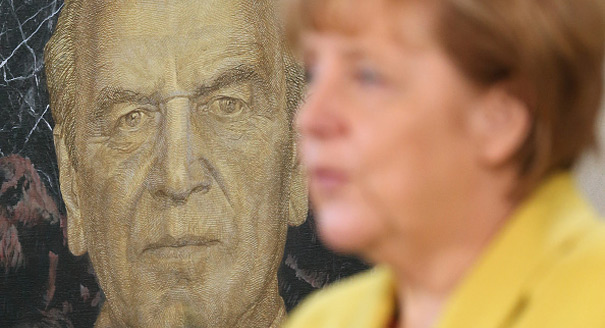
Source: Getty
The future of a controversial Russian gas pipeline rests with the German chancellor and her predecessor.
An unlikely coalition is emerging in Germany between Chancellor Angela Merkel’s conservative Christian Democrats and the opposition Greens. Increasingly, leading members of both parties want to stop the construction of a second pipeline that will transport gas directly from Russia to Germany under the Baltic Sea.
For the parliamentarians, it is politics not economics that is driving their opposition to Nord Stream 2, an additional pipeline to the original Nord Stream venture. Why, they ask, should a group of European energy companies finance a Russian project and import Russian gas that in effect pays for President Vladimir Putin’s military campaign in Syria and his meddling in Ukraine?
In a lengthy analysis in the Frankfurter Allgemeine Zeitung, politicians Norbert Röttgen, a Christian Democrat who chairs the German parliament’s foreign affairs committee, and Reinhard Bütikofer, a senior German Green in the European Parliament and co-chair of the European Green Party, are quoted as saying the project should be scrapped on moral and political grounds.
The party that continues to support the venture is the Social Democratic Party, Merkel’s coalition partner. And the person ensuring that the Social Democrats do not waver in their support is former German chancellor Gerhard Schröder.
Schröder was recently appointed chairman of the board of Nord Stream 2. Like the original Nord Stream, the new pipeline is being built by Gazprom, the Russian state-owned energy giant, along with a consortium of Western European energy companies. The group consists of Austria’s OMV, France’s Engie, Germany’s Uniper and Wintershall, and the Anglo-Dutch firm Shell. Once operational—scheduled for 2019—the pipeline will carry 55 billion cubic meters (1.9 trillion cubic feet) of gas a year to Germany.
The agreement to build the first Nord Stream pipeline was signed in 2005 when Schröder was chancellor. During his time in the Chancellery, from 1998 to 2005, he struck up a very close relationship with Putin. Shortly after Schröder lost the 2005 parliamentary election to Merkel, he joined the Nord Stream board, essentially becoming Gazprom’s—and Putin’s—most prominent lobbyist for Russian energy and political interests in Germany.
Despite strong opposition from Poland and the Baltic states, the first pipeline was built. Poland’s main objection was not the fact that it would lose transit fees for transporting Russian gas across its territory to Western Europe. It was the fact that the new gas pipeline would make Europe more dependent on Russian gas imports. It would undermine the EU’s plans for energy security. And it would make a mockery of European attempts to diversify its energy sources.
While Poland did succeed in putting the issue of energy security high on EU’s agenda, it couldn’t stop Nord Stream. It is trying again with Nord Stream 2, this time through the country’s antitrust office. In July 2016, the Polish Office of Competition and Consumer Protection refused to approve the notification in Poland of a joint venture to construct and operate the new pipeline on the grounds that Nord Stream 2 would restrict competition in gas supplies.
The consortium seemed to shrug off such attempts to derail the pipeline. “The applicants have decided to jointly withdraw their merger control notification from the Polish competition authority,” according to a statement by the Nord Stream 2 consortium. The group added that the project would in any case go ahead.
It is now up to the European Commission, the EU’s executive, to decide whether the offshore and onshore parts of Nord Stream 2 comply with the bloc’s third energy package, which aims to create a single EU gas and electricity market. Essentially, competitors must have access to pipelines.
The commission’s views matter. Gazprom dropped plans to build the South Stream pipeline, which would have brought gas to Southeast Europe via pipelines built under the Black Sea. Because the Russian firm would not open the pipeline to competitors, it had to ditch the increasingly expensive project.
What happens in Berlin also matters hugely. Merkel could stop Nord Stream 2. She has already defended it as a purely economic venture even though the project has become intensely political. Conservative and Green parliamentarians suggest Merkel is reluctant to step into the fray because she has to keep the Social Democrats on board.
But it is hard to see the Social Democrats jumping ship with just less than a year to go before Germany’s next parliamentary election. With their own party struggling in the polls and amid uncertainty over whether their lackluster leader, Sigmar Gabriel, will last long enough to stand against Merkel, the Social Democrats are in a very weak position.
Not only that. Younger Social Democrats oppose Nord Stream 2 as much as Putin’s domestic and foreign policies. But they are still in a minority. Gabriel, who in 2015 told Putin he would ignore any EU ruling on Nord Stream 2, has not changed course. One reason is that Schröder still exerts immense influence over the Social Democrats.
Another reason is the hankering after Ostpolitik—Germany’s former policy of rapprochement toward Moscow—based on the belief that big economic deals between Germany and Russia will bind Russia to Europe and positively influence the country’s political and economic direction. That has clearly not happened.
Which begs the question why Merkel continues to support Nord Stream 2 as more Christian Democrats and Greens speak out against the project. It’s a puzzling policy that damages Germany’s standing among its Eastern neighbors, undermines European energy security, and increases Germany’s dependence on Russian gas.

Nonresident Senior Fellow, Carnegie Europe
Judy Dempsey is a nonresident senior fellow at Carnegie Europe
Recent Work
Judy Dempsey
Judy Dempsey
Carnegie does not take institutional positions on public policy issues; the views represented herein are those of the author(s) and do not necessarily reflect the views of Carnegie, its staff, or its trustees.

With its public finances in shambles, the far right polling at 35 percent ahead of the 2027 presidential election, and a growing protest movement, is France’s crisis a threat to the EU’s geopolitical awakening?

Rym Momtaz, ed.

Ahead of a tough winter for Ukraine, Donald Trump’s swing back toward Russia bodes ill. But instead of panicking, Kyiv’s European allies are focusing on action.
Rym Momtaz

While the EU and European governments are embracing the much-lauded middle-power moment, this entails three difficult conundrums.

Richard Youngs

Much has been said of the changes Brussels is trying to make to the EU enlargement process. Here’s why gradual integration might—or might not—be the answer.

Dimitar Bechev

The European Commissioner for Trade is headed to China. But after President Xi’s bridge-building visit to Washington, can a more isolated EU overcome Beijing’s stranglehold on critical raw materials? Who will blink first?
Rym Momtaz, ed.