

Commentary
Gwendolyn Sasse
{
  "authors": [
    "Gwendolyn Sasse"
  ],
  "type": "commentary",
  "blog": "Strategic Europe",
  "centerAffiliationAll": "",
  "centers": [
    "Carnegie Endowment for International Peace",
    "Carnegie Europe"
  ],
  "collections": [
    "Europe’s Eastern Neighborhood"
  ],
  "englishNewsletterAll": "",
  "nonEnglishNewsletterAll": "",
  "primaryCenter": "Carnegie Europe",
  "programAffiliation": "",
  "programs": [],
  "projects": [],
  "regions": [
    "Europe",
    "Eastern Europe",
    "Ukraine"
  ],
  "topics": [
    "Political Reform",
    "EU"
  ]
}
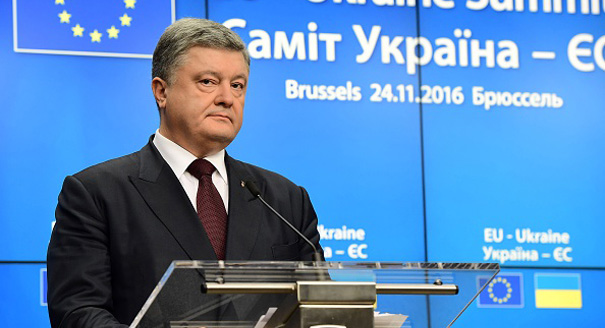
Source: Getty
Visa-free access to EU countries is a major attraction for Ukrainians. But delays in the process risk eroding the much-needed support of pro-EU movements in Ukraine.
One of the agenda items at the annual EU-Ukraine summit in Brussels on November 24 was visa liberalization. Visa-free access to EU countries is one of the biggest incentives for Ukrainians—not just for the political and economic elites, but for a significant cross-section of the Ukrainian population at large. As a result, it has also been one of the concrete issues on which the EU has managed to exercise conditionality to incentivize reforms in its neighborhood.
However, the timetable for implementing visa liberalization for Ukraine remains unclear after the summit. The process has now reached a point where a delay in implementation would incur political costs—both in Ukraine and in Ukraine’s relations with the EU.
The issue of visa liberalization has been on the agenda of EU-Ukraine relations for a long time. A Visa Liberalization Dialogue with tailor-made action plans was put in place for each of three Eastern Partnership countries: Ukraine (2008), Moldova (2010), and Georgia (2012). These dialogues have structured the process of aligning the countries’ internal security, border management, migration and asylum policies, and public order with EU norms in return for the promise of lifting visa restrictions.
In Ukraine, the issue gained further prominence after the 2013–2014 Euromaidan antigovernment protests. It has practical and symbolic value for Ukrainians and has been a fairly successful external lever for reform. Ukraine’s last big anticorruption measure tied to visa liberalization was the implementation of an electronic system for public officials to declare their personal assets.
EU conditionality evolves and is therefore prone to inconsistencies over time. However, stretching one particular incentive by tying it to an expanding reform agenda is a process that has its natural limits. One can only add so many steps to the process before the underlying trust on which the relationship is built begins to erode.
The proposed scheme would grant Ukrainian citizens with biometric passports visa-free access to the EU’s Schengen area of open borders for ninety days within a one-hundred-eighty-day period. Visa-free travel does not equate to the right to work in the EU. It is designed for tourism and family visits. The unknown behind the scheme is the number of people who would overstay their visas.
In the EU’s Eastern neighborhood more broadly, Georgia temporarily seemed to be ahead of Ukraine in the line for EU visa liberalization, but the two countries are now in the same position. The introduction of the new regime depends on the creation of a mechanism that would allow the EU to suspend visa-free travel if a member state sees the political conditions in the partner countries as a threat or an unmanageable burden.
By comparison, Moldova was granted EU visa liberalization in 2014. There was considerably less discussion with regard to Moldova at the time, and most importantly, implementation has been relatively smooth. No significant increase in the number of people leaving for the EU or in the level of asylum applications was recorded in the first year after visa-free travel was introduced.
In view of the recent inflow of large numbers of refugees into Europe and the successful agenda setting of right-wing populist parties on the issue of immigration, EU member states have imposed a condition on themselves in connection with visa liberalization. This is the creation of a so-called emergency brake, a suspension mechanism through which individual member states can reimpose visa restrictions.
Creating this safety mechanism in the EU will take some time, thereby delaying the start of visa-free travel for Ukrainian citizens. The Slovak six-month presidency of the EU Council in the second half of 2016 will have to negotiate with the European Parliament to put this mechanism in place. That makes Ukrainian President Petro Poroshenko’s wish to start implementation in early December unrealistic. The European Commission had already deemed all the conditions in the visa liberalization action plan fulfilled in its last progress report in December 2015 and formally asked the EU Council and the parliament to lift the visa requirements. On November 17, 2016, the EU member states followed suit and declared that Ukraine had met the conditions attached to visa liberalization. The EU-Ukraine summit one week later reiterated this.
However, with a likely delay in the implementation of visa liberalization, the EU now risks losing the support of pro-EU constituencies in Ukraine that are important to carry forward the reform momentum. There is already considerable frustration in Ukrainian society about the unfulfilled promises of the Euromaidan.
This is a scenario neither Ukraine nor the EU can afford. To avoid it, the EU needs to deliver on its side of the bargain fast.
Gwendolyn Sasse is a nonresident associate at Carnegie Europe and director of the Center for East European and International Studies in Berlin.

Nonresident Senior Fellow, Carnegie Europe
Gwendolyn Sasse is a nonresident senior fellow at Carnegie Europe. Her research focuses on Eastern Europe, with a particular focus on Ukrainian politics and society, EU enlargement, and comparative democratization.
Recent Work
Gwendolyn Sasse
Gwendolyn Sasse
Carnegie does not take institutional positions on public policy issues; the views represented herein are those of the author(s) and do not necessarily reflect the views of Carnegie, its staff, or its trustees.

In supporting Europe’s far-right, MAGA and Russia both want the same thing: a weaker EU. Europe must defend itself without abandoning the openness these forces exploit.

Armida van Rij
As we close out another season of Strategic Europe, it is worth taking stock of the deep shifts underway.

Rym Momtaz
The EU had to compromise to adopt a twenty-first sanctions package against Russia, exposing growing cracks in the union’s resolve. Is this latest, weaker round worth it to keep pressure on Moscow?
Rym Momtaz, ed.

Trump is distracted and Ukraine wants Europe to step up. The continent’s leaders must find their voice and assert it in talks with Russia.

Alissa de Carbonnel

Mounting economic strain and battlefield losses will not necessarily make the Kremlin less dangerous. They could instead push Moscow toward a more aggressive hybrid campaign designed to test NATO’s Eastern flank, exploit allied hesitation, and fracture European resolve.

Maksym Beznosiuk