

Commentary
Judy Dempsey
{
  "authors": [
    "Judy Dempsey"
  ],
  "type": "commentary",
  "blog": "Strategic Europe",
  "centerAffiliationAll": "",
  "centers": [
    "Carnegie Endowment for International Peace",
    "Carnegie Europe"
  ],
  "collections": [
    "Transatlantic Cooperation"
  ],
  "englishNewsletterAll": "",
  "nonEnglishNewsletterAll": "",
  "primaryCenter": "Carnegie Europe",
  "programAffiliation": "",
  "programs": [],
  "projects": [],
  "regions": [
    "Europe",
    "North America",
    "United States",
    "Western Europe"
  ],
  "topics": [
    "Foreign Policy",
    "Security",
    "EU"
  ]
}
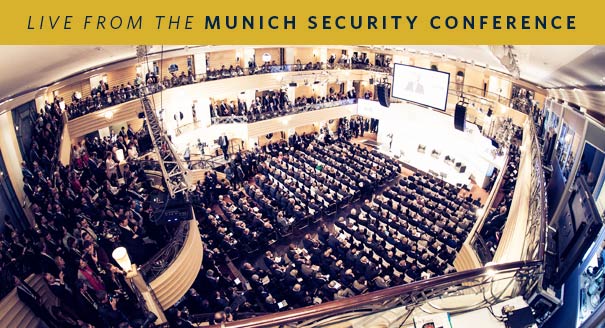
Source: Getty
Diplomats, professors, and parliamentarians at the Munich Security Conference weigh in on a very troubled transatlantic relationship.
Carnegie Europe was on the ground at the 2017 Munich Security Conference, offering readers exclusive access to the debates as they unfolded and providing insights on today’s most urgent international issues. Check out our live coverage here.
*
Maneuvering my way through the throng of participants at the Munich Security Conference, an annual gathering of leaders, diplomats, and defense and security experts, I popped this question: What does U.S. President Donald Trump mean for Europe? Respondents were asked to sum up their thoughts in about 20 words.
For the last sixty years, every American president has supported European unity because it was also in the interests of the United States.
We have to go back to the fundamentals that we stand for.
A united Europe also strengthens the United States. And the United States has always safeguarded our democracy and the rule of law.
For the first time since Trump, we don’t know if the American president supports the EU project or NATO.
Europe will be more independent and responsible for European security and Europe’s future.
Trump means that Europe has to take responsibility for the rules-based, liberal global order.
Uncertainty. Unpredictability.
He is the president of the United States. We have just been speaking with U.S. Vice President [Mike] Pence along with the other Baltic states.
Trump is going to discover very soon that Europe is his most reliable and stable ally.
Trouble. I’m hopeful that he will gravitate to more conventional positions on European security and the importance of NATO. But I worry that he will remain indifferent if not hostile toward the project of European integration.
Trump is a wake-up call for Europe to grow up.
He is the first president of the United States who defends the opposite of those who represent multilateralism.
Photo by Munich Security Conference / Mueller

Nonresident Senior Fellow, Carnegie Europe
Judy Dempsey is a nonresident senior fellow at Carnegie Europe
Recent Work
Judy Dempsey
Judy Dempsey
Carnegie does not take institutional positions on public policy issues; the views represented herein are those of the author(s) and do not necessarily reflect the views of Carnegie, its staff, or its trustees.

A summer of escalation in the Black Sea has hurt Ukraine economically and is exacerbating world food security. A truce is needed—as is a broader reframing of Europe’s Ukraine strategy.

Thomas de Waal

Are Germany’s economic, industrial, and political struggles becoming a liability for the EU’s ability to rise to the geopolitical moment?

Rym Momtaz, ed.

European Commission President Ursula von der Leyen is about to give her annual address on the state of the EU. Here’s what she won’t—but should—say.
Rym Momtaz

The aftermath of the Ceuta crisis shows Europe has drawn the wrong lessons. Rather than doubling down on failed migration policies, the EU needs to address the underlying roots of such episodes.

Richard Youngs

An overwhelming victory by a far-right-wing party in a small state in eastern Germany will have major repercussions for Chancellor Friedrich Merz’s coalition.
Judy Dempsey