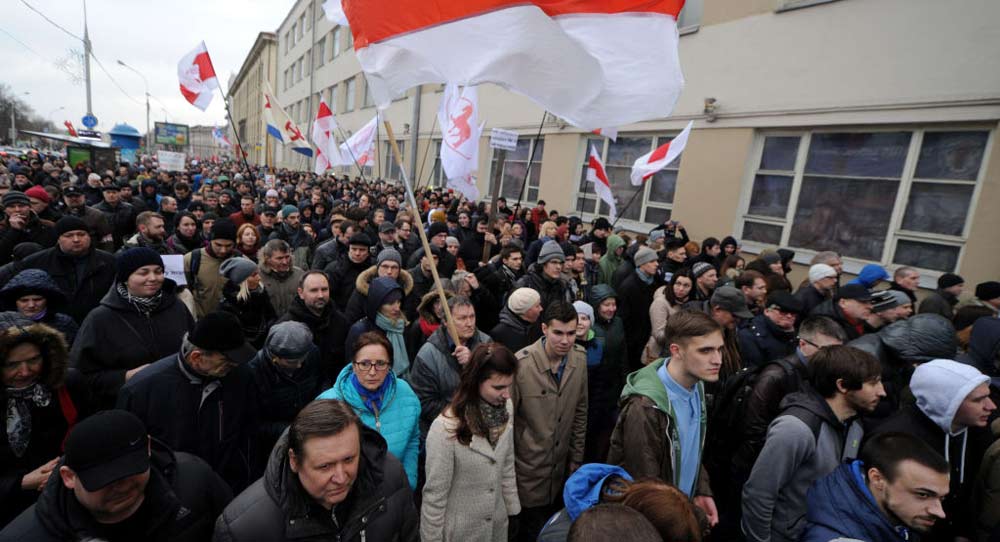
They are called roughnecks, a fifth column. Western intelligence services are trying to destabilize the situation in Belarus. Such are the views of Alexander Lukashenko. Since the beginning of March 2017, the president of Belarus has been confronted with demonstrations that have spread from the capital Minsk to other major cities.
According to Belsat, an independent satellite television station operating out of Warsaw but with reporters on the ground, these protests are spontaneous and special. “These demonstrations are different from previous ones,” said Agnieszka Romaszewska, director of Belsat. “They reflect a growing frustration over the deteriorating economic situation. They also reveal how Lukashenko is completely divorced from reality,” she told Carnegie Europe.
What sparked the protests was a decision by the Belarusian regime to implement a so-called parasite law. Passed in 2015, the legislation decreed that anyone who worked less than one hundred eighty-three days a year would have to pay a fee of $230 (€213).
The authorities didn’t enforce the law until 2017. When they did, the reaction was unprecedented for Belarus, a country whose Western borders straddle EU members Latvia, Lithuania, and Poland and whose Eastern neighbors are Russia and Ukraine. Young and old have taken to the streets to protest. During the first few days, the crowds were small—a few hundred. But footage from Belsat and other networks shows that people have not been afraid to speak directly to local authorities. They argue. They applaud those who speak out.
Those caught on camera complain about the authorities not listening to their grievances. They complain about increased prices, low wages, and deteriorating economic conditions. It is the economic situation that is causing so much discontent in a country known for its patience and resilience. The authorities have reacted to the demonstrations by detaining hundreds and rounding up any opposition figures. But the point about these protests is that, as Romaszewska noted, they involve “just ordinary people who are fed up with their living conditions.”
The deteriorating economy is related to Belarus’s complicated relationship with Russia. Over the past year, according to the Vienna Institute for International Economic Studies, the Belarusian economy has undergone “a painful adjustment and a prolonged recession.” In 2016, GDP plunged by 2.6 percent, after falling by 3.8 percent the previous year.
One of the main reasons for this sharp decline was a dispute between Belarus and Russia over the price at which Moscow should sell its oil to Minsk. That led to a reduction of oil supplies. About one-third of Belarus’s export revenues comes from refining and exporting Russian oil. Over the years, Russian subsidies have amounted to up to 20 percent of Belarus’s GDP. The knock-on effect has been a weakening of Belarus’s processing industry and its exports. In response, the authorities abolished price controls on certain important services.
At first, Moscow played down the protests and Minsk’s criticism of higher energy imports from Russia. But now, blackmail seems to be the order of the day. Russia can ill afford to have the unrest continue.
Russian Prime Minister Dmitry Medvedev told his Belarusian counterpart, Andrei Kobyakov, that no one was forcing Belarus to remain in the Eurasian Economic Union. The EEU was established by Russia and also includes Armenia, Belarus, Kazakhstan, and Kyrgyzstan. “If some of the countries participating in the Eurasian Economic Union had not joined it, they would have to buy gas at [higher] European prices,” Medvedev said. “No one forcibly keeps anyone here [in the EEU], we did all this voluntarily,” he added. But Belarus hardly has a choice.
The reality is that Lukashenko hasn’t many options at his disposal. In the past, he has been adept at playing Russia and the EU off against each other in the hope of extracting concessions from them. The status quo always remained intact.
The EU, for its part, hasn’t been adept at dealing with Belarus. The union tried imposing sanctions, mainly on individuals, and insisted that Minsk release all political prisoners in return for the EU lifting the sanctions. As soon as the sanctions were ended in February 2016 after Minsk made some gestures, the Belarusian authorities carried out four executions.
The EU’s response to the current wave of demonstrations has been cautious. “The European Union is committed to a stable, democratic and prosperous future for Belarus, for the benefit of its people, and will continue its work with all the stakeholders with this objective firmly in mind,” the European External Action Service (EEAS) stated.
Reading between the lines, one can see the EU has no long-term strategy toward its Eastern neighbor. Russia’s goals remain unchanged: to keep Belarus in the fold of the EEU and to keep dissent to a minimum.
This time round, however, Belarusian citizens are challenging Lukashenko’s authority and room for maneuver. If he did back down by rescinding the parasite law and reintroducing subsidies, he would need financial reserves. Russia would extract a high price for granting any new loans. And assistance from the International Monetary Fund would require structural reforms. “We have no idea how this is going to end,” said Romaszewska.