
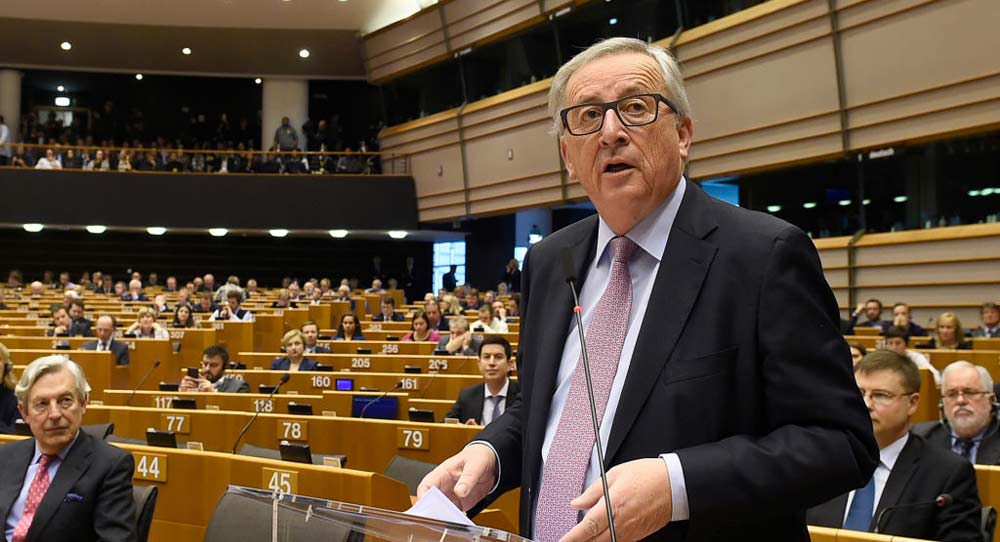
No matter what Jean-Claude Juncker says or does these days, he will be blamed and he will blame others. The president of the European Commission, the EU’s executive, has in recent months repeatedly criticized the way in which Brussels has become a convenient punching bag for national governments.
He has often decried the way national leaders reach agreements at summits in Brussels only to return to their home countries to denounce interference by bureaucrats in the EU’s capital. It is as if national leaders would rather close their eyes to the need for more Europe, despite crises that include eurozone debt, the influx of refugees, terrorism, and the immense fallout from Britain’s June 2016 vote to leave the EU—capped by the November 2016 election of U.S. President Donald Trump.
Against such an inauspicious background, on March 1 Juncker published his White Paper on the Future of Europe. Subtitled “Reflections and scenarios for the EU27 by 2025,” referring to the 27 member states that will remain after Brexit, the paper lists a catalogue of deep, structural problems plaguing the bloc. The population is dwindling. Economic power is waning. Youth unemployment is stubbornly high. Member states are not getting a grip on digitalization, which will affect the nature of work. And the number of citizens who trust the EU is decreasing, down from half of Europeans ten years ago to around one-third today.
These facts are not new. But the commission spelled them out to find ways to deal with such complex trends that affect the EU’s future as a global security and foreign policy player.
Juncker’s proposals, however, aim to please all constituencies throughout the EU’s soon-to-be 27 member states. Instead of embracing the language of Europhiles such as France’s independent presidential contender Emmanuel Macron or Germany’s Social Democratic candidate for chancellor Martin Schulz, Juncker listed five scenarios for the future of the union. Here they are: carrying on as before; focusing only on the EU single market; allowing willing member states to integrate more; doing less but more efficiently; and doing much more together.
Member states will debate this shopping list as part of the white paper process, which will begin later in March when the EU celebrates its sixtieth anniversary in Rome and will continue through to the European Parliament elections in June 2019. Nothing like having the luxury of time as the rest of the world moves on.
The scenarios reveal two major weaknesses of the European Commission. The first is that the commission has lost all authority and ambition in setting out how it sees the EU’s future. It seems that Juncker’s team didn’t dare state which direction the union should take. In short, the commission has lost the real sense of conviction that made it such a driving force of integration under Jacques Delors’s presidency from 1985 to 1994.
Second, the five scenarios show a complete lack of strategy for the EU. Europe does not need shopping lists or à la carte menus. There are enough opt-out clauses for member states as it is. Offering more options amounts to diluting, not strengthening, the EU.
Juncker and his team had to take into account the growing distrust of national and EU-level institutions as well as the rise of Euroskeptic and populist movements. But the white paper’s major mistake is that it panders to all the different views. The commission no longer seems to know what it stands for. It sees how the member states’ parliaments and lobbies are gnawing away at its powers, especially on trade. Yet it has been too slow to defend those powers, which have given the EU substantial economic clout and influence.
Not everything can be blamed on bureaucratic inertia in Brussels, powerful lobbies, and obstinate national leaders who prefer to pursue their own agendas. Nevertheless, the sign-off sentence to the white paper’s introduction, after it lists a catalogue of woes affecting Europe, encapsulates a combination of wish fulfillment and misplaced nostalgia. Europe, it stated, “has always been at a crossroads and has always adapted and evolved.” Were it as simple as that.

.png)


