

Commentary
European Commission President Ursula von der Leyen is about to give her annual address on the state of the EU. Here’s what she won’t—but should—say.
Rym Momtaz
{
  "authors": [
    "John R. Deni"
  ],
  "type": "commentary",
  "blog": "Strategic Europe",
  "centerAffiliationAll": "",
  "centers": [
    "Carnegie Endowment for International Peace",
    "Carnegie Europe"
  ],
  "collections": [
    "Europe’s Eastern Neighborhood"
  ],
  "englishNewsletterAll": "",
  "nonEnglishNewsletterAll": "",
  "primaryCenter": "Carnegie Europe",
  "programAffiliation": "",
  "programs": [],
  "projects": [],
  "regions": [
    "Europe",
    "Eastern Europe"
  ],
  "topics": [
    "Security",
    "Military"
  ]
}
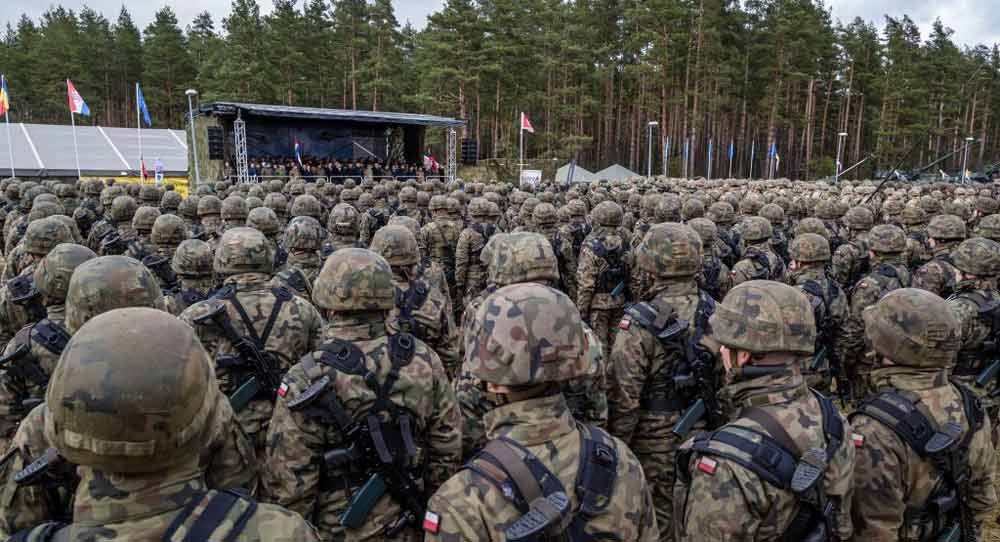
Source: Getty
Boosting NATO’s troop numbers in northeastern Europe is a major step forward for the alliance, but allies cannot rest in the face of the region’s dynamic security environment.
Over recent days and weeks, NATO member states have begun implementing an enhanced forward presence across the Baltic states and Poland. For the first time, the alliance is basing combat forces east of the former East-West German border on a continuous basis. Admittedly, the deployments to northeastern Europe will be rotational, not permanent, but they represent a strengthening of the alliance’s deterrence and reassurance posture.
However, while the enhanced forward presence in its current form is a necessary initiative, it’s not yet clear whether it is sufficient, especially in terms of its operational effectiveness and its response to the most likely security challenges of the next several years.
Allied battle groups—essentially, battalion task forces numbering around 1,000 troops each—are now beginning their deployments to Estonia, Latvia, Lithuania, and Poland. Framework nations for each battle group are the UK in Estonia, Canada in Latvia, Germany in Lithuania, and the United States in Poland.
While the lead nations provide most of the troops as well as command and control for each battle group, a number of other allies are also contributing forces. Denmark and France are contributing to the UK-led battle group in Estonia. For the Canadian-led unit in Latvia, Albania, Italy, Poland, Slovenia, and Spain are providing forces. Belgium, Croatia, France, Luxembourg, the Netherlands, and Norway will participate in the German-led battle group in Lithuania. And the U.S.-led task force in Poland also includes Romania and the UK.
The multinational character of the battle groups is both a major strength at the strategic level and an Achilles’ heel at the operational level. In terms of strength, by including so many NATO allies (sixteen out of 28), the enhanced forward presence effectively spreads risk across many allies. If, in the worst-case scenario, Russia were to invade, troops from several alliance member states would likely be casualties. This would probably spur a faster, more unified response from the alliance.
Spreading risk in this way is similar to multinational formations used by NATO during the Cold War. In particular, the former Allied Command Europe (ACE) Mobile Force—Land was a brigade-sized force comprising fourteen of NATO’s then fifteen member states. It was meant to be quickly deployed to an emerging crisis zone and to be a tangible manifestation of allied solidarity. Enhanced forward presence plays a similar role on the ground today.
However, that same multinationalism is also a vulnerability. With so many allies involved, especially in the battle groups in Latvia and Lithuania, there is bound to be a reduction in operational effectiveness. It had been common practice among NATO allies to limit multinationalism below the brigade level. Multinational brigades serving side by side under a common division headquarters seemed workable, but trying to put battalions from multiple countries together as part of a single brigade stretched multinationalism to its limit, leading to challenges in terms of language, equipment interoperability, and command philosophy.
Nevertheless, given the demands of generating forces for the fight in Afghanistan, the allies experimented with and successfully implemented multinationalism below the brigade level. In only very limited cases did the allies do the same below the battalion level in Afghanistan, with good reason: interoperability challenges remain significant even among allied ground forces that spent a dozen years working together in the International Security Assistance Force (ISAF). The fact that the enhanced forward presence battle groups will be operating in a permissive environment—on friendly territory, among welcoming populations—should help them overcome the challenges associated with multinational battalions.
If the alliance can surpass these hurdles, it must still address what role, if any, these units play in terms of the most likely security challenges confronting the Baltic states and Poland. The enhanced forward presence battle groups are best suited for deterring by punishment the most dangerous scenario of a Russian military incursion. As such, they represent a tangible manifestation of NATO’s Article 5 mutual-defense clause. However, a crisis based on a clear invasion of allied territory remains a low probability, even for the likes of Russian President Vladimir Putin.
Far more likely are security challenges that approach but fall short of the Article 5 threshold. Unattributable cyberattacks—particularly those that strike at critical infrastructure such as electrical power generation and distribution facilities, television and Internet service providers, and water treatment and distribution systems—are among the first that come to mind.
Other equally destabilizing scenarios might include stirring ethnic discord in Russian-speaking communities in allied countries, conducting disinformation operations to characterize foreign troops or NATO as a whole as occupiers instead of protectors, or even employing provocateurs to bait allied troops into reacting in a disproportionate, dangerous manner and thereby splitting them from the populations they intend to protect.
To counter these security challenges and avoid the worst pitfalls, the alliance’s battle groups will need to work seamlessly with the host nations’ military and civilian officials, from the level of central governments to that of local mayors. Allies will also need to think creatively about the kinds of training and exercises to be conducted during each battle group rotation. Decisive action training may be less important than working through the modalities of civil-military cooperation during an electrical grid failure, for instance.
Getting NATO’s enhanced forward presence battle groups on the ground is a major step forward for the alliance, but the allies cannot rest in the face of the dynamic security environment in Eastern Europe.
John R. Deni is a research professor of security studies at the Strategic Studies Institute of the U.S. Army War College and an adjunct professor at the American University’s School of International Service. The views expressed here are his alone.

John R. Deni
Atlantic Council
John R. Deni is a research professor at the U.S. Army War College’s Strategic Studies Institute, a nonresident senior fellow at the Atlantic Council, and an associate fellow at the NATO Defense College. He is the author of NATO and Article 5. The views expressed are his own.
Carnegie does not take institutional positions on public policy issues; the views represented herein are those of the author(s) and do not necessarily reflect the views of Carnegie, its staff, or its trustees.

European Commission President Ursula von der Leyen is about to give her annual address on the state of the EU. Here’s what she won’t—but should—say.

Rym Momtaz

The aftermath of the Ceuta crisis shows Europe has drawn the wrong lessons. Rather than doubling down on failed migration policies, the EU needs to address the underlying roots of such episodes.

Richard Youngs

An overwhelming victory by a far-right-wing party in a small state in eastern Germany will have major repercussions for Chancellor Friedrich Merz’s coalition.

Judy Dempsey

Canadian Prime Minister Mark Carney has twice inspired praise for standing up to U.S. President Donald Trump: at the 2026 World Economic Forum in Davos and on Canada-U.S. trade negotiations. Is Carney showing a third way better than the EU has in dealing with the Trump administration?
Rym Momtaz, ed.

The EU’s responses to two recent incidents expose the gulf between European perceptions and capabilities. Unless the union can bridge that gap, it will never become a real geostrategic power.
Rym Momtaz