

Commentary
While the EU and European governments are embracing the much-lauded middle-power moment, this entails three difficult conundrums.
Richard Youngs
{
  "authors": [
    "John R. Deni"
  ],
  "type": "commentary",
  "blog": "Strategic Europe",
  "centerAffiliationAll": "",
  "centers": [
    "Carnegie Endowment for International Peace",
    "Carnegie Europe"
  ],
  "collections": [
    "Europe’s Eastern Neighborhood",
    "Transatlantic Cooperation"
  ],
  "englishNewsletterAll": "",
  "nonEnglishNewsletterAll": "",
  "primaryCenter": "Carnegie Europe",
  "programAffiliation": "",
  "programs": [],
  "projects": [],
  "regions": [
    "Europe",
    "North America",
    "United States",
    "Eastern Europe",
    "Western Europe"
  ],
  "topics": [
    "Security",
    "Military"
  ]
}
Source: Getty
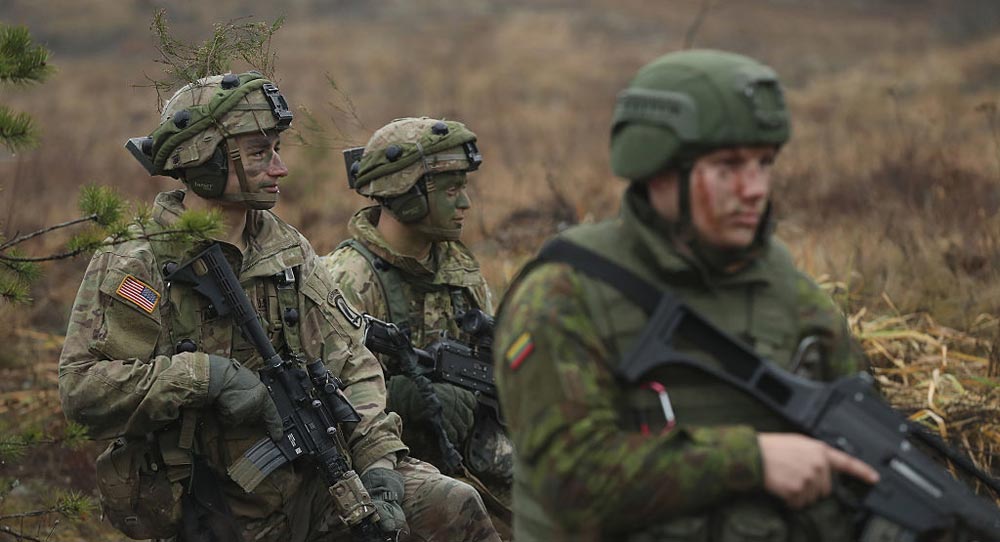
The insistence of some NATO allies on maintaining commitments made to Russia twenty years ago risks undermining stability and security in Europe.
In 1997, NATO and Russia negotiated and signed a founding act designed to guide relations by building increased trust, unity of purpose, and habits of consultation and cooperation. This political agreement—not a legally binding treaty—committed NATO to carry out its collective defense and other missions by “ensuring the necessary interoperability, integration, and capability for reinforcement rather than by additional permanent stationing of substantial combat forces” on the territories of the former Warsaw Pact states.
Twenty years on, the NATO-Russia Founding Act ought to be considered a dead letter—an agreement that remains in force in name only. NATO should ignore its provisions in order to more effectively and efficiently safeguard the security of its most vulnerable members. As it stands, some NATO allies insist on maintaining commitments to Russia made in a very different security environment. This approach risks undermining stability and security in Europe, all in the name of pursuing the chimera of Russian cooperation in the East.
The limitations on NATO’s force posture in Eastern Europe are relatively well known. What is often forgotten is that the founding act obliges Russia to “exercise similar restraint in its conventional force deployments in Europe.” Moreover, all of these principles were based on the “current and foreseeable security environment” of two decades ago. It is obvious that Russia’s illegitimate March 2014 annexation of Crimea, its ongoing invasion of eastern Ukraine, and its massive exercises on the borders of NATO allies are not examples of restraint, and that today’s security environment in Europe is nothing like that of 1997.
Nevertheless, NATO remains for the time being committed to what some in the alliance—particularly Germany—consider the moral high ground. While appealing from a normative perspective, such an approach utterly fails if one’s negotiating partner isn’t guided by similar incentives. To date, there’s been little evidence that Moscow cares about norms or cooperative relations. From a practical perspective, the alliance’s approach has the effect of hobbling NATO in crafting sustainable, effective, and efficient deterrence and assurance.
In trying to satisfy the legitimate security concerns of the alliance’s most vulnerable members while maintaining some degree of fealty to the founding act, NATO has implemented its enhanced forward presence initiative. This persistent presence consists of continuous rotational battalion-sized deployments to the Baltic states and Poland.
In response, did Moscow hail the alliance’s adherence to the terms of the founding act and declare the relatively small deployments to be no serious threat to Russian security? Hardly. Instead, Russia condemned the enhanced forward presence initiative as escalatory, claimed it violated the spirit of the founding act, and vowed to retaliate. In sum, NATO’s satisficing solution has neither mollified Moscow nor, arguably, done enough to deter or assure.
Rotational deployments of personnel and equipment can become extraordinarily costly very quickly, in some cases exceeding the costs of more permanent forward stationing, even after accounting for infrastructure costs. Moreover, it is not clear that the enhanced forward presence initiative will result in operationally effective military capability, or that it will amount to an appropriate response to the security challenges NATO will most likely face in the East.
To build a sustainable, efficient, and effective deterrent posture that reassures Estonians, Latvians, Lithuanians, and Poles, the alliance needs to detach itself from the founding act. Admittedly, this is unlikely to occur in the short run, before two important events. First, German Chancellor Angela Merkel is unlikely to embark on what could become a major foreign policy debate in Germany before the federal election there in September, even as polls show her pulling away from her Social Democratic challenger, Martin Schulz. Second, the alliance is unlikely to discuss the founding act before the administration of U.S. President Donald Trump has a chance to develop its strategy and supporting policies toward Russia.
Once these events occur, however, the alliance ought to move forthrightly yet quietly toward ignoring the founding act. Any kind of formal abrogation would only give Moscow another opportunity to inaccurately portray NATO as the aggressor. In any case, getting the alliance beyond the founding act will undoubtedly require difficult diplomatic political discussion among the allies, but it is a sound objective for at least two reasons.
For one thing, as a political agreement, the NATO-Russia Founding Act is subject to evolving political interpretation. If the founding act were a binding treaty ratified by member states, adjusting NATO’s interpretation would be more complicated and time consuming.
Second, NATO’s force posture has never been truly static, and the alliance has a history of modifying that posture based on the security situation it confronts and on changes in membership. For example, after West Germany joined the alliance in 1955, NATO pushed its planned line of defense forward from the Benelux countries to the inner German border. The forward defense concept adopted then by NATO was vital to reassure the alliance’s newest member state and deter aggressive Soviet behavior and posturing in East Germany and Czechoslovakia.
Today, the sooner the alliance moves toward ignoring the outdated founding act, the sooner it can begin to effectively, efficiently, and sustainably meet all the requirements for deterrence and assurance in Eastern Europe. Fettering itself through blind adherence to an agreement that Russia has de facto abrogated serves only Moscow’s interests.
John R. Deni is a research professor of security studies at the Strategic Studies Institute of the U.S. Army War College and an adjunct professor at the American University’s School of International Service. The views expressed are those of the author and do not necessarily reflect the official policies or positions of the U.S. Department of the Army, the U.S. Department of Defense, or the U.S. government.

John R. Deni
Atlantic Council
John R. Deni is a research professor at the U.S. Army War College’s Strategic Studies Institute, a nonresident senior fellow at the Atlantic Council, and an associate fellow at the NATO Defense College. He is the author of NATO and Article 5. The views expressed are his own.
Carnegie does not take institutional positions on public policy issues; the views represented herein are those of the author(s) and do not necessarily reflect the views of Carnegie, its staff, or its trustees.

While the EU and European governments are embracing the much-lauded middle-power moment, this entails three difficult conundrums.

Richard Youngs

Much has been said of the changes Brussels is trying to make to the EU enlargement process. Here’s why gradual integration might—or might not—be the answer.

Dimitar Bechev

The European Commissioner for Trade is headed to China. But after President Xi’s bridge-building visit to Washington, can a more isolated EU overcome Beijing’s stranglehold on critical raw materials? Who will blink first?

Rym Momtaz, ed.

The domestic impacts of how long it is taking to end the war in Ukraine have pushed the French electorate to the political extremes and compromised the country’s diplomatic capacity.
Rym Momtaz

Before the next wave of EU enlargement takes place, the union needs to grapple with thorny questions of how power is distributed among its members.


Emil Sondaj Hansen, Ditte Brasso Sørensen