
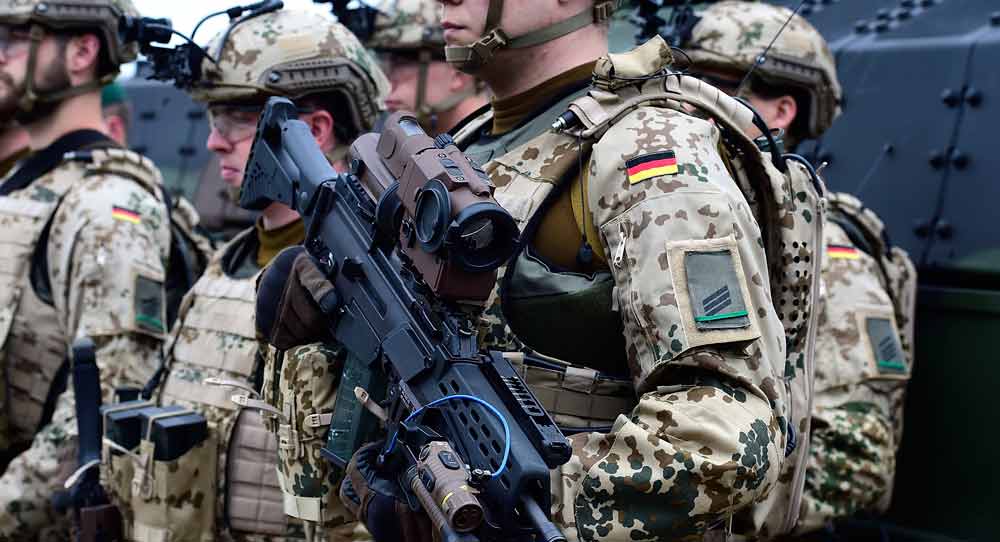
Good stories include ingredients such as power, myth, and surprising facts. One story currently making the rounds in defense debates is that Germany is secretly and systematically building a European army. It is, apparently, an army that will be so powerful that all other Europeans should worry and—here the story goes wild—will be fully under German control but will never be used, because German politicians remain antimilitaristic peace lovers. Berlin has put a spell on as many as sixteen European capitals to place their forces under German command. This master plan is hidden behind a deliberately technical, typically German term: the framework nations concept (FNC).
One can enjoy the fairy tale, or one can listen to the real but more boring story behind recent headlines. Yes, the FNC is a German idea to organize defense cooperation in Europe. But the goal is not to take over but to strengthen European defense by linking big and small countries in a meaningful way. Here are the five most important facts behind the fable.
It started with an accident. Former German defense minister Thomas de Maizière declared during a NATO meeting in 2013 that Germany would come up with a new initiative for cooperation. This announcement took his own ministry by surprise. But some smart people recognized the opportunity to Europeanize the Bundeswehr. And so, the FNC was born.
Second came a reality check. It was not the vision of a European army that was the starting point, but a systematic assessment of the depressing defense landscape in Europe. Individual European armed forces were too small to make a difference by themselves. While Russia has 1 million soldiers, Europe’s forces range from around 6,400 (Estonia) to about 200,000 (France). One-third of EU and NATO countries have fewer than 20,000 soldiers, and eight states make up 80 percent of European forces. This imbalance and the related gaps and redundancies have to be managed to ensure that Europeans can defend themselves.
Third was a desire to make Europe strong again. The FNC offers a model to systematically organize defense cooperation in Europe. It aims to link big and small states and turn them into more than the sum of their parts.
The idea is that Europeans form clusters to coordinate who will provide which assets and troops on a long-term basis. The framework nation takes the lead of such a cluster. It provides the group with the military backbone, which consists of logistics and command and control. Into this frame, smaller nations plug their specialized capabilities, like air defense. The entire cluster would therefore become capable of carrying out longer and more complex operations than individual countries can. In the future, not every nation would have to provide and pay for everything. Thus, more money would be available to procure what each group needs.
Fourth, a living concept was born. The first version, FNC 1.0, focused on niche capabilities like air defense. FNC 2.0 was triggered when the 2013–2014 Ukraine crisis and Russia brought deterrence and defense back to Europe. It became clear that the classic approach of small, mobile units would not be enough to deter large, state-based forces.
Hence, the FNC was scaled up. Groups of states would strive to form larger formations—divisions of 15,000 soldiers or so—on a multinational basis. FNC 3.0, the next iteration, will be the long-term harmonization and synchronization of defense sectors beyond force structures. It will include joint procurement and industrial cooperation, such as the recently launched German-Norwegian submarine cooperation.
Fifth, there will be mutual dependence by design. If implemented, the FNC would turn Berlin into the centerpiece of European defense. Europe’s defense would depend on Germany, but only as much as Germany depends on the sixteen countries that have signed up to the FNC. Two-thirds of European NATO allies have joined the FNC; non-NATO states like Finland are eager to take part too. Yet, the initiative lacks the commitment of other big countries like France that have refrained from serving as a backbone. This turns Germany into a leader by default.
In the absence of alternatives, the FNC reorganizes European defense cooperation in a way that affects Europe’s forces as much as the 2007–2008 financial crisis did in a negative way. The concept is likely to be a future organizing pattern for cooperation.
Yet, it’s not all sunshine. States willing to engage wonder whether they can use their capabilities if they are bound to Berlin. After all, they feel dependent on Germany’s security policy. Although Berlin has become more active in international security, it remains reluctant to use force. There is also a fear that the FNC disables combat-willing countries in Europe, such as the Netherlands, if they are too closely linked to Germany.
Finally, some argue that by concentrating on larger formations to be used for territorial defense and deterrence, Berlin is focusing on forces that will never be used—avoiding once again the question of actually using hard power. States are more likely to use smaller, mobile formations for crisis management, as France did in Mali.
Still, far from a German plot to govern Europe, the FNC is about making the most of what little was left of European armed forces after the financial crisis. By setting up cooperation with others, Germany becomes dependent on them.
The German question is back—but this time, Berlin is an enabler for European defense. Europeans need Germany to ensure effective defense in Europe.
Claudia Major is a senior associate for international security at the German Institute for International and Security Affairs (SWP) and a member of Women in International Security (WIIS) Berlin. Christian Mölling is the research director at the German Council on Foreign Relations (DGAP).


