

Commentary
Judy Dempsey
{
  "authors": [
    "Judy Dempsey"
  ],
  "type": "commentary",
  "blog": "Strategic Europe",
  "centerAffiliationAll": "",
  "centers": [
    "Carnegie Endowment for International Peace",
    "Carnegie Europe"
  ],
  "collections": [
    "EU Integration and Enlargement"
  ],
  "englishNewsletterAll": "",
  "nonEnglishNewsletterAll": "",
  "primaryCenter": "Carnegie Europe",
  "programAffiliation": "",
  "programs": [],
  "projects": [],
  "regions": [
    "Europe",
    "Western Europe",
    "Germany"
  ],
  "topics": [
    "EU",
    "Economy",
    "Climate Change"
  ]
}
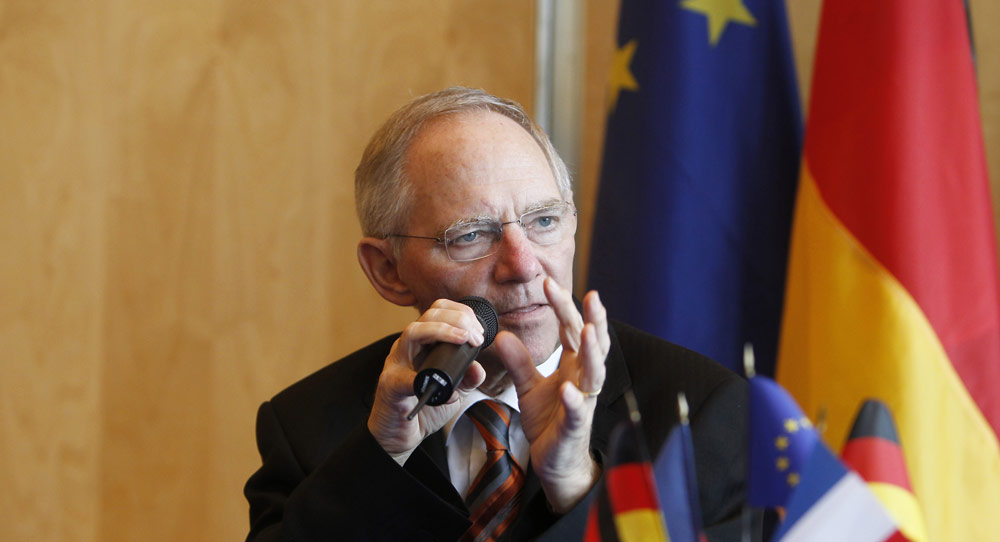
Source: Getty
In leaving the German finance ministry, Europe’s most influential politician leaves a big gap in the intellectual direction of the EU.
Back in September 1994, three highly experienced politicians belonging to the conservative faction in the German parliament, or Bundestag, published a working paper.
Despite its spectacularly bland title, “Reflections on European Policy,” the paper was anything but dull. It was radical.
The three authors—Wolfgang Schäuble, Karl A. Lamers, and Theo Waigel—proposed a multi-speed Europe. At the same time, a “core Europe” consisting of Germany, France, and the Benelux countries would take the lead in further integrating what was then a bloc of twelve countries.
Schäuble, a key player in making German reunification possible after the Berlin Wall was torn down in November 1989, has never wavered from his support for a more integrated Europe.
But as Schäuble prepares to relinquish his role as finance minister in Chancellor Angela Merkel’s next coalition government to become president of the Bundestag, he will leave behind a deep intellectual and political gap. It will be felt not only among the eurozone finance ministers and EU leaders, but in the German government itself.
Wolfgang Schäuble, who since 2005 has served as German interior minister and then as finance minister in Merkel’s three cabinets, has been the only convinced European in each government coalition.
Within the EU itself, it is hard to find another politician, perhaps with the exception of French President Emmanuel Macron, who never doubted Europe’s direction. For Europe to be strong and competitive it had to be more integrated. If that necessitated a core group of countries to lead such integration, then so be it. For Schäuble, now seventy-five years old, procrastination and muddling through are no longer options Europe can afford.
Muddling through was certainly not Schäuble’s style as the Greek, Spanish, and other eurozone finance ministers well knew when their country’s economy and banking system were near collapse during the euro crisis.
With Merkel hardly saying anything memorable about Europe, or the economic crisis for that matter, the chancellor delegated the future of the eurozone to Schäuble, not to the European Commission, the EU’s executive.
How the German finance minister was pilloried, particularly by the Greeks, for imposing very tough austerity measures. Pensioners and teachers, young people and the public sector were left struggling to make ends meet. Germany was accused by the Greek media of taking over Europe. The Nazi era was invoked. Cartoons showing Merkel dressed in a swastika uniform were not uncommon.
Schäuble was unremitting. For him, Europe’s economic crisis provided the EU with two opportunities: turn the eurozone into a bloc of competitiveness, not inefficiency and unsustainable high budget deficits. And use the crisis, and now Brexit, to push through more monetary and economic integration in the core.
The former is slowly happening, although Schäuble warned in an interview with the Financial Times on October 9 that soaring levels of debt and liquidity were major risks to the world economy.
The latter—Europe’s future direction—has not yet been clarified. This is because the EU is divided over its direction. There are those, like Jean-Claude Juncker, the European Commission president, who, depending on how you read his State of the Union address, believes that the EU can be inclusive. But Juncker’s definition of inclusivity is qualified: non-eurozone countries are obliged to eventually adopt the euro currency. And the Commission president wants more economic integration.
Then there are the “sovereignists,” such as Poland and Hungary, whose governments believe they can be independent. Yet they agreed to join the EU knowing full well that they ceded part of their sovereignty to Brussels and to the acquis communutaire, the battery of legislation that all EU members signed up to.
Then there is Schäubelism, which is a special sensitivity for Europe. Schäubelism is not based on sentimentalism. It is based on a hard-nosed realism that Europe’s future as a major economic and political player on the world stage will be reduced to a dwarf if a core group of countries, led by France and Germany but also the (underperforming) Netherlands, among other member states, do not take up the reins.
Macron cannot do it alone. It is unclear how far Merkel will go in realizing the French president’s policies for a stronger and more integrated Europe.
Populists and Euroskeptics, sovereignists and anti-globalists, anti-foreign as well as those who oppose a more open Europe, will balk at the idea of further integration.
But Schäuble is ready to engage and defend Europe’s values and what it has achieved since the end of World War II. As the incoming president of the Bundestag, Schäuble will have the unprecedented task of dealing with the Alternative for Germany (AfD), the first time that a far-right, anti-immigration, anti-Islam party with anti-Semitic strands, was elected to the federal parliament.
Schäuble never held his tongue as finance minister in the building that was once the Reich’s Aviation Ministry. Nor did he mince his words during meetings with eurozone finance ministers or the International Monetary Fund. Schäuble’s defense of Europe, its values, and Germany’s responsibilities are not issues that the incoming president of the Bundestag will allow the AfD to denigrate.

Nonresident Senior Fellow, Carnegie Europe
Judy Dempsey is a nonresident senior fellow at Carnegie Europe
Recent Work
Judy Dempsey
Judy Dempsey
Carnegie does not take institutional positions on public policy issues; the views represented herein are those of the author(s) and do not necessarily reflect the views of Carnegie, its staff, or its trustees.

The European Commissioner for Trade is headed to China. But after President Xi’s bridge-building visit to Washington, can a more isolated EU overcome Beijing’s stranglehold on critical raw materials? Who will blink first?

Rym Momtaz, ed.

The domestic impacts of how long it is taking to end the war in Ukraine have pushed the French electorate to the political extremes and compromised the country’s diplomatic capacity.
Rym Momtaz

Before the next wave of EU enlargement takes place, the union needs to grapple with thorny questions of how power is distributed among its members.


Emil Sondaj Hansen, Ditte Brasso Sørensen

A summer of escalation in the Black Sea has hurt Ukraine economically and is exacerbating world food security. A truce is needed—as is a broader reframing of Europe’s Ukraine strategy.

Thomas de Waal

Are Germany’s economic, industrial, and political struggles becoming a liability for the EU’s ability to rise to the geopolitical moment?
Rym Momtaz, ed.