

Commentary
Judy Dempsey
{
  "authors": [
    "Judy Dempsey"
  ],
  "type": "commentary",
  "blog": "Strategic Europe",
  "centerAffiliationAll": "",
  "centers": [
    "Carnegie Endowment for International Peace",
    "Carnegie Europe"
  ],
  "collections": [],
  "englishNewsletterAll": "",
  "nonEnglishNewsletterAll": "",
  "primaryCenter": "Carnegie Europe",
  "programAffiliation": "",
  "programs": [],
  "projects": [],
  "regions": [
    "Europe",
    "Western Europe"
  ],
  "topics": [
    "EU",
    "Political Reform",
    "Democracy"
  ]
}
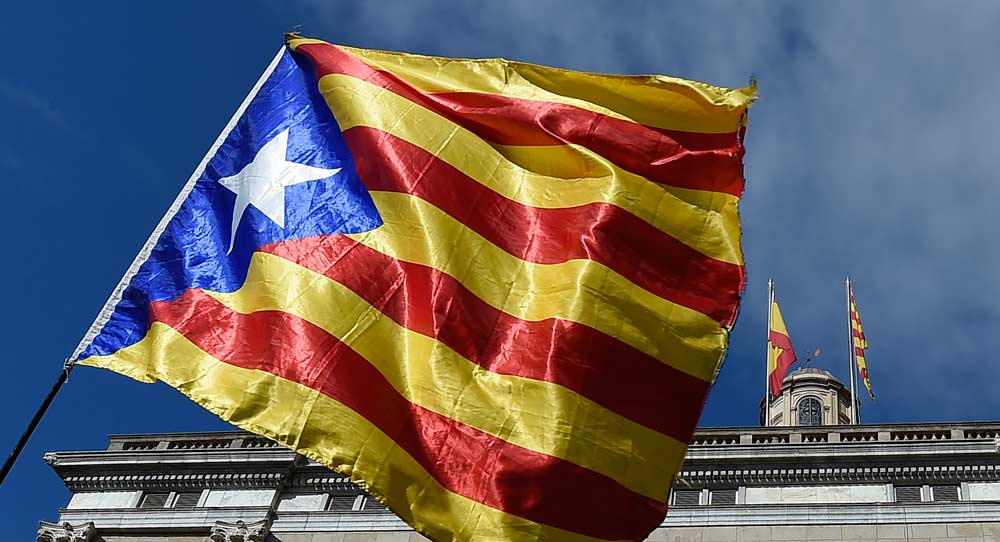
Source: Getty
In an exclusive interview, Javier Solana discusses Catalonia’s upcoming election, how far Madrid can go in offering the region more autonomy, and the EU’s role in the crisis.
After the Catalan parliament voted on October 27 to become an independent republic, Spanish Prime Minister Mariano Rajoy used the constitution to fire the government in Barcelona, dissolve the parliament, and impose direct rule on the region from Madrid. Catalan President Carles Puigdemont, along with a few ministers, left the country for Belgium. Eight leaders of the pro-independence movement, including Oriol Junqueras, leader of the Esquerra Republicana party, have been detained. A new regional election has been called for December 21.
In the meantime, in Barcelona on October 29, over 300,000 people demonstrated against Catalan independence, according to the estimates provided by the municipal police force. Carnegie Europe asked Javier Solana, the EU’s former foreign policy chief, former secretary general of NATO, and former foreign minister of Spain, about what the future holds for the country.
Judy Dempsey: What is the way forward?
Javier Solana: Well, the election campaign must be launched. The Catalan election will be held on December 21 and there’s very little time to prepare. The electoral lists have to be ready by November 17. Fortunately, all parties represented in the Catalan parliament have announced that they will be participating in this election.
Dempsey: Was Puigdemont’s decision to leave the country a sign of desperation or even cowardice?
Solana: He went to Brussels to avoid the action of the Spanish courts, which some found very difficult to understand, after the Catalan parliament declared independence. Perhaps he was also seeking international support but, if that’s the case, it is clear that he has failed.
Dempsey: What’s the mood like right now?
Solana: As we speak, the mood in Catalonia is a little bit calmer. The speaker of the Catalan parliament was freed on bail after saying she will comply with the constitution. Puigdemont has announced that he wants to participate in the upcoming election, which will be the most important subject in the next few weeks. A very significant development is that pro-independence parties have not agreed to form a joint list for the election. The winning preelectoral coalition of 2015 won’t be repeated. Rajoy’s move to take away the powers of the Catalan institutions was met with some resistance, but by calling elections right away he managed to throw the pro-independence camp off a bit.
Dempsey: Did Rajoy overplay his hand?
Solana: He played his cards in a very intelligent manner. Puigdemont was convinced on October 26 that he should call elections rather than declare independence. But he got scared when he was accused by the radicals of being a traitor. It was at this point that Puigdemont opted for a unilateral declaration of independence. Rajoy decided to step in and called elections immediately.
Dempsey: Now what happens?
Solana: We are entering a preelection process. Independence will not be the only issue. This election should be chiefly about which party or parties will govern Catalonia.
Dempsey: Can Madrid amend the constitution?
Solana: Yes, there could be some constitutional amendments.
Dempsey: For example?
Solana: Maybe along the lines of a more federal state. But Catalonia in Spain already has more autonomy than Bavaria in Germany. Spain is a very decentralized state.
Dempsey: Then how much further can it go?
Solana: Not very much. Catalonia already has its own education system and police. On the other hand, perhaps something could be done about the financial transfers that Catalonia makes to other less developed regions of the country.
Dempsey: What about the role of the EU?
Solana: This is a very delicate matter for the EU. If the objective is to further integrate Europe, the EU cannot support creating more borders. The EU was right to be firm and its position was coherent. It is clear that it is unacceptable for a region to break away without following the rules of the game.
Javier Solana was EU High Representative for Foreign and Security Policy, Secretary-General of NATO, and Foreign Minister of Spain. He is currently president of the ESADE Center for Global Economy and Geopolitics, distinguished fellow at the Brookings Institution, and a member of the World Economic Forum’s Global Agenda Council on Europe.

Nonresident Senior Fellow, Carnegie Europe
Judy Dempsey is a nonresident senior fellow at Carnegie Europe
Recent Work
Judy Dempsey
Judy Dempsey
Carnegie does not take institutional positions on public policy issues; the views represented herein are those of the author(s) and do not necessarily reflect the views of Carnegie, its staff, or its trustees.
The EU had to compromise to adopt a twenty-first sanctions package against Russia, exposing growing cracks in the union’s resolve. Is this latest, weaker round worth it to keep pressure on Moscow?

Rym Momtaz, ed.

Trump is distracted and Ukraine wants Europe to step up. The continent’s leaders must find their voice and assert it in talks with Russia.

Alissa de Carbonnel

Mounting economic strain and battlefield losses will not necessarily make the Kremlin less dangerous. They could instead push Moscow toward a more aggressive hybrid campaign designed to test NATO’s Eastern flank, exploit allied hesitation, and fracture European resolve.

Maksym Beznosiuk

Over the past ten years, NATO has held almost as many summits as it did during the entirety of the Cold War. Are they still useful, or is it time to stop holding annual meetings?
Rym Momtaz, ed.
Nearly a year and a half after Europeans leaned into sucking up to Trump, the strategy has produced some benefits when it comes to Ukraine.
Rym Momtaz