

Commentary
Judy Dempsey
{
  "authors": [
    "Judy Dempsey"
  ],
  "type": "commentary",
  "blog": "Strategic Europe",
  "centerAffiliationAll": "",
  "centers": [
    "Carnegie Endowment for International Peace",
    "Carnegie Europe"
  ],
  "collections": [
    "Europe’s Eastern Neighborhood"
  ],
  "englishNewsletterAll": "",
  "nonEnglishNewsletterAll": "",
  "primaryCenter": "Carnegie Europe",
  "programAffiliation": "",
  "programs": [],
  "projects": [],
  "regions": [
    "Europe",
    "Eastern Europe",
    "Western Europe"
  ],
  "topics": [
    "Foreign Policy",
    "EU",
    "Security",
    "Democracy",
    "Political Reform"
  ]
}
Source: Getty
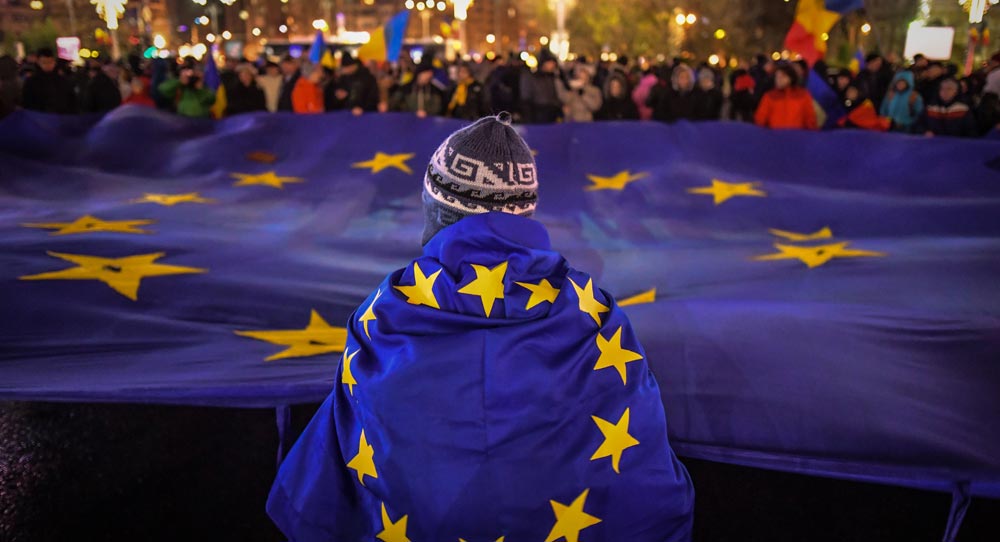
As 2017 ebbs, Europe can expect a bumpy ride in the coming months, not least because of the impact of the digital revolution on democracy.
Europeans have a knack of extrapolating one event and making it a trend.
So it was with the election last May of Emmanuel Macron. As France’s new president, Macron based his campaign on Europe and on domestic reform. In doing so, he roundly defeated his rival and leader of the far-right National Front, Marine Le Pen. Most European leaders were gushing in their praise for Macron. For them, his victory meant that populism was on the run. Europe was “back on track.”
But Macron’s radical policies to push for further integration of the eurozone and his enthusiasm to have European political parties have yet to be widely embraced.
Angela Merkel, France’s most important ally, was too slow on the uptake to respond to Macron’s proposals. The German chancellor was preoccupied with federal elections that left her conservative bloc seriously weakened. Merkel is now trying to cobble together another grand coalition with the equally-weakened Social Democrats.
If Europe is lucky, there might be a new German government in place by March of 2018. That is when Merkel and Macron plan to present their ideas for further EU integration. In the meantime, in 2017 populism in all its varieties and nastiness was back in business, no thanks to social media.
In Britain, as Prime Minister Theresa May struggled to make headway with Brexit negotiations, the political narrative in the UK turned degenerated into death threats against conservatives that questioned the decision to leave the EU.
With the help of social media and the tabloid press, Brexit unleashed a vitriolic and dangerous form of anti-Europeanness. With few exceptions, a discourse based on decency and tolerance has been discarded.
Britain is not alone. The government-friendly/controlled media in Hungary has injected the politics of fear and xenophobia across the country. Prime Minister Viktor Orbán’s Fidesz party has targeted one man: George Soros. The billionaire philanthropist of Hungarian and Jewish origin has consistently supported civil society activists during the communist era and its aftermath.
Soros is portrayed as the devil incarnate, the man who will swamp Europe with Muslims and destroy Christianity. It’s shocking to see pictures of Soros’s face on the floor of the metro trains as people trod across his image. The EU’s silence over the demonization of Soros—and the implicit anti-Semitism—has been shameful.
Across in Vienna, the new conservative chancellor, Sebastian Kurz, has formed a coalition with the far-right, anti-immigration Freedom Party—which just happens to now hold Austria’s interior, defense, and foreign portfolios.
Up in Poland, the governing nationalist-conservative Law and Justice Party has reined in the media and the judiciary. On December 20, the European Commission launched proceedings against Poland for breaching European common values and the rule of law that could lead to sanctions and a suspension of EU voting rights. Whatever the outcome, Polish society is now polarized. The space for the center has narrowed.
Spain is also polarized over the future status of Catalonia. Much of the quality press has lost any sense of impartiality. Wait until the Italian election campaign heats up ahead of next May’s poll.
These trends across Europe matter not just because they will continue into 2018. They matter because the information, narrative, and discourse are increasingly being led by social media and populists.
It’s easy to blame the big tech giants of Facebook, Google, Twitter, and YouTube after they were praised for helping mobilize civil society during the Arab Spring of 2011.
But since then—leaving aside how Russia, Turkey, China, and Myanmar have used social media to control or influence its citizens—the digital revolution is now in competition with (and indeed, well ahead of) traditional forms of Western statecraft and governance, information, and diplomacy.
The digital revolution is challenging conventional politics because it’s outside the traditional political arena. Yet Western governments have been slow to respond to this new kind of social media politics.
U.S. President Donald Trump’s first National Security Strategy (NSS) hinted at this challenge. In the chapter on diplomacy and statecraft, it stated that “America’s competitors weaponize information to attack the values and institutions that underpin free societies, while shielding themselves from outside information.” The NSS went on to add: “They exploit marketing techniques to target individuals based upon their activities, interests, opinions, and values. They disseminate misinformation and propaganda.”
There was an explicit reference to Russia: “Russia uses information operations as part of its offensive cyber efforts to influence public opinion across the globe… and false online personas with state-funded media, third-party intermediaries and paid social media users or trolls.” This from a president who has denied Russian interference in American domestic politics.
Several European countries are only slowly beginning to understand the power of social media for spreading disinformation, fear, and hatred.
Macron’s election campaign team was quick to spot Russian interference. In Germany, social media companies now face fines of up to €50 million if they fail to remove illegal content from their sites. But as a whole, the EU institutions and governments are doing too little to challenge the political, social, and economic aspects of the digital revolution.
The NSS suggested that the private sector, which provides the platforms in the first place, “should lend its creativity and resources to promoting the values that inspire and grow a community of civilized groups and individuals.”
As 2018 beckons, it’s time that European governments understood how digitization has the power to strengthen or undermine the West’s democratic liberal values. The stakes have become too high.
*
This is the last Strategic Europe blog post of what has been another extraordinary and unpredictable year across the globe. We wish all our readers and writers very happy holidays and a peaceful New Year. We look forward to welcoming you back on Monday, January 8.

Nonresident Senior Fellow, Carnegie Europe
Judy Dempsey is a nonresident senior fellow at Carnegie Europe
Recent Work
Judy Dempsey
Judy Dempsey
Carnegie does not take institutional positions on public policy issues; the views represented herein are those of the author(s) and do not necessarily reflect the views of Carnegie, its staff, or its trustees.

Trump is distracted and Ukraine wants Europe to step up. The continent’s leaders must find their voice and assert it in talks with Russia.

Alissa de Carbonnel

Mounting economic strain and battlefield losses will not necessarily make the Kremlin less dangerous. They could instead push Moscow toward a more aggressive hybrid campaign designed to test NATO’s Eastern flank, exploit allied hesitation, and fracture European resolve.

Maksym Beznosiuk

Over the past ten years, NATO has held almost as many summits as it did during the entirety of the Cold War. Are they still useful, or is it time to stop holding annual meetings?

Rym Momtaz, ed.
Nearly a year and a half after Europeans leaned into sucking up to Trump, the strategy has produced some benefits when it comes to Ukraine.
Rym Momtaz
Far-right leader Marine Le Pen can—and will—run in France’s next presidential election. What does the outcome of her appeal against a 2025 embezzlement conviction mean for the country’s political future?

Catherine Fieschi