

Commentary
Judy Dempsey
{
  "authors": [
    "Judy Dempsey"
  ],
  "type": "commentary",
  "blog": "Strategic Europe",
  "centerAffiliationAll": "",
  "centers": [
    "Carnegie Endowment for International Peace",
    "Carnegie Europe"
  ],
  "collections": [
    "EU Integration and Enlargement"
  ],
  "englishNewsletterAll": "",
  "nonEnglishNewsletterAll": "",
  "primaryCenter": "Carnegie Europe",
  "programAffiliation": "",
  "programs": [],
  "projects": [],
  "regions": [
    "Europe",
    "Western Europe",
    "Germany"
  ],
  "topics": [
    "EU"
  ]
}
Source: Getty
It will be bad news for Europe if an interim coalition deal between Germany’s two main political parties falls apart.
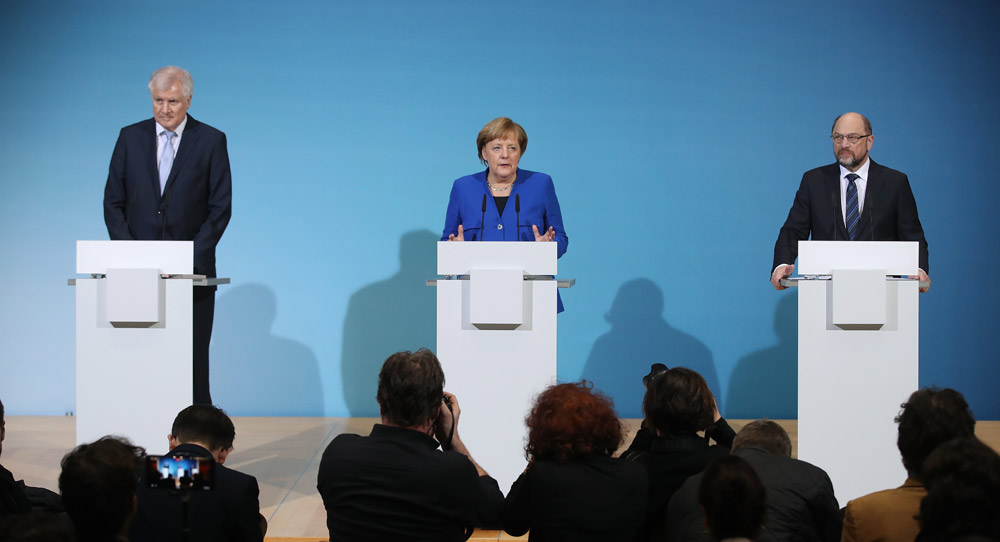
Angela Merkel finally came off the fence. After five days of intense negotiations with the Social Democrats, whom she hopes to have again as her coalition partners, the German chancellor threw her hat into Europe’s ring. To be more precise, she responded to Emmanuel Macron’s plans for the European Union. Merkel is at last dealing with unfinished business over Europe.
Ever since Macron was elected last May, the French President has repeatedly and consistently spoken about the need for a more integrated Europe and a reform of how the eurozone functions. Merkel shillyshallied over his proposals, preferring to wait until after the German federal election when she would have a free hand to react.
But the outcome of the September 24 poll was a disaster for both Merkel’s Christian Democrats and for the Social Democrats led by Martin Schulz. Voters drifted in the hundreds of thousands to the far-right, anti-immigrant, anti-Muslim Alternative for Germany (AfD) party. It is now the third-largest party in the German Bundestag having run a campaign based on opposing Merkel’s decision to take in almost one million refugees fleeing the wars in Syria and Iraq during 2015.
When Merkel’s own attempts to form a coalition with the pro-business Free Democrats and the Greens collapsed, she turned to the Social Democrats. Briefly, after weeks of sounding each other out—as if they didn’t know what both parties stood for—Merkel and Schulz agreed the outline of a new government program. Macron was thrilled. And no wonder. Pushed by Schulz, a former president of the European Parliament, the interim accord put Europe at the top of its program.
It spoke about allotting “specific budgetary resources for economic stabilization [and] … social convergence.” It could be the “departure point for an investment budget for the eurozone,” it continued. And Berlin could “increase Germany’s contribution to the EU budget.” These were issues that Merkel would not contemplate in the past. She was always more on the side of the member states and their national interests rather than community or commission policies.
The reason for Merkel’s change is that she is desperate to clinch a deal with the Social Democrats. Failing that, she faces the prospect of calling fresh elections or leading a minority government. Both would lead to further uncertainty about the future of Europe’s direction at a time when Europe is waiting for a stable Germany to join France in taking the EU further.
Yet for all the sense of relief by Merkel, Schulz, and Macron, the deal could unravel—and fast.
Schulz is already facing a rebellion from the grassroots of his own party. Social Democrats in the state of Saxony-Anhalt and in Berlin rejected the interim accord but Brandenburg supported it. Just wait until January 21, when Schulz has to sell the deal to a divided party congress. It’s not only his future that’s at stake. The entire coalition deal could be torn asunder.
As a party, the Social Democrats don’t want to play second fiddle yet again to Merkel’s conservative bloc. They did it twice before, between 2005 and 2009 and then again between 2013 until today. And after each election, they lost voters. The rank and file believed the party was losing its identity; that it was walking away from its traditional values of social democracy.
The reality is that the Social Democrats had turned away from old, left-wing values when Gerhard Schröder was chancellor. He was one of the few German leaders who introduced a radical overhaul of the labor market and of the social welfare and unemployment benefit system. Schröder paid a high price for those reforms. He lost the 2005 election to Merkel.
The fact that Germany has record levels of employment is in large measure due to Schröder’s labor reforms, not to the successive coalition governments led by Merkel. Indeed, business leaders bemoan the absence of economic reforms over the past dozen years. Tax, health, and education reforms have been put on hold.
These were the issues that the rank and file of the Social Democrats wanted Schulz to address during the interim coalition talks. In particular, they wanted a universal health system, not one based on the present two-tier private and public system. Yet for all that, Schulz can tell them he managed to persuade the conservatives to increase the payments for pensioners and children. Schulz’s leadership is on the line. If things go badly wrong for him on January 21, Merkel’s hand will be further weakened too.
This would be bad news for Germany and bad news for Europe. No doubt some of Merkel’s critics in Poland and Hungary, Greece, and of course in Russia, would be delighted to see the back of her. But it is not yet time to write off Merkel. This interim coalition deal, if Schulz can sell it to his party, is really about Merkel dealing with unfinished business. That unfinished business is about Europe.

Nonresident Senior Fellow, Carnegie Europe
Judy Dempsey is a nonresident senior fellow at Carnegie Europe
Recent Work
Judy Dempsey
Judy Dempsey
Carnegie does not take institutional positions on public policy issues; the views represented herein are those of the author(s) and do not necessarily reflect the views of Carnegie, its staff, or its trustees.

The European Commissioner for Trade is headed to China. But after President Xi’s bridge-building visit to Washington, can a more isolated EU overcome Beijing’s stranglehold on critical raw materials? Who will blink first?

Rym Momtaz, ed.

The domestic impacts of how long it is taking to end the war in Ukraine have pushed the French electorate to the political extremes and compromised the country’s diplomatic capacity.
Rym Momtaz

Before the next wave of EU enlargement takes place, the union needs to grapple with thorny questions of how power is distributed among its members.


Emil Sondaj Hansen, Ditte Brasso Sørensen

Are Germany’s economic, industrial, and political struggles becoming a liability for the EU’s ability to rise to the geopolitical moment?
Rym Momtaz, ed.

European Commission President Ursula von der Leyen is about to give her annual address on the state of the EU. Here’s what she won’t—but should—say.
Rym Momtaz