
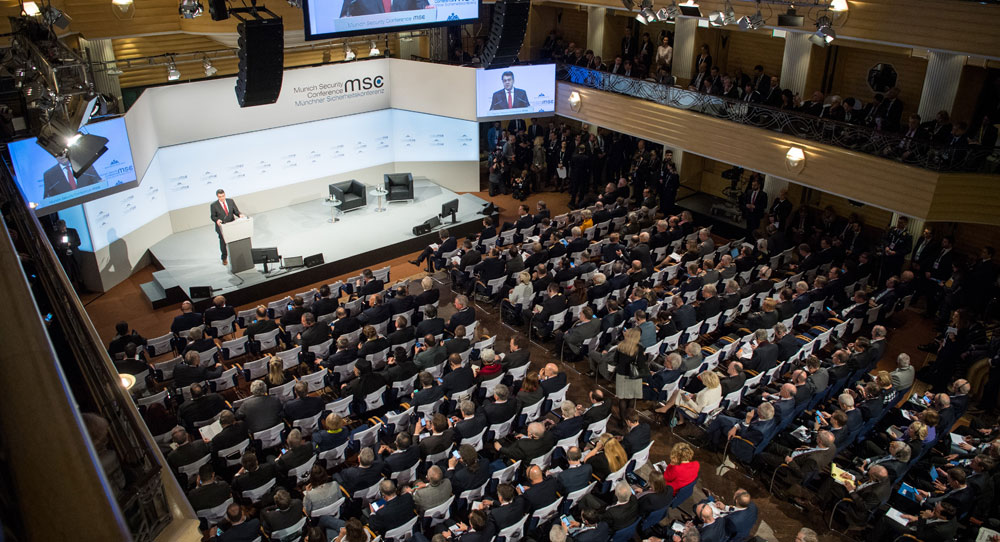
Carnegie Europe was on the ground at the 2018 Munich Security Conference, offering readers exclusive access to the debates as they unfold and providing insights on today’s most consequential threats to international peace.
*
Speeches at the Munich Security Conference, with just a few minutes afterward for a question and answer session, can either be excruciatingly boring or contain a nugget that may surprise.
Take Germany.
When Sigmar Gabriel kicked off the second day of the this year’s conference, the German foreign minister delivered what he considered were a few home truths about the United States, Russia, and China.
“We Germans in particular are perturbed when we look across the Atlantic. Is it deeds, is it words, is it tweets that we should look at to measure America?” he asked. Gabriel was quick to acknowledge that “the liberal order which restructured our world following the devastation and chaos of two world wars certainly was and is not perfect, but it is the best we can think of.” That’s the good news.
But Gabriel gave no inkling as to how Germany could develop a serious strategic outlook that Europe desperately needs to reinvigorate the transatlantic relationship. If anything, Europe will only adopt such a strategy when it is driven by Germany. That’s not going to happen tomorrow.
When it came to China and Russia, Gabriel opined that “the West does not have a new strategy to deal with these two powers. Powers will shift with the rise of China,” he said.
He added that the new Silk Road was about China putting a mark on the world. “China is developing a comprehensive alternative system; a system unlike ours that is not based on freedom, democracy, and individual human rights. China seems to have a real global strategic idea and they are pursuing this idea persistently.” Of course, this has serious implications for Europe. Powers like China and Russia, Gabriel said, “constantly try to test and to undermine the EU’s unity.” And they offer sticks and carrots to Central Europe over whether “they want to stay in the EU or whether they can be singled out.” That was pretty blunt.
But last time I looked, Hungary’s prime minister was a fan of China’s illiberal system. And Germany has done little to put pressure on Orbán to rein in his attacks on civil society, the media, and use of EU structural funds.
As for Russia, Gabriel touched on the idea of a United Nations peacekeeping mission in Donbas. It would be extremely demanding, he conceded. But wait for it. Gabriel added that “establishing a ceasefire [in eastern Ukraine] could lead to a step-by-step lifting of sanctions [on Russia].” It’s not the first time Gabriel has made that suggestion, which is all Chancellor Merkel needs as she tries to cobble another grand coalition together.
Wobbling over sanctions sure didn’t go down well with Poland’s new prime minister, Mateusz Morawiecki.
For Poland, the threat was Russia. But during his question and answer session, Morawiecki was asked about how a new Polish law about the Holocaust. It states that “whoever accuses, publicly and against the facts, the Polish nation or the Polish state of being either responsible or complicit in Nazi crimes committed by the Third German Reich… shall be subject to a fine or a penalty of imprisonment of up to three years.” A young Israeli journalist, Ronen Bergman, asked Morawiecki about the law denying Polish complicity in the Holocaust to Jewish perpetrators in Ukraine and received a huge applause. Morawiecki seemed unmoved. His attitude to this new law was seeped in victimhood.
When Austrian Chancellor Sebastian Kurz got his turn to speak, leaving aside all the remarks about reforming the EU, he called on the union to return to its original idea of “unity in diversity” and to focus on its Judeo-Christian heritage. If that is the case, is there room for diversity, given the recent influx of Muslims to Europe? And if Kurz really believes this, wasn’t the Judeo-Christian tradition almost wiped out by Christians during the Holocaust?
Here’s one last take on the Europeans at MSC—a positive one.
The French delegation has been sparkling. For the past several years, its presence was weak and lacking inspiration. But heavens! Defense Minister Florence Parly was so focused on security issues and how to push European defense further.
As for Édouard Philippe, the young French prime minister: he might as well have been reading a script from Macron. The French delegation has exuded a confidence here in Munich based on a strategy—and a financial commitment to back that strategy up. When he was asked during the Q&A session what he thought about Kurz’s remarks about a Judeo-Christian culture, the French-trained lawyer shrugged it off. France, he said, was a secular country. France had no illusions about the complexities of diversity and identity.
What contrasts between these four EU countries. A Germany that talks about strategy and the rise of China but does very little about it. A Poland that is now reverting to the past to forge a nationalist-conservative consensus. An Austria intent on securing Europe’s external borders and protecting what it considers to be European identity. And a France that is back and trying to deliver. How much support Macron can muster from the other big EU states will depend on Germany’s new government, whenever that will be sworn in.


