

Commentary
Judy Dempsey
{
  "authors": [
    "Judy Dempsey"
  ],
  "type": "commentary",
  "blog": "Strategic Europe",
  "centerAffiliationAll": "",
  "centers": [
    "Carnegie Endowment for International Peace",
    "Carnegie Europe"
  ],
  "collections": [
    "Transatlantic Cooperation"
  ],
  "englishNewsletterAll": "",
  "nonEnglishNewsletterAll": "",
  "primaryCenter": "Carnegie Europe",
  "programAffiliation": "",
  "programs": [],
  "projects": [],
  "regions": [
    "Europe",
    "North America",
    "United States",
    "Western Europe",
    "Germany"
  ],
  "topics": [
    "EU",
    "Security",
    "Economy",
    "Climate Change"
  ]
}
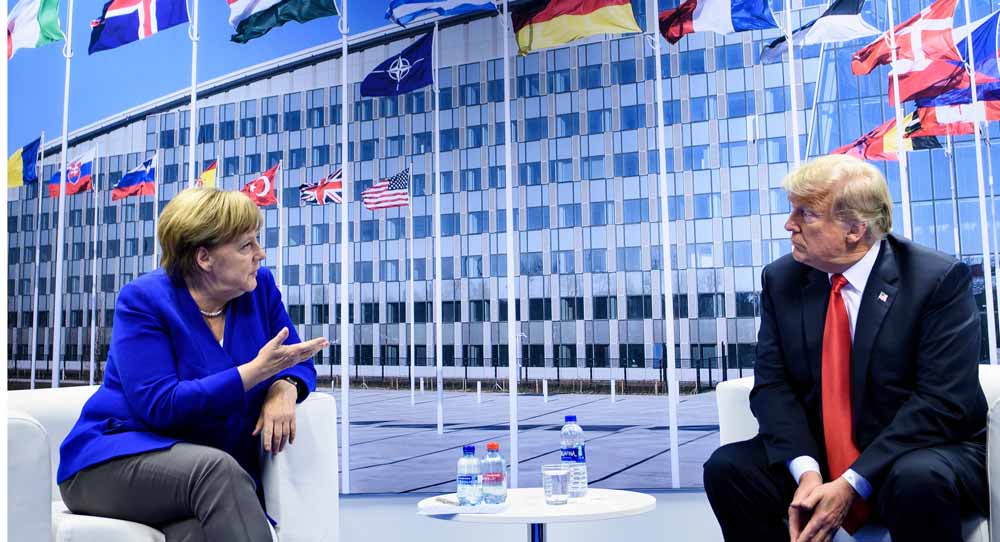
Source: Getty
President Trump’s hectoring of NATO and Germany could prove counterproductive—or the opposite.
Carnegie Europe is on the ground at the 2018 NATO summit in Brussels, offering readers exclusive access to the high-level discussions as they unfold.
**
U.S. President Donald Trump heads off to the UK today, leaving behind a NATO that was spared no amount of criticism.
But since NATO’s European allies have nowhere else to turn for their defense or security, all but one of them, German Chancellor Angela Merkel, stood her ground.From the very start of the summit, Trump was true to his mantra. The Europeans are not spending enough on defense. That’s well-known. The United States, as ever, is paying the lion’s share. That’s well-known, too. But two of his remarks overshadowed the summit declaration—which devoted a huge amount of space to Russia and sharply criticized the country—won’t be forgotten by NATO officials in general or by Merkel in particular.
During his meeting with NATO leaders, Trump surprised them by saying the allies should spend 4 percent of their gross domestic product on defense, as if two percent, the declared pledge made at the summit in Wales in 2014, was not enough.
“During the president’s remarks today at the NATO summit he suggested that countries not only meet their commitment of 2 percent of their GDP on defense spending, but that they increase it to 4 percent,” White House press secretary, Sarah Sanders, said. Well, Trump might as well pluck an even bigger figure out of his hat during the next summit.
Whether he was serious or not, one just doesn’t know. He didn’t raise the issue during the dinner. But when it came to criticizing Germany, Trump was entirely focused.
He berated Merkel for spending only 1.2 percent of GDP on defense. Yes, it is too low in comparison to the size of the country’s economy. But Merkel and her defense minister, Ursula von der Leyen, are committed to spending a more over the next several years. That didn’t impress or convince Trump.
What he did seem convinced about was the highly controversial Nord Stream 2 pipeline. This joint venture between Russia’s Gazprom and a consortium of European companies will allow Russia to send more gas via two pipelines laid under the Baltic Sea directly to Germany.
The charges against Nord Stream 2 have been well-rehearsed. Ukraine’s role as a transit route for Russia gas will be reduced, with a considerable loss of transit fees. And instead of Germany—but also Europe—increasing its diversification of energy supplies, Europe’s dependence on Russia could be consolidated.
Merkel herself used to describe Nord Stream 2 simply as a commercial project. It has now turned into a major geostrategic and political issue. Trump is threatening German and other companies with sanctions if they continue to support Nord Stream 2.
Ignore the fact that he would be pleased if those gas supplies would be replaced by liquefied natural gas shipped from the United States. And ignore the fact that Russia is the major shareholder in Nord Stream 2, which is unlikely to figure in Trump’s discussions with Putin in Helsinki on July 16.
What really irked Merkel was when Trump, using Berlin’s commitment to the pipeline, argued that Germany was “captive” to Russia. Merkel was not going to let that pass. She didn’t need any lessons about Russia or history.
“I have experienced myself how a part of Germany was controlled by the Soviet Union,” she said on her arrival to the summit. “I am very happy that today we are united in freedom, the Federal Republic of Germany. Because of that we can say that we can make our independent policies and make independent decisions. That is very good, especially for people in eastern Germany.”
Publicly at least, not one NATO leader or Secretary General Jens Stoltenberg rallied around Germany. And there’s little doubt that Poland and the Baltic States are delighted with Trump’s criticism of Nord Stream 2. But does Merkel’s leadership and Germany’s trade surplus always have to be the targets of Trump’s hectoring of an important strategic, economic, and political ally?
Indeed, Trump’s blustering may well have its limits. It could tap into anti-American sentiments, particularly in Germany. Only 15 percent of Germans agree with Merkel that Germany should reach NATO’s 2 percent defense spending goal in 2024; 24 percent say spending 1.5 percent is right, while 36 percent believe it is already too much.
Merkel is caught in a bind over the defense budget and over Nord Stream 2.
Politically and strategically the pipeline should have been dumped as soon as Merkel became chancellor back in 2005. She could still ditch the project, although now she would be criticized for bowing to American pressure. But if Trump is serious about sanctions, Merkel may have no option.
Indeed, given the way she rallied other European countries to impose sanctions on Russia over its illegal annexation of Crimea in 2014 and its subsequent invasion of the Donbas region in Eastern Ukraine, the cancellation of Nord Stream 2 should have been part of that sanctions package.
As the first day of the NATO summit progressed, whether prompted by aides or not, Trump was positively conciliatory during his meeting with Merkel.
“We’re having a great meeting. We’re discussing military expenditure,” Trump said. “We have a very, very good relationship with the chancellor. We have a tremendous relationship with Germany… you’ve had tremendous success and I congratulate you. Tremendous success. And I believe that our trade will increase and lots of other things will increase. But we’ll see what happens over the next period of a few months.” Indeed.
Before that, let see what happens during the day two of this NATO summit in Brussels.

Nonresident Senior Fellow, Carnegie Europe
Judy Dempsey is a nonresident senior fellow at Carnegie Europe
Recent Work
Judy Dempsey
Judy Dempsey
Carnegie does not take institutional positions on public policy issues; the views represented herein are those of the author(s) and do not necessarily reflect the views of Carnegie, its staff, or its trustees.

As we close out another season of Strategic Europe, it is worth taking stock of the deep shifts underway.

Rym Momtaz
The EU had to compromise to adopt a twenty-first sanctions package against Russia, exposing growing cracks in the union’s resolve. Is this latest, weaker round worth it to keep pressure on Moscow?
Rym Momtaz, ed.

Trump is distracted and Ukraine wants Europe to step up. The continent’s leaders must find their voice and assert it in talks with Russia.

Alissa de Carbonnel

Mounting economic strain and battlefield losses will not necessarily make the Kremlin less dangerous. They could instead push Moscow toward a more aggressive hybrid campaign designed to test NATO’s Eastern flank, exploit allied hesitation, and fracture European resolve.

Maksym Beznosiuk

Over the past ten years, NATO has held almost as many summits as it did during the entirety of the Cold War. Are they still useful, or is it time to stop holding annual meetings?
Rym Momtaz, ed.