

Commentary
Peter Kellner
{
  "authors": [
    "Peter Kellner"
  ],
  "type": "commentary",
  "blog": "Strategic Europe",
  "centerAffiliationAll": "",
  "centers": [
    "Carnegie Endowment for International Peace",
    "Carnegie Europe"
  ],
  "collections": [
    "EU Integration and Enlargement",
    "Brexit and UK Politics"
  ],
  "englishNewsletterAll": "",
  "nonEnglishNewsletterAll": "",
  "primaryCenter": "Carnegie Europe",
  "programAffiliation": "",
  "programs": [],
  "projects": [],
  "regions": [
    "Europe",
    "Western Europe",
    "United Kingdom"
  ],
  "topics": [
    "EU"
  ]
}
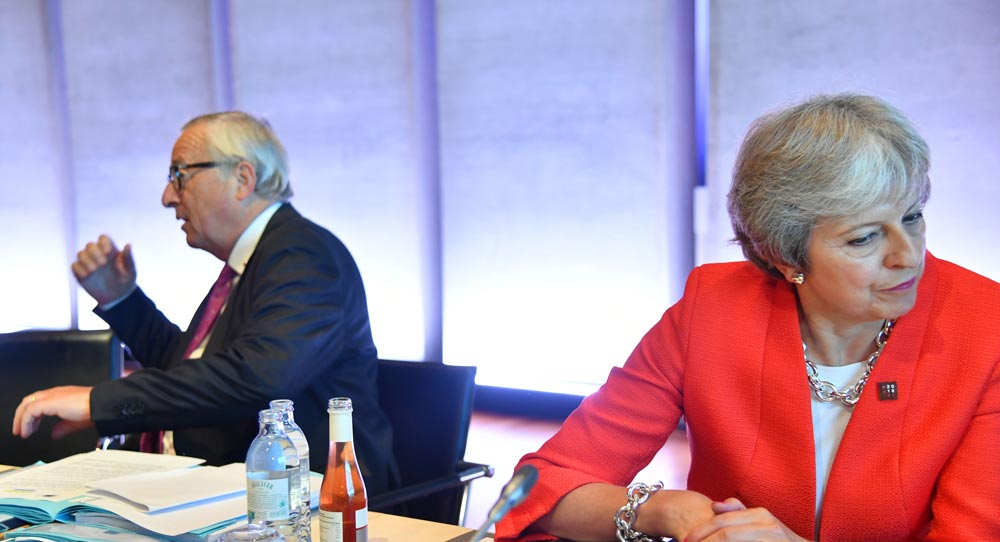
Source: Getty
The endgame in the Brexit negotiations has come down to a battle of nerve for the UK and the EU. Unless one side gives way, the chances of talks ending without a deal look high and rising.
The British media, unusually consistent in their analysis of what happened, agreed that Theresa May was humiliated in Salzburg last week. She had come armed with her “Chequers” plan for the UK’s long-term relationship with the European Union. Chequers is the official country residence of British prime ministers; located 50 kilometers from London, it’s where the plan was thrashed out by May’s Cabinet in July.
May never expected other EU leaders to welcome the Chequers proposal with open arms. She did, however, expect them to accept it as a starting point for the final round of negotiations. Instead, last Thursday, Donald Tusk, president of the European Council, said bluntly that the plan “will not work.” He demanded a new approach from the UK; otherwise, the EU would terminate the Brexit negotiations at next month’s Council meeting. The widely expected extra meeting in November to finalize a UK-EU deal would not happen.The following day, May, bruised and angry, blamed other EU leaders for not showing “respect” for the UK position. She demanded a different tone for the talks over the next few weeks. She complained that EU negotiators had attacked her plan, but without proposing any alternative.
May’s real problem, however, has nothing to do with tone or respect. The gulf between the UK and EU positions cannot be bridged by a soothing form of words. Whatever language is used, and however friendly or unfriendly the mood of the talks over the next few weeks, one side or the other has to blink: that is, to surrender one of the redlines it says cannot be violated.
The underlying issues, which mainly concern trade, are especially fraught because of the collision of politics and economics at the only land border between the UK and the rest of the EU, between Northern Ireland and the Irish Republic.
These are May’s redlines:
This is the EU’s position on these issues.
Shortly before last week’s Salzburg meeting, Michel Barnier, the EU’s chief negotiator, proposed one way forward: keep Northern Ireland in the Customs Union, and have a smart system for checking trade across the Irish Sea to minimize the checks on goods being traded between Northern Ireland and the UK. The UK rejected this on principle; for however unobtrusive the checks, this plan would violate the principle that Northern Ireland must not in any way operate according to different rules than mainland Britain.
So where do we go from here? Logically there are five possibilities. The first three are ways in which Theresa May might give way.
It is hard to see May agreeing to any of these options and keeping her party together. Indeed, doing any of these things could lead to her being deposed as the Tory Party leader and British prime minister.
The other two options would involve a retreat by Barnier and governments across the EU:
The UK’s preferred solution is the fifth and final option. The trouble is that the technology does not exist at the moment. Maybe it will be developed in some years’ time—five, ten, or perhaps twenty. But until then, if the UK is not to crash out of the EU without a deal, one of the other four options must be agreed.
At present, May is fiercely opposed to all three of her options—and might not survive politically were she to change her mind. Equally, the chances are vanishingly small of the EU allowing the UK to enjoy the benefits of Customs Union membership without agreeing to abide by its rules and system for enforcing them.
The current deadlock, then, is rooted in a set of real, apparently unbridgeable, differences between the two sides. Sharp language and complaints of disrespect don’t help, but they are not the real cause of the current standoff. Unless someone sacrifices one of their redline principles, the chances of the current Brexit negotiations ending without a deal look high and rising.
Former Nonresident Scholar, Carnegie Europe
Kellner was a nonresident scholar at Carnegie Europe, where his research focused on Brexit, populism, and electoral democracy.
Recent Work
Peter Kellner
Peter Kellner
Carnegie does not take institutional positions on public policy issues; the views represented herein are those of the author(s) and do not necessarily reflect the views of Carnegie, its staff, or its trustees.

The aftermath of the Ceuta crisis shows Europe has drawn the wrong lessons. Rather than doubling down on failed migration policies, the EU needs to address the underlying roots of such episodes.

Richard Youngs

An overwhelming victory by a far-right-wing party in a small state in eastern Germany will have major repercussions for Chancellor Friedrich Merz’s coalition.

Judy Dempsey

Canadian Prime Minister Mark Carney has twice inspired praise for standing up to U.S. President Donald Trump: at the 2026 World Economic Forum in Davos and on Canada-U.S. trade negotiations. Is Carney showing a third way better than the EU has in dealing with the Trump administration?

Rym Momtaz, ed.

The EU’s responses to two recent incidents expose the gulf between European perceptions and capabilities. Unless the union can bridge that gap, it will never become a real geostrategic power.
Rym Momtaz

In supporting Europe’s far-right, MAGA and Russia both want the same thing: a weaker EU. Europe must defend itself without abandoning the openness these forces exploit.

Armida van Rij