

Commentary
Judy Dempsey
{
  "authors": [
    "Judy Dempsey"
  ],
  "type": "commentary",
  "blog": "Strategic Europe",
  "centerAffiliationAll": "",
  "centers": [
    "Carnegie Endowment for International Peace",
    "Carnegie Europe"
  ],
  "collections": [],
  "englishNewsletterAll": "",
  "nonEnglishNewsletterAll": "",
  "primaryCenter": "Carnegie Europe",
  "programAffiliation": "",
  "programs": [],
  "projects": [],
  "regions": [
    "Europe",
    "Western Europe",
    "Germany"
  ],
  "topics": [
    "EU"
  ]
}
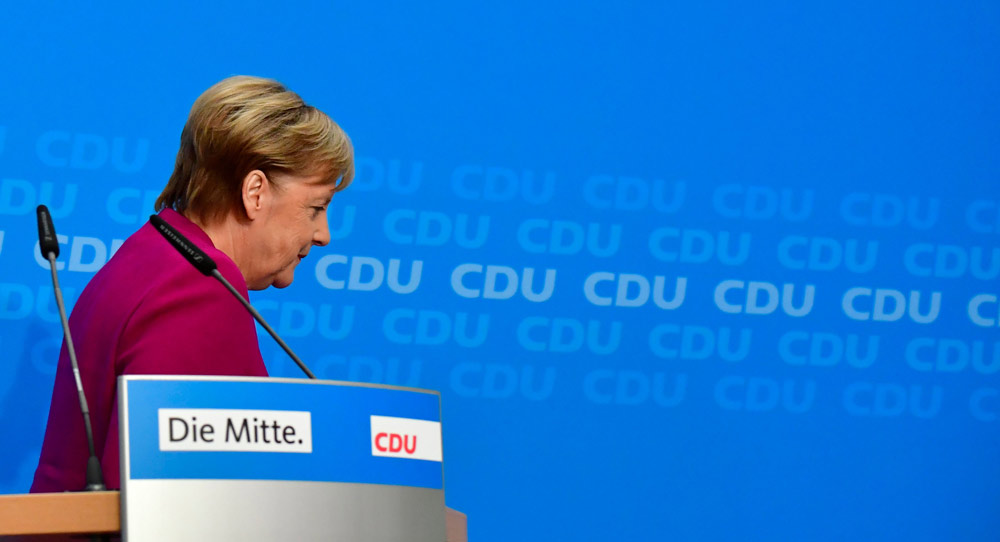
Source: Getty
Angela Merkel’s decision to step aside as party leader and not run again as chancellor in 2021 may have surprising consequences.
It was vintage Angela Merkel. No bravado. No recriminations. No emotional outpouring.
The day after her Christian Democrats lost 10 percent of the vote, but still managed to remain the biggest party in the state of Hesse, Merkel took to the podium in the CDU’s headquarters in Berlin. In her matter of fact style she made two announcements.
“Firstly, at the next CDU party congress in December in Hamburg, I will not put myself forward again as candidate for the CDU chair,” she said. “Secondly, this fourth term is my last as German chancellor. At the federal election in 2021, I will not stand,” she added. Thus began the dignified ebbing of the Merkel era.
The race has already begun for the party leadership that will be settled in December. Whoever manages to win will almost certainly run for chancellor. In any case, it’s going to be a contest and probably an unseemly one at that, which just may give Merkel the breathing space needed to complete her legacy. That legacy is about Europe’s future direction.Since becoming chancellor in November 2005, Merkel steered Germany and Europe through several crises. From the global financial crash of 2008 followed by the near collapse of the eurozone, she and especially the former finance minister, Wolfgang Schäuble imposed a policy of austerity on the heavily-indebted eurozone countries.
Such controversial measures were welcomed in Ireland but deeply resented in Greece where the public sector and pensions were slashed. Heaven knows how the German government and the European Commission are going to deal with the populist and Euroskeptic Italian coalition, which seems hell-bent on breaking all the rules that underpin the stability and functioning of the euro.
Even though Berlin, so far, steered Europe through the euro crisis, Merkel did not use the time to shape the EU’s direction. It’s not just because she didn’t respond to President Emmanuel Macron’s speech he made at the Sorbonne in September 2017, a silence that was disappointing in itself. In many European capitals, however, Merkel’s attitude toward Macron’s ambitious plans for a more integrated EU have been welcomed, especially by smaller countries.
With Brexit looming, the idea of a Franco-German engine based on Macron’s policies has created a backlash among the northern member states. Quietly, Merkel is on their side. Unless the German coalition fails to see out its term, which cannot be ruled out, Berlin’s policy toward the EU’s future direction will be cautious.
That is already one of Merkel’s legacies. As chancellor she steered Germany away from its traditional communautaire stance to intergovernmental policies in which the member states held sway. On her watch, national interests increasingly prevailed.
Yet in her 2015 decision to open the borders to one million refugees fleeing the war in Syria and Iraq, Merkel belatedly realized the importance of the European Commission in trying to forge a common refugee and asylum policy that has eluded the bloc for at least two decades.
Both Merkel and Brussels failed, for many reasons, to convince the other 27 member states to uphold international law, to share the burden of taking in refugees, and to act humanely and decently. Merkel’s legacy is that she did all four, only to be hammered during the 2017 federal elections and now the two recent regional elections in Bavaria and Hesse.
Her coalition of conservatives and Social Democrats did little to support her policies. Indeed, the constant sniping by Horst Seehofer, the interior minister who over the past several months did his best to unseat Merkel, played into the hands of the far-right, anti-immigrant Alternative for Germany (AfD). Seehofer, himself weakened as leader of the Christian Social Union party in Bavaria, has now gotten what he wanted with Merkel’s decisions. But it’s a Pyrrhic victory. His ranting against Merkel and her refugee policy damaged the coalition.
No doubt there’ll be some European leaders, Hungarian Prime Minister Viktor Orbán for one, who may be glad to see the end of the Merkel era. Not only did he and other leaders oppose Merkel’s refugee policy. They also opposed the EU sanctions on Russia but actually never blocked them from being rolled over.
The sanctions were another principled stance by Merkel. She managed to rally round all the member states to slap sanctions on Russia’s illegal annexation of Crimea and its invasion of eastern Ukraine in 2014, plus the shooting down of Malaysia Airlines Flight 17 (MH17). And inside Germany, she changed the political discourse about Russia, no longer making “Ostpolitik,” which was essentially a rapprochement with Russia, the defining focus of relations between Berlin and Moscow.
In her remaining years as chancellor, Merkel will hardly give up the dossiers that she has accumulated since 2005, be they Russia or Ukraine, Europe, China, digitization (belatedly), or the United States.
Indeed, managing these last two dossiers are arguably Merkel’s biggest challenges as she sees out her term. They are about Germany acting strategically to cope with the immense changes affecting leadership, communications, and security. So far the “Merkel Way” has been to shun strategy. So far.

Nonresident Senior Fellow, Carnegie Europe
Judy Dempsey is a nonresident senior fellow at Carnegie Europe
Recent Work
Judy Dempsey
Judy Dempsey
Carnegie does not take institutional positions on public policy issues; the views represented herein are those of the author(s) and do not necessarily reflect the views of Carnegie, its staff, or its trustees.
The EU had to compromise to adopt a twenty-first sanctions package against Russia, exposing growing cracks in the union’s resolve. Is this latest, weaker round worth it to keep pressure on Moscow?

Rym Momtaz, ed.

Trump is distracted and Ukraine wants Europe to step up. The continent’s leaders must find their voice and assert it in talks with Russia.

Alissa de Carbonnel

Mounting economic strain and battlefield losses will not necessarily make the Kremlin less dangerous. They could instead push Moscow toward a more aggressive hybrid campaign designed to test NATO’s Eastern flank, exploit allied hesitation, and fracture European resolve.

Maksym Beznosiuk

Over the past ten years, NATO has held almost as many summits as it did during the entirety of the Cold War. Are they still useful, or is it time to stop holding annual meetings?
Rym Momtaz, ed.
Nearly a year and a half after Europeans leaned into sucking up to Trump, the strategy has produced some benefits when it comes to Ukraine.
Rym Momtaz