
One of the good things about Angela Merkel’s decision not to run again as German chancellor is that her Christian Democratic Union (CDU) party is finally having a real debate about its future. Well, sort of.
Ever since taking over the leadership of the CDU back in 2000, Merkel has held a tight rein. She rarely missed the regular meetings of the conservative bloc’s parliamentary caucus. She kept everything in check. Those who challenged her were seen off. Debates were not encouraged and certainly not dissent.
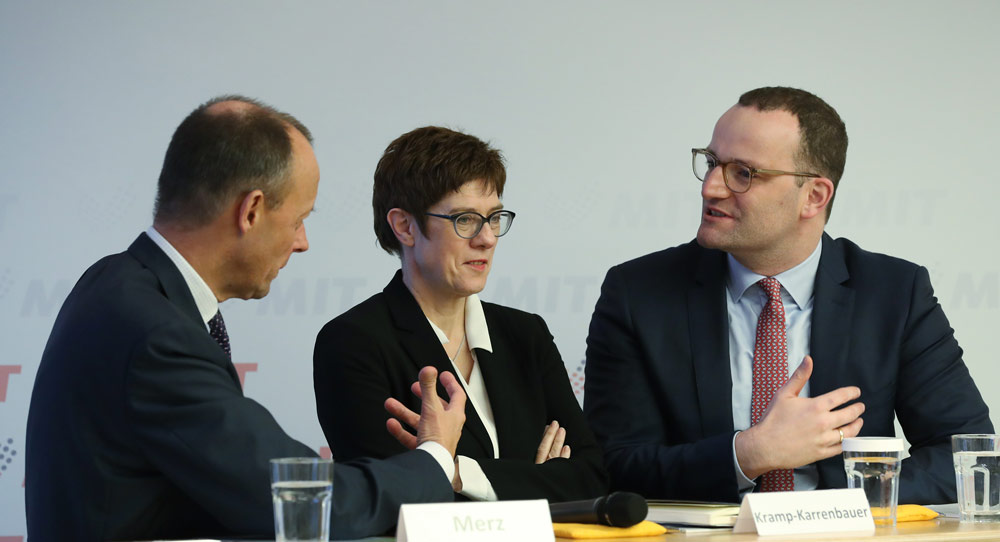
But now, after Merkel’s decision not to run for a fourth time as chancellor, three main contenders have thrown their hats into the ring. One of them is Annegret Kramp-Karrenbauer. The fifty-six-year-old was chosen by Merkel last February to take over as the CDU’s general secretary, which is a pretty powerful post. A former premier of Saarland, she has a gift of reaching out to voters and belongs to the liberal wing of the party but is more conservative than Merkel when it comes to migration and gay marriage.Then there’s Jens Spahn. At thirty-eight, Spahn is known for his undisguised ambition. Merkel brought him into the cabinet as health minister last year. He’s very much to the right of the CDU. He is critical of Merkel’s migration policies and critical of dual citizenship.
Finally, there is the chancellor’s former foe, sixty-three-year-old Friedrich Merz. He was once the leader of the conservative bloc in the parliament, which is a very influential post. At the time, he had ambitions to run against Merkel—until she unceremoniously cast him aside. He is now planning a comeback, hoping to win the support of the business community.
While all three seem very different in character, they all know that if any of them wants to become the next chancellor of Germany, they have to win back the many hundreds of thousands of voters who defected either to the far-right Alternative for Germany (AfD) or to the Greens.
Spahn would move the party more to the right. It’s hard to know how Merz, who is not popular among the younger generation, would woo back disaffected voters. As for Kramp-Karrenbauer (or AKK), who is so far the most popular of the contenders, she would try to strengthen the center of the party instead of pandering to the AfD. That would mean coming up with some fresh policies about how to deal with Germany’s demographic time bomb, integration, housing, education, and the growing skills shortage that plagues industry.
But as they position themselves ahead of the CDU’s annual congress in Hamburg on December 7-8, whoever wins the party leadership race faces daunting challenges. The person who succeeds Merkel and hopes to become the next chancellor has to take a hard look at Germany’s role in Europe. If the EU is to succeed as an economic, trading, and political bloc, Germany needs to give it a strategic direction. The pace of digitization, globalization, and the rise of China have become so intense that neither the EU nor Germany can believe the current status quo is adequate.
The status quo rested on the idea that the Western liberal order, forged after the Second World War and led by the United States, was permanent. This is no longer the case. It’s not just because of U.S. President Donald Trump’s policies. It’s because Europe, and particularly Germany, are reluctant to acknowledge the ebbing of the post-1945 era. The multilateral institutions that were established are out of sync with today’s shifting geostrategic alliances; the emergence of new regional and world powers, such as China; and new threats, especially cyber attacks.
The potential for disruption caused by digitization has already made its impact on social media and on traditional democratic practices that have been too long taken for granted. There is also the disruptive impact on global supply chains that should be of major concern to Germany’s role as a leading exporter and to the EU as a whole.
These are complex questions that German politicians have barely dealt with. Maybe it’s because the whole issue of globalization, protecting the vast network of supply chains, and coming to terms with digitization involves a new approach to foreign, security, and defense policy. Ultimately, it’s about protecting values and democratic institutions that are now severely under strain.
Merkel ducked these issues. As she prepares to bequeath her leadership, it’s not certain that any of her contenders are ready to move the debate into the realm of strategy.


