

Commentary
The European Commissioner for Trade is headed to China. But after President Xi’s bridge-building visit to Washington, can a more isolated EU overcome Beijing’s stranglehold on critical raw materials? Who will blink first?
Rym Momtaz, ed.
{
  "authors": [
    "Balázs Jarábik",
    "Leonid Litra"
  ],
  "type": "commentary",
  "blog": "Strategic Europe",
  "centerAffiliationAll": "",
  "centers": [
    "Carnegie Endowment for International Peace",
    "Carnegie Europe"
  ],
  "collections": [
    "Europe’s Eastern Neighborhood"
  ],
  "englishNewsletterAll": "",
  "nonEnglishNewsletterAll": "",
  "primaryCenter": "Carnegie Endowment for International Peace",
  "programAffiliation": "",
  "programs": [],
  "projects": [],
  "regions": [
    "Eastern Europe",
    "Moldova",
    "Europe"
  ],
  "topics": [
    "Political Reform",
    "EU",
    "Democracy"
  ]
}
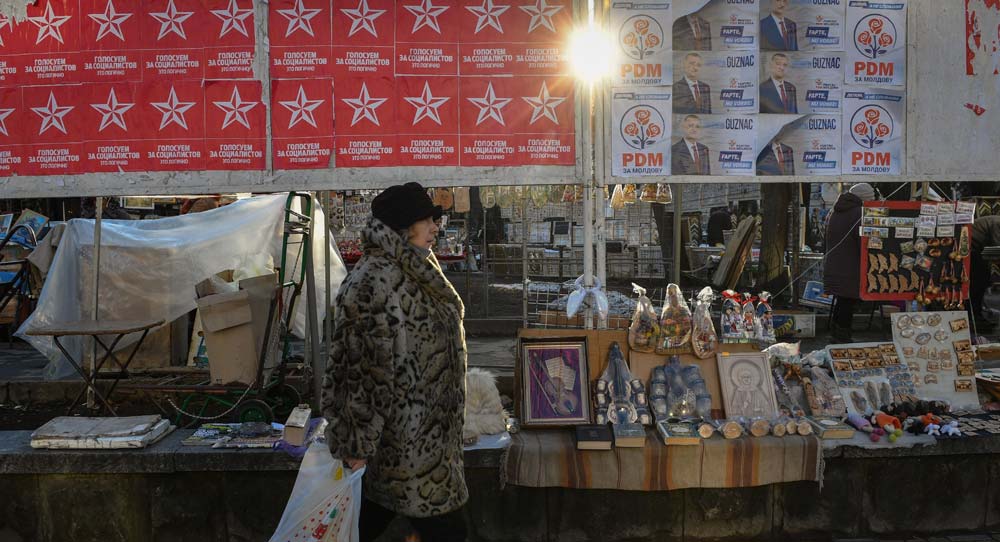
Source: Getty
Moldova’s parliamentary election may deliver a messy coalition, a Socialist government, or an attempt at manipulation. Brussels should put the legitimacy of the process ahead of the result.
Does it really matter who wins Moldova’s parliamentary election on February 24? For sure, there is a serious three-way contest between Vladimir Plahotniuc’s ruling Democratic Party, President Igor Dodon’s Socialist Party, and the pro-EU opposition “NOW” (or ACUM), a coalition led by former minister of education Maia Sandu and protest leader Andrei Năstase.
Even though only 44 percent of Moldovans believe the election will be free and fair, there are no expectations for widespread electoral-day fraud. Moldova’s rulers must keep at least a semblance of democracy, or else face the catastrophe of the European Union not recognizing the vote.
There is no need for fraud as the two main parties have redesigned the electoral system to their advantage. The new system, adopted in 2017, was criticized internationally, including by the Venice Commission. Among other concerns, half of the seats (51 out of 101) will be decided in a first-past-the-post basis in single-member constituency elections, an arrangement that favors the two big parties.
This gives Vlad Plahotniuc, the country’s de facto leader, a chance to remain as power broker. Plahotniuc is widely believed to control key state institutions, the prosecutor general, the judiciary, financial flows, and media. His Democratic Party currently has 42 MPs. It won nineteen seats in the 2014 elections, with the remainder reportedly “persuaded” to join, both by bribes and blackmail.
The general mood in Moldova has improved a little since 2014, when the country was shocked by a billion-dollar theft from its banking system. The economy has stabilized with the help of Western financial institutions. Growth in Moldova is steady, thanks to domestic consumption and remittances. Importantly, there is a profound general shift from Russia toward the EU. The number of Moldovan migrant workers in Russia dropped to 357,000 in 2018, down 16 percent from the previous year. And most remittances, the backbone of the economy, are now coming from the EU. Around 66 percent of Moldova’s exports are sent to the EU and, unexpectedly, agricultural products showed a whopping 44 percent increase since signing a Deep and Comprehensive Trade Agreement with the European Union.
This month’s election may bring a much-needed consolidation of the party system, if only three major political formations would clear the 6 percent threshold to enter parliament. (Astonishingly, one party that may get into parliament is headed by Ilan Shor, the man sentenced to in the billion-dollar banking scandal for seven years but not jailed.)
The fact that the pro-Russian Socialists are frontrunners with up to 49 percent support in some polls should come as no surprise given that pro-Western governments have been mired in infighting, corruption, and political scandals since 2009—and ended up with what the European Parliament calls “a state captured by oligarchic interests.” However, it will be not easy for the Socialists to form a government, unless they win a clear majority.
It will also not be as easy as it once was for Plahotniuc to keep ruling Moldova from behind the scenes. Despite his control of the state, his popular support remains weak, and it will be harder for him to buy or coopt support. The pro-EU alliance NOW has no interest in joining a coalition with him after years of attacks, while relations between Plahotniuc and President Dodon are best described as a forced cooperation with some mutual benefits.
Of course, if things look desperate for the current ruling party, tricks cannot be excluded. Moldova’s democratic credentials have been significantly weakened under Plahotniuc. The small country has been seen expelling political parties before elections, cancelling the results of the mayoral race in Chisinau by a court decision, and changing the electoral system to allow easier manipulation with single districts. The next gambit could be a consultative referendum being held together with the parliamentary election on reducing the number of seats in parliament from 101 to 61. That might be an excuse for a fresh vote in new electoral districts if no ruling coalition is formed.
Where does this leave the EU? As Plahotniuc is bidding for Washington's endorsement and Dodon for the Kremlin’s support, Brussels is the only international actor with an eye on the bigger picture. But the EU’s standing in Moldova has fallen over the past five years. Europe called out the weakening of democratic institutions in Moldova late in the day as it strived to produce quick wins with the Association Agreement.
Belatedly, Brussels suspended the €100 million macro-financial assistance program, and the European Parliament called for sanctions. As the EU is still an outside player that can bestow legitimacy on any government itself, it should prioritize the process ahead of the results.
Brussels would not be thrilled by the election of the Socialist leader Dodon, but he is unlikely to reorient the country strongly to Russia as some allege. Dodon is now publicly saying what was only whispered in Brussels—that he will honor the EU’s Association Agreement. Brussels should insist on free and fair elections and back whatever result they deliver.
Moldova was once declared the success story of the Eastern Partnership. The lessons of that hasty nomination should be clear by now. A democratic transition takes time and needs institutions, not friendly geopolitical support.
Leonid Litra, a Moldovan national, is a senior fellow at the New Europe Center, based in Kyiv.

Political analyst, former Slovak diplomat, and consultant specializing in Eastern Europe
Leonid Litra
Carnegie does not take institutional positions on public policy issues; the views represented herein are those of the author(s) and do not necessarily reflect the views of Carnegie, its staff, or its trustees.

The European Commissioner for Trade is headed to China. But after President Xi’s bridge-building visit to Washington, can a more isolated EU overcome Beijing’s stranglehold on critical raw materials? Who will blink first?

Rym Momtaz, ed.

The domestic impacts of how long it is taking to end the war in Ukraine have pushed the French electorate to the political extremes and compromised the country’s diplomatic capacity.
Rym Momtaz

Before the next wave of EU enlargement takes place, the union needs to grapple with thorny questions of how power is distributed among its members.


Emil Sondaj Hansen, Ditte Brasso Sørensen

A summer of escalation in the Black Sea has hurt Ukraine economically and is exacerbating world food security. A truce is needed—as is a broader reframing of Europe’s Ukraine strategy.

Thomas de Waal

Are Germany’s economic, industrial, and political struggles becoming a liability for the EU’s ability to rise to the geopolitical moment?
Rym Momtaz, ed.