

Commentary
Judy Dempsey
{
  "authors": [
    "Judy Dempsey"
  ],
  "type": "commentary",
  "blog": "Strategic Europe",
  "centerAffiliationAll": "",
  "centers": [
    "Carnegie Endowment for International Peace",
    "Carnegie Europe"
  ],
  "collections": [
    "Brexit and UK Politics"
  ],
  "englishNewsletterAll": "",
  "nonEnglishNewsletterAll": "",
  "primaryCenter": "Carnegie Europe",
  "programAffiliation": "",
  "programs": [],
  "projects": [],
  "regions": [
    "Europe",
    "Western Europe",
    "Germany"
  ],
  "topics": [
    "Security",
    "EU"
  ]
}
Source: Getty
Berlin’s consistent calls to protect multilateralism in the wake of President Donald Trump’s verbal attacks on the post-1945 institutions often ring hollow.
That’s all Berlin’s allies needed to hear.
Finance Minister Olaf Scholz intends to reduce Germany’s defense budget. It will rise to 1.37 percent of national income in 2020 but fall to 1.25 percent by 2023.
Forget the fact that just last year Chancellor Angela Merkel’s center-right government had planned to increase defense spending to 1.5 percent by 2024. And forget too that it was Merkel who, at the NATO summit in Wales in 2014, promised with other allies that Germany would in principle spend 2 percent of its gross domestic product on the armed forces by 2024.When asked about Scholz’s plans, Richard Grenell, the U.S. ambassador to Germany, didn’t mince his words. “Reducing its already unacceptable commitments to military readiness is a worrisome signal to Germany’s 28 NATO allies,” he said. If the finance minister goes ahead with the reductions, they are bound to further sour relations between Berlin and Washington. It’s easy to see why.
It’s not just because the Trump administration criticizes Germany’s economic prowess and its huge export surplus, particularly its car sales to the United States. Washington’s view is that transatlantic trade is not a level playing field.
It’s also because the Trump administration—and Germany’s allies in Europe—question whether Merkel’s commitment to multilateralism is as deep and sincere as she makes it out to be. Her speech at the Munich Security Conference in February ended up being a highly emotional plea for protecting the post-1945 multilateral order.
Yet in reality, there are several examples in which Germany undermines the architecture that was built after World War II and which brought stability, security, and prosperity to Europe.
The first is NATO. Germany is not pulling its weight when it comes to a serious commitment to burden sharing. Burden sharing is not a Trump mantra. Since the end of the Cold War, when defense budgets across Europe were slashed, Washington began to warn the Europeans that they had to spend more. This was the price for America continuing to provide the security umbrella to its allies.
NATO finally increased spending since Russia's illegal annexation of Crimea in early 2014 and its subsequent invasion of eastern Ukraine. And since taking office over two years ago, Trump has never lost an opportunity to warn the Europeans that they cannot take the American security umbrella for granted. That’s slowly beginning to sink in.
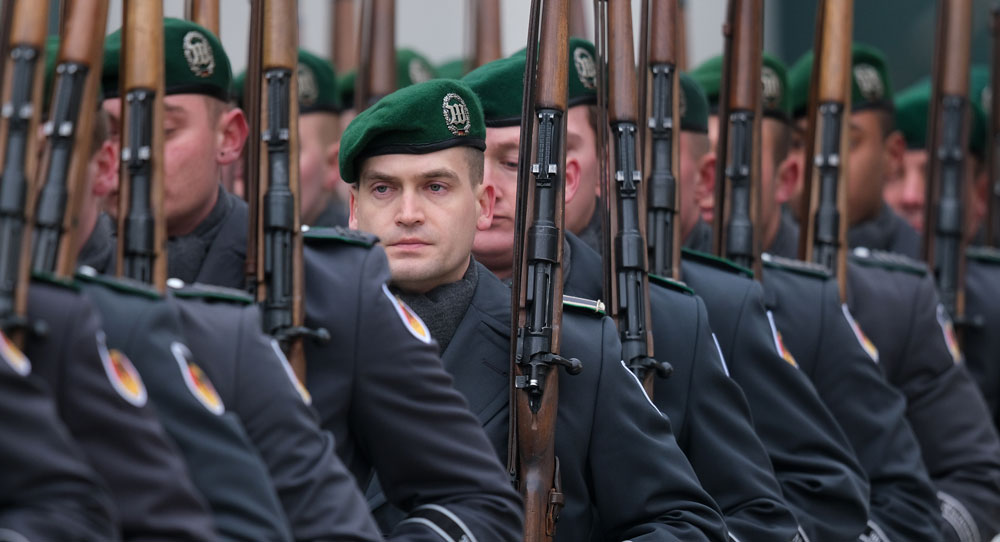
But defense spending by the Europeans has been uneven. Only seven of NATO’s 29 allies have met the 2 percent target. And even though Germany now spends over €44 billion a year on defense, the condition of its armed forces is miserable. Troops lack basic equipment and clothing. Military hardware from submarines to tanks have been singled out for their inability to function.
The list of woes is endless. Turning the Bundeswehr into a modern, mobile, and agile force and being able to integrate cyber security and artificial intelligence into the defense culture will require a long-term commitment, serious investment, and explaining to the public why defense is necessary. And even if German defense minister Ursula von der Leyen, a Christian Democrat, recognizes these challenges, she is hamstrung by Scholz, a Social Democrat.
Whether Scholz is pandering to his own pacifist wing of his party or its anti-Americanism base, or has his sights on the Chancellery, Germany’s credibility inside NATO is being dented.
Germany’s credibility as a defender of multilateralism inside the EU is also open to question. The most glaring example is Merkel’s continuing support for Nord Stream 2. This pipeline—which allows Russia to send gas directly to Germany under the Baltic Sea—challenges the very goal of the EU creating energy security with the emphasis on diversifying supplies. The pipeline will deprive Ukraine, a major transit route for Russian gas exports to Europe, of transit fees but also Poland.
Above all, Germany will be tied to Russian gas for the foreseeable future. Merkel can no longer state with credibility that Nord Stream 2 is a commercial venture. Russia has repeatedly used energy as an instrument of its foreign policy. Nord Stream 2 is no exception.
What links Nord Stream 2 to the NATO spending issue is solidarity and cohesion but also lack of strategic foresight. By reneging on its commitment to reach defense spending targets—however controversial the 2 percent goal is in terms of its value—and by undermining the EU’s attempts at energy security, Berlin is adopting a unilateral stance. Both examples are essentially anti-multilateralist.
China is another example. Belatedly, German industry and the security services see how Chinese investments across Europe undermine European security. Chancellor Angela Merkel wants to agree a deal with China not to spy on each other. (Former U.S. president Barack Obama tried that too.) Germany is very reluctant to exclude Huawei on principle from building a 5G network in Germany—which confirms how Germany is lagging behind digitization and other forms of new technologies. The Huawei case is another source of friction between the United and its allies. Washington has called on the Europeans not to use the Chinese technology.
Germany is not alone in pursuing national interests or acting bilaterally. But what irks Berlin’s allies is its often sanctimonious tone when it comes to defending the multilateral order. It all very well taking jabs at Trump’s attitudes toward that order. But what about Berlin questioning its own rhetoric and actions?

Nonresident Senior Fellow, Carnegie Europe
Judy Dempsey is a nonresident senior fellow at Carnegie Europe
Recent Work
Judy Dempsey
Judy Dempsey
Carnegie does not take institutional positions on public policy issues; the views represented herein are those of the author(s) and do not necessarily reflect the views of Carnegie, its staff, or its trustees.

Trump is distracted and Ukraine wants Europe to step up. The continent’s leaders must find their voice and assert it in talks with Russia.

Alissa de Carbonnel

Mounting economic strain and battlefield losses will not necessarily make the Kremlin less dangerous. They could instead push Moscow toward a more aggressive hybrid campaign designed to test NATO’s Eastern flank, exploit allied hesitation, and fracture European resolve.

Maksym Beznosiuk

Over the past ten years, NATO has held almost as many summits as it did during the entirety of the Cold War. Are they still useful, or is it time to stop holding annual meetings?

Rym Momtaz, ed.
Nearly a year and a half after Europeans leaned into sucking up to Trump, the strategy has produced some benefits when it comes to Ukraine.
Rym Momtaz
Far-right leader Marine Le Pen can—and will—run in France’s next presidential election. What does the outcome of her appeal against a 2025 embezzlement conviction mean for the country’s political future?
Catherine Fieschi